
If you are searching for safe, government-backed investment options in 2026, understanding the current NSC interest rate should be your first step. The National Savings Certificate continues to be one of the most trusted small savings schemes in India, and knowing the latest NSC interest rate can help you plan your tax-saving investments wisely. In this detailed, easy-to-understand guide written specifically for Indian retail investors, we will explain everything about the NSC interest rate, how it is calculated, its tax benefits, and why it remains a preferred choice for conservative investors across the country.
What is NSC (National Savings Certificate)?
The National Savings Certificate, popularly known as NSC, is a fixed-income savings scheme backed by the Government of India and offered through post offices across the country. It was designed to encourage small and medium savings among Indian citizens while offering tax benefits under Section 80C of the Income Tax Act. The current NSC interest rate makes it an attractive option for risk-averse investors who want guaranteed returns without exposure to market volatility.
Unlike mutual funds or stock market investments, NSC does not fluctuate with market conditions. The NSC interest rate is fixed by the government every quarter, and once you invest, the rate applicable at the time of purchase remains locked for the entire five-year tenure. This makes NSC an ideal choice for people who prioritize capital protection along with steady returns. The scheme has existed for decades and continues to be one of the most searched small savings instruments among Indian taxpayers every financial year.
Current NSC Rate Update 2026
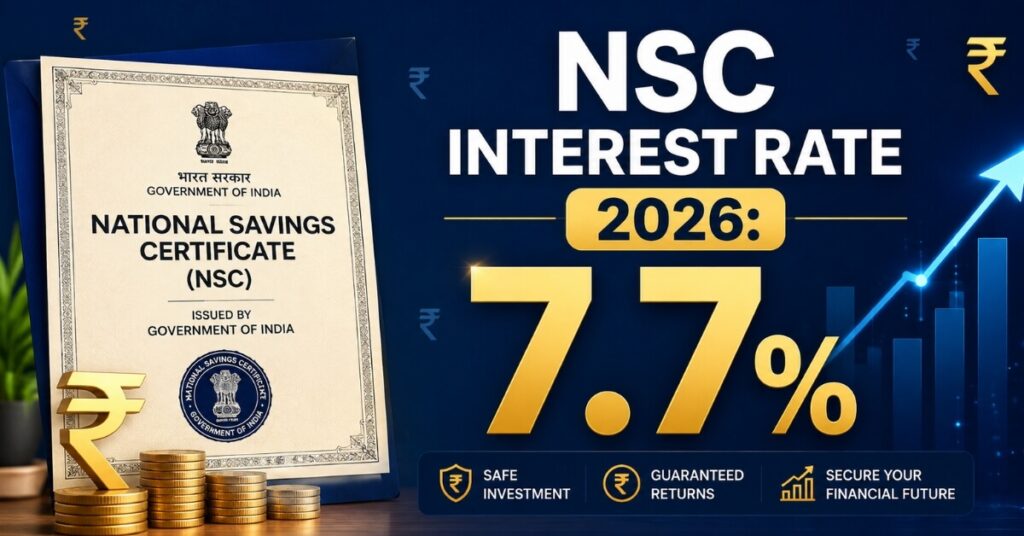
As per the latest update from the Ministry of Finance and India Post, the NSC interest rate for the current quarter stands at 7.7% per annum, compounded annually and payable at maturity. You can verify this rate anytime on the official India Post website, which publishes quarterly updates on all small savings schemes. This rate has remained stable for several consecutive quarters, reflecting the government’s intent to keep small savings schemes attractive amid changing economic conditions.
It is important to note that the NSC interest rate is reviewed and revised quarterly by the government, similar to other small savings schemes like the Post Office Time Deposit and Sukanya Samriddhi Yojana. Investors should always check the official notification before investing, since the applicable rate can change from one quarter to the next.
How NSC Interest Works
The NSC interest rate is compounded annually, but the actual interest amount is paid only at maturity, along with the principal. This means investors do not receive periodic interest payouts like in the case of monthly income schemes. Instead, the interest earned each year is reinvested and added to the principal amount, allowing the investment to grow through the power of compounding over the five-year tenure.
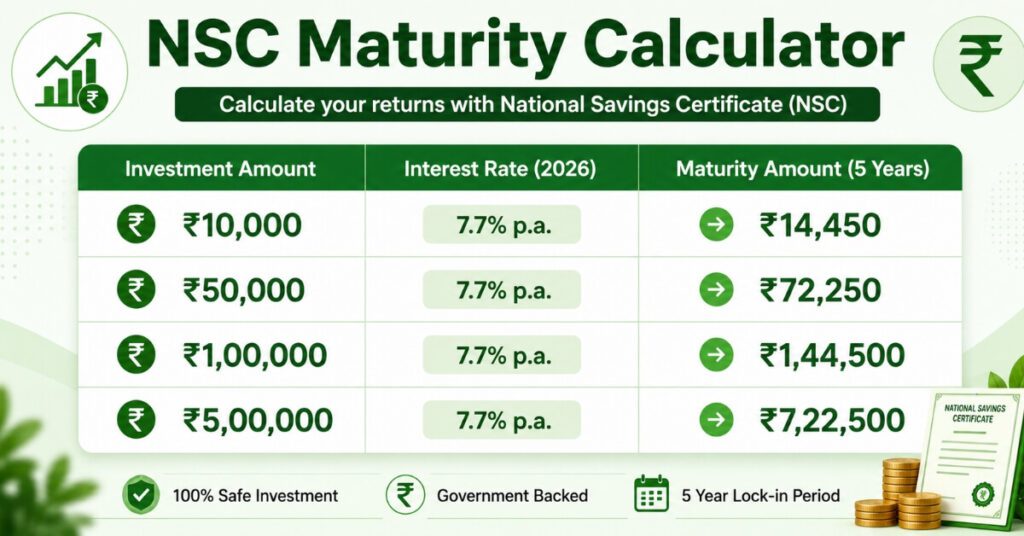
For example, if you invest ₹1,00,000 in NSC at the current rate of 7.7%, compounded annually, your investment would grow to approximately ₹1,44,500 at the end of five years. This calculation assumes the NSC interest rate remains constant throughout the tenure, since the rate is locked at the time of investment regardless of future changes.
Sample Maturity Calculation Table
| Investment Amount | Tenure | Approx Interest Rate | Maturity Value |
| ₹10,000 | 5 years | 7.7% | ₹14,450 |
| ₹50,000 | 5 years | 7.7% | ₹72,250 |
| ₹1,00,000 | 5 years | 7.7% | ₹1,44,500 |
| ₹5,00,000 | 5 years | 7.7% | ₹7,22,500 |
Please note these figures are indicative and rounded off for easy understanding. Always use an official calculator or consult your nearest post office for exact maturity values based on the applicable rate at the time of investment.
Key Features of NSC
Before deciding whether to invest based on the current NSC interest rate, it helps to understand the core features of this scheme:
Tenure: NSC has a fixed lock-in period of five years, and premature withdrawal is generally not allowed except in specific cases like the death of the account holder.
Minimum Investment: You can start investing in NSC with as little as ₹1,000, with no upper limit on investment amount.
Interest Payment: The interest is compounded yearly, and the entire amount is paid along with the principal at maturity.
Tax Benefit: Investment up to ₹1.5 lakh in NSC qualifies for deduction under Section 80C of the Income Tax Act.
Availability: NSC can be purchased at any post office across India, and many banks now also facilitate NSC investments.
Transferability: NSC certificates can be transferred from one person to another, subject to certain conditions.
Nomination Facility: Investors can nominate a family member to receive the maturity proceeds in case of an unfortunate event.
Loan Against NSC: Many banks accept NSC certificates as collateral for secured loans, adding another layer of financial flexibility.
NSC vs Fixed Deposit: Which Offers Better Returns?
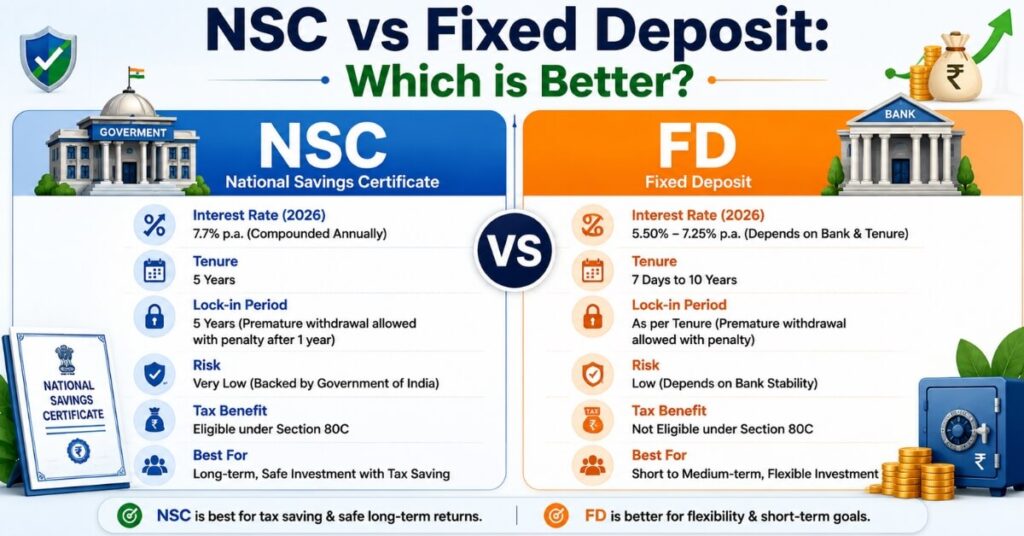
One of the most common questions investors ask is whether NSC or a five-year tax-saving Fixed Deposit is the better option. While both offer tax benefits under Section 80C, the NSC interest rate is often more competitive compared to the interest rates offered by most banks on their tax-saving FDs. Additionally, NSC is backed directly by the Government of India, making it a safer option compared to bank FDs, which are insured only up to ₹5 lakh under the DICGC scheme.
However, one key difference is liquidity. Bank FDs sometimes offer premature withdrawal facilities with a penalty, while NSC does not allow premature withdrawal except in exceptional circumstances. If you are comparing the NSC interest rate with bank FD rates, remember to also factor in these differences in flexibility and safety before making your investment decision.
NSC vs PPF: A Quick Comparison
Another popular comparison investors make is between NSC and the Public Provident Fund (PPF). While PPF has a longer lock-in of 15 years and offers tax-free interest, NSC has a shorter five-year tenure, making it suitable for medium-term goals. The interest earned on NSC is taxable, unlike PPF, but the shorter lock-in period and predictable maturity value make NSC a practical choice for investors who do not want to commit funds for as long as 15 years.

Tax Benefits of Investing in NSC
Investors often overlook one unique tax advantage of NSC. While the interest earned is taxable in the year it accrues, this same accrued interest (except in the final year) qualifies for deduction under Section 80C, since it is deemed to be reinvested. This means that for the first four years, the interest earned on your NSC investment effectively becomes eligible for further tax deduction, subject to the overall ₹1.5 lakh limit under Section 80C.
However, in the fifth and final year, the interest is taxable but does not qualify for further deduction, since it is paid out along with the principal rather than reinvested. Understanding this nuance is essential for accurate tax planning, especially for salaried individuals who are also tracking changes introduced by the new labour code salary rules in 2026, which can affect take-home pay and overall tax planning strategy.
Who Should Invest in NSC Right Now?
This current rate makes NSC particularly suitable for:
Conservative investors who prioritize capital safety over high returns
Individuals looking to save tax under Section 80C without market risk
People seeking an alternative to bank fixed deposits with comparable or better returns
Investors who can commit funds for a five-year period without needing liquidity
Senior citizens or retirees who want a portion of their portfolio in safe, guaranteed instruments
Parents planning medium-term goals such as school admissions or family expenses five years ahead
If your financial goals align with a medium-term horizon and you value the safety of a government-backed scheme, the current NSC interest rate offers a compelling reason to consider this investment option as part of your overall financial strategy.

How to Invest in NSC
Investing in NSC is a simple process. You can visit your nearest post office and fill out the NSC application form, along with KYC documents like Aadhaar, PAN, and address proof. Payment can be made through cash, cheque, or demand draft. Many post offices also allow online investment in NSC through the India Post internet banking facility if you already hold a post office savings account.
Once your investment is confirmed, you will receive an e-certificate or physical certificate reflecting your investment amount, the applicable NSC interest rate, and the maturity date. It is advisable to keep this certificate safe, as it will be required at the time of maturity or premature closure, if applicable.
Documents Required for NSC Investment
Aadhaar card and PAN card copies
Passport size photographs
Address proof, if different from Aadhaar
Duly filled NSC application form available at the post office
Factors That Influence This Rate
The NSC interest rate is not arbitrary; it is linked to the yields of government securities of comparable maturity. The Ministry of Finance reviews and announces the rate every quarter, taking into account factors such as:
Prevailing yields on government bonds
Overall inflation trends in the economy
The Reserve Bank of India’s monetary policy stance
Fiscal requirements and borrowing costs of the government
Because of this linkage, the NSC interest rate can rise or fall depending on broader economic conditions. Investors who track RBI’s repo rate decisions often get an early indication of which direction the rate might move in the upcoming quarter.
Historical Trend of the NSC Rate
Over the past few years, the NSC interest rate has moved in line with changes in the interest rate environment. During periods of rising interest rates, the government has periodically increased the rate to keep small savings schemes competitive with market instruments. Conversely, during periods of falling interest rates, the rate has also been adjusted downward. This historical pattern shows that while the NSC interest rate is generally stable within a quarter, it is not fixed permanently and investors should stay updated on quarterly notifications.
Advantages and Limitations of NSC
Advantages:
Government-backed safety with no market risk
Predictable, guaranteed maturity value
Tax deduction benefit under Section 80C
Easy to purchase at any post office nationwide
Can be used as collateral for loans
Limitations:
Interest earned is taxable, unlike PPF or ELSS
No premature withdrawal in most circumstances
Lower liquidity compared to open-ended mutual funds
Returns may be lower than equity investments over the long term
Who Regulates and Backs NSC?
NSC is regulated by the Ministry of Finance under the Government of India and is operated through the India Post network, along with select authorized banks. Because the scheme is a direct liability of the central government, there is effectively zero default risk associated with your principal or the interest earned at the applicable NSC interest rate. This sovereign guarantee is one of the biggest reasons why conservative investors, including retirees and first-time savers, continue to prefer NSC over many private-sector fixed income products, even when the NSC interest rate is only marginally higher or comparable to bank offerings.
Common Mistakes to Avoid While Investing in NSC
Many first-time investors make avoidable errors when investing in NSC. Some of the most common mistakes include not comparing the current rate with other 80C options before investing, forgetting to factor in the taxability of interest income, assuming the certificate can be withdrawn early without restrictions, and not keeping the certificate or investment proof safely for future reference. Being aware of these pitfalls can help you make a more informed decision and avoid unnecessary complications at the time of maturity.
Alternatives to NSC for Small Savers
If NSC does not fit your investment horizon, the post office and government also offer several other small savings schemes worth considering. The Post Office Time Deposit offers flexible tenures ranging from one to five years, while the Kisan Vikas Patra doubles your investment over a fixed period without any tax benefit under Section 80C. Sukanya Samriddhi Yojana is designed specifically for the girl child and offers a higher rate along with tax-free maturity proceeds, though it comes with a much longer lock-in.
The Senior Citizens Savings Scheme, on the other hand, offers quarterly payouts and is tailored for retirees who need regular income rather than a lump sum at maturity. Comparing these alternatives alongside NSC can help you build a well-diversified, low-risk portion of your overall investment portfolio based on your specific financial goals and liquidity needs.
Frequently Asked Questions (FAQs)
Q1. What is the current NSC interest rate in 2026?
The current NSC interest rate is 7.7% per annum, compounded annually and payable at maturity, as notified by the Ministry of Finance for the ongoing quarter.
Q2. Is NSC better than a 5-year tax-saving FD?
It depends on individual priorities, but the NSC interest rate is often more competitive than many bank FD rates, and NSC carries a direct government guarantee, making it a safer choice for risk-averse investors.
Q3. How often does this rate change?
The NSC interest rate is reviewed and revised quarterly by the Ministry of Finance, based on government bond yields and prevailing economic conditions.
Q4. Can I withdraw NSC before maturity?
Premature withdrawal is generally not permitted, except in specific cases such as the death of the account holder or under a court order.
Q5. Is the interest earned on NSC taxable?
Yes, the interest is taxable each year, though it qualifies for Section 80C deduction (except in the final year) since it is treated as reinvested.
Q6. Where can I check the official rate?
You can verify the latest rate directly from India Post, which publishes quarterly updates on all small savings schemes.
Q7. Can NRIs invest in NSC?
No, Non-Resident Indians are not eligible to purchase new NSC certificates. However, if a resident Indian later becomes an NRI while holding NSC, the certificate can generally be held until maturity, subject to applicable rules.
Conclusion
The National Savings Certificate remains one of the most reliable investment options for Indian investors seeking safety, guaranteed returns, and tax benefits. With the current NSC interest rate at 7.7% per annum, compounded annually, NSC continues to offer a strong alternative to bank fixed deposits, especially for those who want government-backed security. Whether you are a first-time investor or someone rebalancing your portfolio towards safer instruments, keeping track of the latest NSC interest rate can help you make informed financial decisions. As always, evaluate your financial goals, liquidity needs, and tax planning strategy before committing funds to any five-year investment like NSC.
Disclaimer
This article is for informational and educational purposes only and should not be considered financial or investment advice. Interest rates, tax rules, and scheme features mentioned here are subject to change as per government notifications. Readers are advised to verify the latest NSC interest rate and terms from official sources such as India Post or consult a certified financial advisor before making any investment decisions.


Pingback: Gold Silver Investment 2026: 7 Smart Tips to Follow