
Every salaried employee in India looks forward to one thing every month — their salary credit date. But delays, uncertainty, and unclear timelines have long been a source of frustration for workers across sectors. This is exactly the gap that the New Labour Code Salary Rules aim to fix. Under the Code on Wages, 2019, the government has introduced clear, enforceable timelines for salary payments, making it mandatory for employers to pay wages within a defined window. In this detailed guide, we break down everything you need to know about these new provisions, including deadlines, penalties, remedies, and how they affect your monthly finances.
Whether you are a monthly-salaried employee, a daily wage worker, or someone recently exited a company, these new provisions apply to you. Let us understand the complete picture, step by step.
What Are the New Labour Code Salary Rules?
The New Labour Code Salary Rules are a set of statutory provisions under the Code on Wages, 2019, that mandate timely payment of wages to every employee, regardless of their salary level or designation. Earlier, under the Payment of Wages Act, 1936, only employees below a certain wage ceiling were protected from delayed payments. Now, under the new framework, this protection extends to all employees — including senior management and high-income earners.
This is one of the most significant shifts brought about by these rules, since it removes the earlier wage-ceiling loophole that left many professionals outside the scope of legal protection.
Why the New Labour Code Salary Rules Matter
For millions of working Indians, salary is the backbone of monthly budgeting — rent, EMIs, groceries, school fees, and savings all depend on timely income. A delay of even a few days can disrupt financial planning and trigger late fees on loans or credit cards. This is exactly why these provisions were introduced — to bring predictability and legal accountability into the salary payment process across India, for organisations big and small.
Salary Payment Timelines Under the New Labour Code
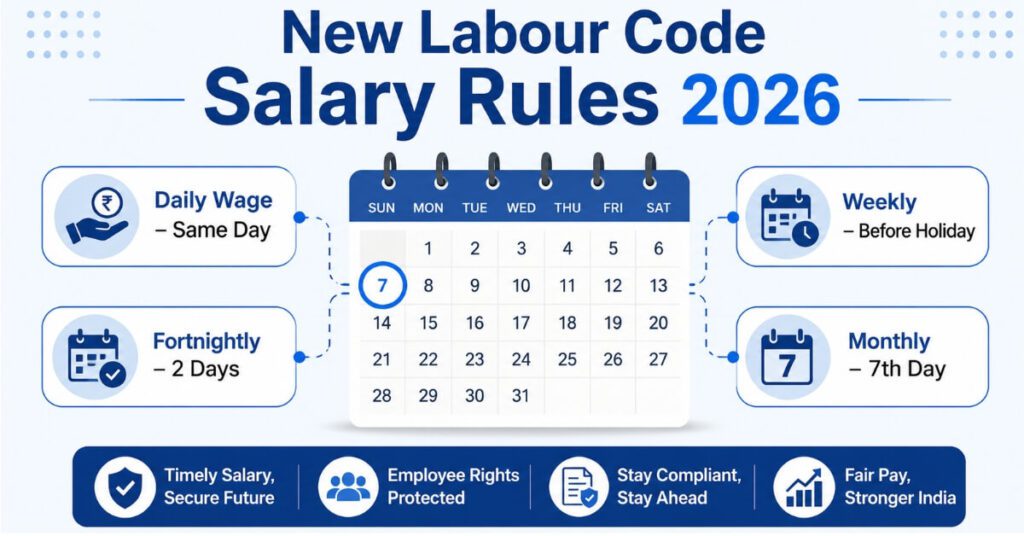
One of the most talked-about aspects of the New Labour Code Salary Rules is the clear categorisation of payment timelines based on how an employee is engaged:
Daily-wage workers: Must be paid at the end of their shift, the same day.
Weekly-rated employees: Must be paid before their weekly holiday.
Fortnightly-rated employees: Must be paid within 2 days after the end of the fortnight.
Monthly-rated employees: Must be paid before the expiry of the 7th day of the succeeding month.
This structured approach ensures that no category of worker is left in uncertainty about when their wages will arrive, regardless of industry or company size.

Full and Final Settlement: The 2-Day Rule
Among the most employee-friendly aspects of these provisions is the rule around final settlements. If an employee resigns, is removed, dismissed, or retrenched, the employer must pay all due wages within 2 working days of the last working day. Earlier, this process could stretch for weeks or even months in many organisations, leaving former employees waiting for their rightful dues.
This 2-day settlement rule is a major relief for employees changing jobs, since delayed full and final settlements have historically been a common grievance in India’s employment landscape.
Universal Coverage: No More Wage Ceiling Restrictions
Before the New Labour Code Salary Rules came into effect, the Payment of Wages Act, 1936, only protected employees earning below a specified wage ceiling. This meant that senior professionals, managers, and higher-income earners had no formal legal recourse if their salaries were delayed.
Under the new framework, this restriction has been removed entirely. This rule now applies universally — irrespective of an employee’s salary level, designation, or seniority — bringing every working professional under the protective umbrella of the law.
The 50% Wage Rule and Its Impact on Take-Home Pay
Alongside payment timelines, the New Labour Code Salary Rules also introduce a structural change to how salaries are designed. Under the new wage definition, Basic Pay plus Dearness Allowance must constitute at least 50% of an employee’s total Cost to Company (CTC). If allowances such as HRA, conveyance, or special allowances exceed 50% of CTC, the surplus amount gets added back to the wage base for calculation purposes.
This has a direct impact on Provident Fund contributions and gratuity calculations, since both are computed as a percentage of “wages” as newly defined. Many employees may notice a slightly different take-home salary structure as companies realign compensation packages to comply with these new provisions.

Mandatory Wage Slips
Another important component of the New Labour Code Salary Rules is the requirement for employers to issue wage slips, either physical or electronic, on or before the date of payment. This improves transparency significantly and gives employees documented proof of their earnings, deductions, and net pay — which becomes especially useful if a dispute arises later
What Happens If Salary Is Delayed? Remedies for Employees
The New Labour Code Salary Rules do not just set timelines — they also provide a clear grievance redressal mechanism. If an employer delays wages or makes unauthorised deductions, the employee can approach the “inspector cum facilitator,” a role newly introduced under this Code.
Key remedies available under the New Labour Code Salary Rules include:
The inspector cum facilitator advises both employer and employee on wage-related compliance and encourages payment before disputes escalate to a judicial forum.
If the issue remains unresolved, either the employee or the inspector cum facilitator can approach the Industrial Tribunal for claim settlement.
Authorities are obligated to decide claims within 3 months of filing, ensuring faster resolution than before.
If an employer fails to pay the compensation determined by authorities, a recovery certificate can be issued to the District Magistrate or Collector, and the dues are recovered as “arrears of land revenue.”
Extended Limitation Period for Filing Claims
Another employee-friendly change under the New Labour Code Salary Rules is the extended limitation period for filing wage-related claims. Previously, under the fragmented older laws, the time limit to file a claim ranged from just 6 months to 2 years depending on the applicable legislation. Under this revised framework, the limitation period has been extended to 3 years, giving employees significantly more time to gather evidence and pursue appropriate redressal.
This extended timeframe is particularly helpful for employees who may not immediately realise a wage discrepancy or who need time to build a strong case before approaching authorities.
Deduction Limits Under the New Labour Code Salary Rules
This framework also regulates how much an employer can deduct from an employee’s wages. Authorised deductions — such as those for damages, loss, fines, or duty-related charges — are permitted, but the total deductions generally cannot exceed the statutory ceiling, which is capped around 3% of wages payable in many cases. This prevents employers from effectively withholding large portions of salary through excessive or arbitrary deductions.

Penalties for Non-Compliance
Employers who fail to comply with the New Labour Code Salary Rules can face serious consequences. Non-compliance may attract monetary penalties, and in certain repeated or severe cases, even imprisonment. This strong enforcement mechanism is designed to ensure that companies take these timelines seriously rather than treating them as optional guidelines.
How the New Labour Code Salary Rules Affect Your Financial Planning
With guaranteed salary timelines now in place, employees can plan their monthly finances with greater confidence. Whether it is paying EMIs on time, avoiding late fees on credit cards, or managing household budgets, predictable salary credit dates make a real difference. If you are also managing long-term financial commitments like a home loan alongside your monthly salary, it is worth understanding related provisions such as Home Loan Tax Benefits to make the most of your income and reduce your overall tax liability while your salary payment timeline remains protected under these provisions.
A Practical Example of How These Rules Work
Consider a monthly-salaried employee working for a mid-sized IT company. Their salary for the month of June must legally be credited on or before July 7th. If the company delays payment beyond this date without valid reason, the employee has the right to raise the issue with the inspector cum facilitator. Similarly, if this employee resigns in July, the company is legally bound to clear all final dues, including pending salary, leave encashment, and other settlements, within just 2 working days of their last working day — a stark improvement compared to the delays many professionals faced under the older wage laws.
Another example involves a factory worker paid on a daily basis. Under the earlier regime, timely payment enforcement for such workers varied depending on state-specific rules. Now, the same clear-cut framework applies uniformly, whether the worker is in Andhra Pradesh, Maharashtra, or any other state, since this framework operates at the central legislative level with consistent applicability across India. This consistency is especially valuable for workers who migrate between states for employment opportunities, as they no longer need to worry about learning a different set of wage protection rules each time they change location.

Impact on Employers and Compliance Requirements
Organisations across India now need to revisit their internal payroll processes to remain compliant. HR and payroll teams must ensure salary disbursement systems are aligned with statutory deadlines, wage slips are generated and shared on time, and full and final settlement processes are streamlined to meet the mandatory 2-day window. Non-compliance not only invites monetary penalties but can also damage an organisation’s reputation as an employer, especially in a job market where employees increasingly research company practices before accepting offers.
Many companies are also updating their appointment letters and HR policies to reflect the revised wage definition, ensuring that the 50% Basic Pay plus Dearness Allowance requirement is built into compensation structures from day one, rather than being adjusted reactively later.
Documents and Information Employees Should Keep Handy
To make the most of the protections under the New Labour Code Salary Rules, employees should maintain a few essential records:
Wage slips (physical or electronic) issued by the employer every payment cycle
Appointment letter clearly stating salary structure and payment terms
Bank statements showing salary credit dates over time
Any written communication regarding delayed payment or disputes
Resignation or termination letters, along with full and final settlement statements
Keeping these documents organised ensures you have strong evidence if you ever need to approach the inspector cum facilitator or file a formal claim under the New Labour Code Salary Rules.
Common Misconceptions About the New Labour Code Salary Rules
Many employees have misconceptions about how these rules work. Let us clear up a few:
Misconception: Only low-income employees are protected. Reality: These provisions apply universally to all employees, regardless of salary level.
Misconception: Employers can delay full and final settlement indefinitely. Reality: The law mandates settlement within 2 working days of exit.
Misconception: Filing a claim is only possible within a few months. Reality: The limitation period has been extended to 3 years.
Misconception: There is no penalty for delayed salary. Reality: Non-compliance can attract monetary penalties and even imprisonment in serious cases.
How States Are Implementing These Rules
Since labour falls under the Concurrent List of the Indian Constitution, both the central and state governments play a role in implementation. While the Code on Wages, 2019 lays down the central framework, individual states are responsible for notifying their own rules and setting up the administrative machinery — including appointing inspector cum facilitators and designated authorities to handle claims.
This means the rollout timeline and enforcement intensity may vary slightly from state to state, even though the core provisions, such as the 7th-day payment deadline and the 2-day final settlement rule, remain uniform across the country. Employees are encouraged to check with their state labour department for any state-specific notifications or helpline numbers that may be relevant to their location.
Frequently Asked Questions on New Labour Code Salary Rules
Q1. What is the new labour code rule for salary payment dates?
Under the New Labour Code Salary Rules, monthly-salaried employees must be paid before the 7th day of the succeeding month, while daily, weekly, and fortnightly workers have their own specific timelines defined under the Code on Wages, 2019.
Q2. How soon must an employer pay final dues after resignation?
As per the New Labour Code Salary Rules, employers must pay all final dues within 2 working days of an employee’s resignation, removal, dismissal, or retrenchment.
Q3. Do the New Labour Code Salary Rules apply to high-income employees?
Yes, unlike the earlier Payment of Wages Act which had a wage ceiling, the New Labour Code Salary Rules apply universally to all employees, irrespective of their salary or designation.
Q4. What can an employee do if salary is delayed under the new rules?
Employees can approach the inspector cum facilitator appointed under the Code, who will advise both parties and attempt resolution. If unresolved, the matter can be escalated to the Industrial Tribunal.
Q5. What is the time limit to file a wage-related claim now?
Under the New Labour Code Salary Rules, the limitation period for filing claims has been extended to 3 years, compared to the earlier range of 6 months to 2 years under older legislation.
Q6. How does the 50% wage rule affect my salary structure?
Under the New Labour Code Salary Rules, Basic Pay plus Dearness Allowance must be at least 50% of your total CTC. This may increase your Provident Fund and gratuity contributions while slightly adjusting your take-home pay structure.
Q7. Do these rules apply the same way to every state in India?
The core provisions, including payment timelines and the 2-day final settlement rule, apply uniformly across India since they stem from the central Code on Wages, 2019. However, since labour is a concurrent subject, some administrative aspects, such as the appointment of enforcement authorities, may vary slightly by state.
Conclusion
The New Labour Code Salary Rules mark a major step forward in protecting employee rights across India. From guaranteed payment timelines and universal coverage to faster grievance redressal and an extended limitation period for claims, these provisions bring much-needed structure and accountability to how salaries are paid.
Whether you are a daily wage worker, a monthly-salaried professional, or someone navigating a job transition, understanding the New Labour Code Salary Rules empowers you to know your rights and take timely action if needed. As these regulations continue to be implemented across organisations and states, staying informed will help you protect your income, negotiate confidently with employers, and plan your finances with greater clarity and confidence for the years ahead.
Disclaimer
This article is for informational and educational purposes only and should not be considered as legal or financial advice. The New Labour Code Salary Rules and related provisions are subject to change based on government notifications and official amendments. Readers are advised to refer to official government resources and consult a qualified legal professional before taking any action based on this information.


Pingback: NSC Interest Rate 2026: 7.7% Guaranteed Returns