
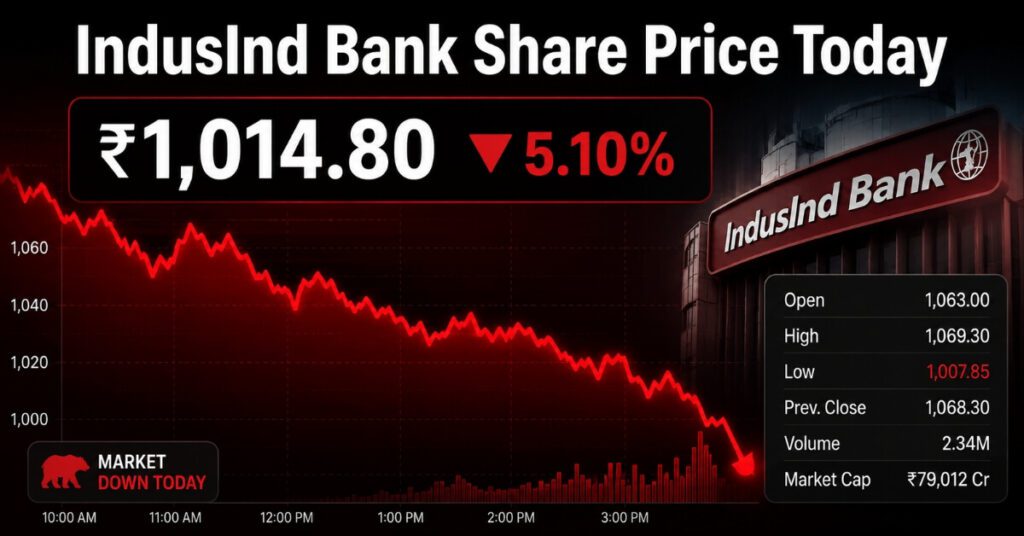
IndusInd Bank Share Price Today slipped nearly 5% in a single trading session on 23 July 2026, even though the bank posted a strong 72% year-on-year jump in consolidated net profit for the June quarter. Investors were surprised to see the stock react negatively to what looks like a solid earnings beat, and this contradiction has become the biggest talking point in Dalal Street circles today.
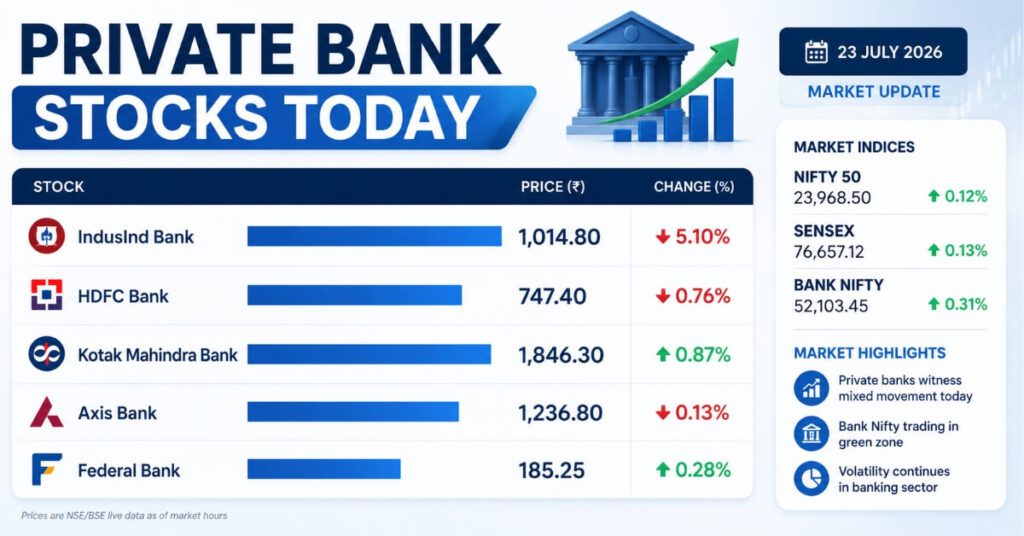
As of 10:30 AM IST, IndusInd Bank Share Price Today stood at ₹1,014.80 on the NSE, down ₹54.50 or 5.10% from the previous close of ₹1,069.30. The stock opened at ₹1,036.60, touched an intraday high of ₹1,042.20, and slipped to a low of ₹1,002.40 before stabilising. Anyone checking the live chart will notice a sharp gap-down open followed by continued selling pressure through the morning session.
IndusInd Bank Share Price Today: Key Numbers at a Glance
Before diving deeper into why IndusInd Bank Share Price Today is falling despite strong earnings, here is a quick snapshot of the numbers that matter most to retail and institutional investors alike.
Current Price: ₹1,014.80 (down 5.10%)
Previous Close: ₹1,069.30
Day’s Open: ₹1,036.60
Day’s High: ₹1,042.20
Day’s Low: ₹1,002.40
Market Cap: ₹79.01 KCr
P/E Ratio: 88.94
Dividend Yield: 0.15%
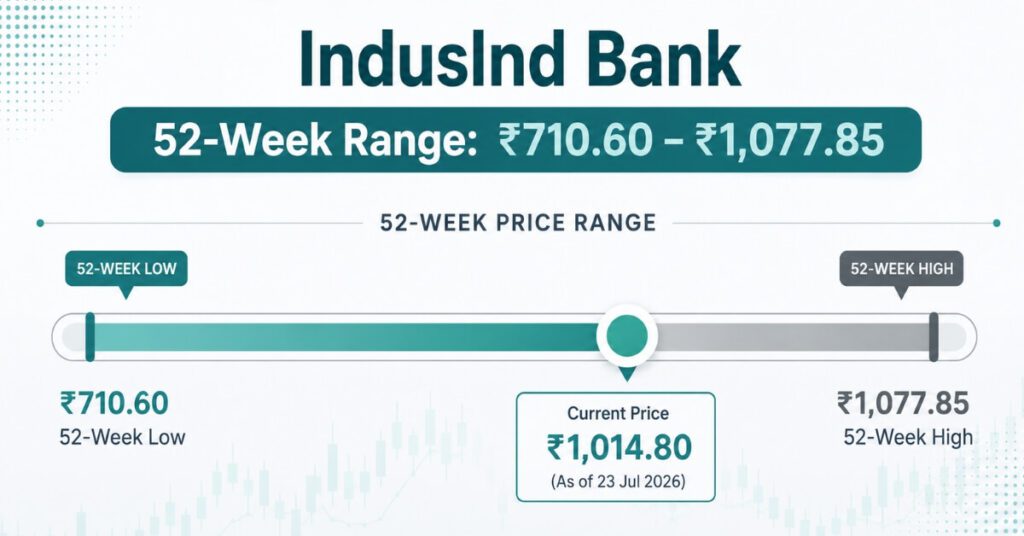
52-Week High: ₹1,077.85
52-Week Low: ₹710.60
These figures make it clear why IndusInd Bank Share Price Today has become one of the most searched finance queries in India this morning. A stock hitting a fresh intraday low while sitting close to its 52-week high just weeks earlier is unusual, and it explains the surge in retail investor attention.
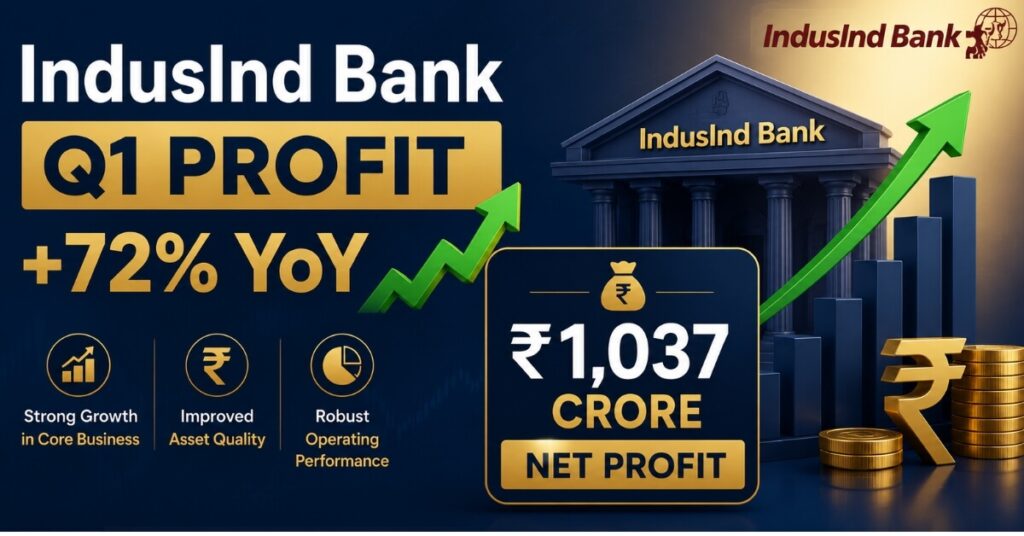
Why Is IndusInd Bank Share Price Today Falling Despite Strong Q1 Results?
The most common question investors are asking about IndusInd Bank Share Price Today is simple: if profit jumped 72% year-on-year to ₹1,037 crore for the June quarter, why is the stock falling instead of rallying? There are a few possible explanations analysts are pointing to.
First, much of the profit growth appears to be a base effect story — IndusInd Bank had reported unusually weak numbers in the same quarter last year due to accounting irregularities in its derivatives book, so a 72% jump looks impressive on paper but may not reflect a dramatic underlying turnaround. Second, brokerages have flagged asset quality concerns and slower loan growth, which tend to weigh more heavily on long-term valuation than a single quarter’s profit beat. Third, profit booking is common after a stock approaches its 52-week high, and IndusInd Bank Share Price Today may simply be reflecting investors locking in gains ahead of uncertainty.
Despite the fall, the bank’s Q1 2027 earnings actually beat estimates on both fronts — EPS beat by 44.79% and revenue beat by 3.85%, with quarterly revenue growth of 272.69% year-on-year reported in the latest quarterly financials. This mismatch between strong headline numbers and a weak stock reaction is exactly why IndusInd Bank Share Price Today has become such a widely discussed topic among traders today.
IndusInd Bank Share Price Today vs Peer Banks
To understand whether the fall in IndusInd Bank Share Price Today is a sector-wide trend or specific to the bank, it helps to compare it against peer private banks trading on the same day.
Kotak Mahindra Bank: ₹384.30, up 0.83%
HDFC Bank: ₹747.50, down 0.75%
Federal Bank: ₹353.35, up 0.028%
Axis Bank: ₹1,236.80, down 0.13%
Clearly, most private banking peers are trading with mild movements today, while IndusInd Bank Share Price Today shows a much sharper decline of over 5%. This confirms that the fall is largely stock-specific, driven by the market’s reaction to the bank’s own earnings and management commentary rather than any broader banking sector sell-off. Broader indices like BSE Sensex (76,657.12, down 0.13%) and NIFTY 50 (23,968.50, down 0.12%) were also only marginally lower, reinforcing that today’s move in IndusInd Bank Share Price Today is company-specific.
Technical Analysis: What the Charts Are Showing
Looking purely at the intraday chart, the stock opened with a visible gap-down from the previous close, immediately breaking below the psychologically important ₹1,050 mark. From there, sellers pushed the price further down toward the ₹1,002 zone before a mild recovery set in during the late morning session. This kind of price action — a sharp opening decline followed by consolidation rather than a fresh breakdown — often suggests that a large chunk of the negative reaction was already priced in during pre-market and early trade, with some value buyers stepping in near the day’s low.
From a broader trend perspective, the stock has been range-bound over the past few months, oscillating between the ₹950 and ₹1,080 zone. Today’s fall pulls it closer to the middle of that range rather than pushing it toward a new low, which is an important distinction for traders using support and resistance levels to plan entries and exits. The ₹1,000 mark is likely to act as a near-term psychological support, while ₹1,070 (near the previous close) could serve as immediate resistance if the stock attempts to recover in the coming sessions.
Volume patterns are also worth watching closely. A high-volume sell-off, as seen today, typically signals conviction behind the move rather than a temporary blip caused by a handful of large trades. Traders should track whether volumes remain elevated over the next two to three sessions, as sustained high volume on down days would indicate that institutional investors are actively reducing exposure, while a quick drop in volume could suggest the sell-off is nearing exhaustion.
Quarterly Financial Performance
The bank’s latest quarterly financials for 2026 Q4 showed revenue of ₹4.6 KCr, marking a striking 272.69% year-on-year revenue growth. While such a large percentage jump often reflects a low base from the previous year’s derivatives-related write-downs, it nonetheless signals that the bank’s core operations are recovering. For the June quarter (Q1 2027), the bank beat earnings estimates with an EPS beat of 44.79% and a revenue beat of 3.85%, both of which are generally seen as positive indicators by analysts.
However, seasoned investors know that beating estimates does not automatically translate into share price gains, especially when the broader narrative around a stock involves concerns about governance, asset quality, or management transition. In IndusInd Bank’s case, the market appears to be weighing these qualitative risk factors more heavily than the quantitative earnings beat, which explains today’s counterintuitive price reaction.
What Brokerages and Analysts Are Saying
Several brokerages have weighed in on the stock following the Q1 earnings announcement. While some remain cautiously optimistic, citing the earnings beat and improving core profitability trends as reasons for long-term confidence, others have flagged concerns around loan growth momentum, provisioning levels, and the sustainability of margin improvement. A recent upgrade from a domestic brokerage on asset quality improvement was seen as a positive signal, even as the stock fell on the day, showing that short-term price action and analyst sentiment do not always move in lockstep.
Retail investors should be cautious about reacting purely to headline target price revisions without reading the full rationale behind them. A brokerage might raise its target price while simultaneously flagging near-term volatility, and understanding this nuance is far more useful than simply reacting to a single number.
Key Risks to Watch
Before making any investment decision, it is worth understanding the key risks currently associated with the stock. First, the bank has faced scrutiny in the recent past over derivatives accounting practices, and any fresh disclosures or regulatory action could trigger renewed volatility. Second, private banks operating in a competitive lending environment face constant pressure on net interest margins, especially if the Reserve Bank of India adjusts policy rates in the coming quarters. Third, asset quality in unsecured and microfinance lending segments remains a watch area for the broader banking sector, and any deterioration here could weigh on investor sentiment further.
On the positive side, the bank’s capital adequacy remains within regulatory comfort levels, and its retail deposit franchise continues to grow, which provides a reasonably stable funding base even during periods of stock price volatility.
About IndusInd Bank Ltd
IndusInd Bank Limited is an Indian banking and financial services company headquartered in Mumbai. The bank was established in April 1994 and promoted by the Hinduja Group, with S.P. Hinduja as its founder. Sumant Kathpalia has served as the bank’s CEO since 24 March 2020. With over 44,974 employees as of 2025 and a reported annual revenue of ₹56,351 crore (approximately US$6.7 billion) in 2025, IndusInd Bank remains one of India’s prominent private sector banks. Understanding this background helps put today’s price movement into proper context for long-term investors.
IndusInd Bank’s Business Segments Explained
To fully understand today’s stock movement, it helps to know how the bank actually makes its money. IndusInd Bank operates across three broad business verticals: consumer banking, corporate and commercial banking, and treasury operations. The consumer banking arm includes retail loans, credit cards, vehicle finance, and microfinance lending through its subsidiary, Bharat Financial Inclusion. This segment has historically been a strong growth driver but has also been the source of recent asset quality concerns, particularly in the microfinance book, where delinquencies tend to rise during periods of rural economic stress.
The corporate and commercial banking segment serves mid-sized and large businesses with working capital loans, trade finance, and treasury services. This division tends to be more stable in terms of margins but is sensitive to broader economic cycles and interest rate movements. Finally, the treasury division manages the bank’s investment portfolio and plays a role in generating fee income, though it can also introduce volatility to quarterly earnings depending on market conditions.
Investors evaluating the stock beyond just the daily price movement should look at how each of these segments is performing individually, rather than relying solely on the consolidated profit figure, since a strong headline number can sometimes mask weakness in a specific business line.
Long-Term Outlook for the Stock
Looking beyond today’s volatility, the medium-to-long-term outlook for the bank will largely depend on three factors: the pace of asset quality recovery in the retail and microfinance books, the bank’s ability to sustain net interest margins in a competitive rate environment, and continued clarity and stability in management and governance following the derivatives accounting episode from the prior year. Analysts who remain bullish on the stock typically point to its attractive valuation relative to historical averages and the potential for a re-rating if the bank delivers a few consecutive quarters of clean, consistent earnings without negative surprises.
On the other hand, analysts who remain cautious tend to emphasize that trust, once dented in the banking sector, takes time to rebuild, and that investors may continue to demand a valuation discount until there is a longer track record of stability. This is a common pattern seen across the banking sector globally — stocks that go through a governance or accounting scare often trade at a discount to peers for several quarters even after the underlying issue has been resolved.
For retail investors with a long-term horizon, this could mean an opportunity to accumulate shares gradually at lower valuations, provided they are comfortable with the elevated volatility that typically accompanies such situations. For those with a shorter time horizon or lower risk tolerance, it may be prudent to wait for clearer signs of stabilisation before increasing exposure.
Should You Buy IndusInd Bank Shares Today?
Many readers searching for IndusInd Bank Share Price Today are really asking whether this dip is a buying opportunity or a warning sign. The honest answer is that it depends on your risk appetite and investment horizon. Long-term investors who believe in the bank’s turnaround story may view the current fall as an attractive entry point, especially with the stock still comfortably above its 52-week low of ₹710.60. On the other hand, short-term traders may want to wait for the stock to stabilise and for more clarity from management on asset quality and loan growth guidance before taking a position.
As always, before acting on any movement in IndusInd Bank Share Price Today, it is wise to do your own research, read the full earnings transcript, and consult a certified financial advisor rather than relying solely on price action or headlines. Keeping a close watch on management commentary during the post-earnings investor call, along with follow-up brokerage notes over the next few days, will offer a clearer picture than reacting to a single volatile trading session in isolation.
For readers also tracking other financial stocks, you may find our article on SBI Funds Management Share Price useful for comparing how different financial sector stocks are performing this week. You can also check live, verified data directly on the NSE India official website for real-time updates on IndusInd Bank Share Price Today.
Frequently Asked Questions (FAQs)
Q1. What is IndusInd Bank Share Price Today?
IndusInd Bank Share Price Today is ₹1,014.80 as of 10:30 AM IST on 23 July 2026, down 5.10% from the previous close of ₹1,069.30.
Q2. Why did IndusInd Bank Share Price Today fall despite good Q1 results?
Although the bank reported a 72% YoY jump in consolidated net profit, concerns over asset quality, a favourable base effect from last year’s weak numbers, and profit booking near the 52-week high have pressured IndusInd Bank Share Price Today.
Q3. What is the 52-week high and low for IndusInd Bank shares?
The 52-week high is ₹1,077.85 and the 52-week low is ₹710.60, giving useful context to today’s price movement in IndusInd Bank Share Price Today.
Q4. Is IndusInd Bank a good stock to buy now?
This depends on individual risk tolerance and investment goals. Long-term investors may see value in the current dip, while short-term traders may prefer to wait for stability before acting on IndusInd Bank Share Price Today movements.
Q5. Who is the CEO of IndusInd Bank?
Sumant Kathpalia has been serving as CEO of IndusInd Bank since 24 March 2020.
Conclusion
IndusInd Bank Share Price Today has captured investor attention with a sharp 5.10% fall despite the bank reporting a robust 72% year-on-year jump in net profit for the June quarter. The disconnect between strong headline earnings and weak stock performance highlights how much the market values consistency, asset quality, and forward guidance over a single quarter’s profit number. Investors tracking IndusInd Bank Share Price Today should keep an eye on upcoming brokerage reports, management commentary from the Q1 earnings call, and broader banking sector trends before making any investment decisions. As always, staying updated with verified, real-time data is the safest way to make informed decisions around IndusInd Bank Share Price Today.
Data and figures referenced in this article, including price, volume, market capitalisation, and quarterly financials, were accurate as of the time of publishing on 23 July 2026 and may change with subsequent trading sessions.
Disclaimer
This article is for informational purposes only and does not constitute investment advice. Stock prices, financial data, and figures mentioned regarding IndusInd Bank Share Price Today are based on publicly available information as of the time of writing and are subject to change. Please consult a certified financial advisor and conduct your own research before making any investment decisions.


Pingback: HDFC Bank Share Price Today: Falls 7% in 2 Days