

SBI Funds Management Share Price has become one of the most tracked numbers in the Indian stock market this week, as investors closely follow the recently listed asset management company. As one of the largest and most trusted mutual fund houses in the country, SBI Funds Management’s stock market debut has generated significant interest among both retail and institutional investors. In this comprehensive guide, we break down everything you need to know about SBI Funds Management Share Price, including recent price movement, financial performance, valuation metrics, and what investors should consider before adding this stock to their portfolio.
Understanding SBI Funds Management Share Price Today
SBI Funds Management Share Price has been trading in a fairly wide range since its market debut, generally moving between ₹594 and ₹625 depending on the trading session and the source being tracked. On a recent trading day, the stock opened at ₹609.75, reflecting a gain of approximately 6.23% over its previous close, indicating continued positive momentum in investor sentiment following the company’s listing. The 52-week high and low for SBI Funds Management Share Price currently stand at ₹624.95 and ₹598.20 respectively, giving investors a useful reference range for the stock’s recent trading behaviour.
Since asset management companies are relatively less common on Indian stock exchanges compared to banks, NBFCs, or manufacturing companies, this stock has attracted considerable attention from investors looking to diversify into the financial services and wealth management space through a listed vehicle.
Company Background: Why SBI Funds Management Matters
SBI Funds Management Limited, commonly known as SBI Mutual Fund, is one of India’s largest and most established asset management companies, offering over 53 open-ended domestic funds spanning index funds, equity funds, debt funds, and exchange-traded funds across various market capitalisations, sectors, and investment themes. The company benefits from strong brand recall due to its association with the State Bank of India, India’s largest public sector bank, which has historically helped it build a wide distribution network and a loyal customer base across urban and semi-urban India.
This strong parentage and distribution reach are frequently cited by analysts as key reasons why the stock has commanded a premium valuation compared to some of its smaller, less established peers in the asset management industry.
SBI Funds Management IPO: A Quick Recap
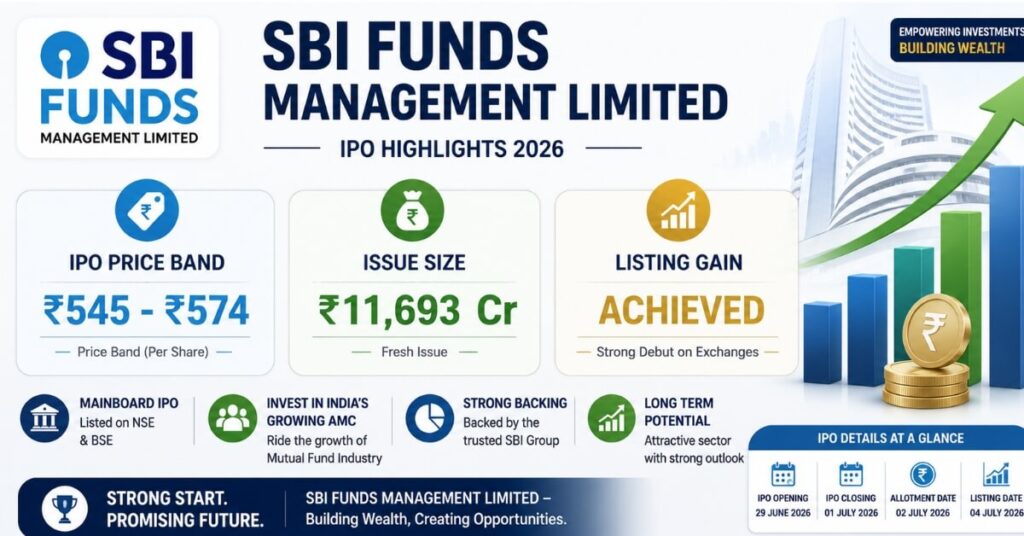
Before diving deeper into the current SBI Funds Management Share Price trends, it helps to revisit the IPO details that brought the company to the stock exchanges. The company had fixed its IPO price band in the range of ₹545 to ₹574 per share, raising a substantial amount as part of an ₹11,693 crore issue, making it one of the larger listings in the asset management space in recent years. Interestingly, this price band was set nearly 30% below the stock’s recent unlisted market price at the time, which had been trading closer to ₹820 in the pre-listing unlisted market, according to data from unlisted share tracking platforms.
This gap between the IPO price band and the unlisted market price is one reason why many investors who applied in the IPO have already seen healthy listing gains, which continues to be reflected in the current SBI Funds Management Share Price levels seen on the exchanges today.
Quarterly Financial Performance Behind SBI Funds Management Share Price
A closer look at the company’s recent quarterly performance offers useful context for understanding the current SBI Funds Management Share Price. According to data reviewed as part of this coverage, the company’s revenue for the period stood at approximately ₹4,970 crore, reflecting a healthy year-on-year growth of around 17.4%. This consistent revenue growth trend has played a meaningful role in supporting investor confidence in the stock, since asset management companies typically generate revenue through management fees linked to the total assets under management, meaning steady growth in this metric usually points to expanding investor participation in the company’s mutual fund schemes.
Strong and consistent financial performance of this nature is often viewed positively by long-term investors evaluating this stock, since it reflects the underlying health of the company’s core business rather than short-term market sentiment alone.
Valuation Metrics: Is SBI Funds Management Share Price Justified?
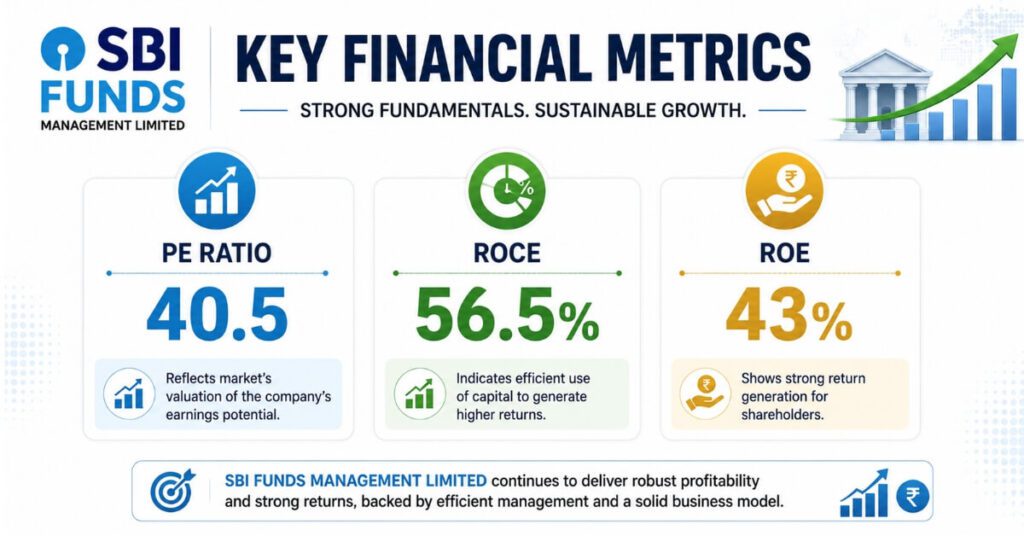
When evaluating whether the current SBI Funds Management Share Price represents fair value, it is useful to look at standard valuation metrics used across the asset management industry. Based on data reviewed for this coverage, the stock’s price-to-earnings ratio stands at approximately 40.5, which is on the higher side compared to many traditional financial services companies, though not unusual for asset management businesses that typically command premium valuations due to their asset-light, high-margin business models. The company’s return on capital employed has been reported at around 56.5%, while return on equity stands at approximately 43%, both of which are considered strong indicators of efficient capital utilisation within the mutual fund business.
These healthy return ratios are frequently highlighted by analysts as a key justification for the premium valuation currently reflected in the stock’s pricing, since businesses that generate high returns on relatively lower capital requirements tend to command higher price-to-earnings multiples in the broader market.
Why SBI Funds Management Share Price Data Varies Across Platforms
Investors tracking SBI Funds Management Share Price may notice slight variations in the exact figures reported across different financial platforms and brokerage websites. This is fairly common for recently listed stocks, since different platforms may pull live data at slightly different timestamps throughout the trading day, and some sources may reflect NSE prices while others reflect BSE prices, which can differ marginally due to variations in trading volumes and order flow between the two exchanges.
For the most accurate and real-time SBI Funds Management Share Price, investors are generally advised to check directly through their trading platform or a live market data terminal rather than relying solely on static website listings that may not update in real time.

Asset Management Sector Outlook in India
Understanding the broader asset management sector context is helpful when evaluating long-term prospects tied to SBI Funds Management Share Price. India’s mutual fund industry has witnessed sustained growth over the past several years, driven by rising financial literacy, increasing systematic investment plan participation among retail investors, and growing awareness around long-term wealth creation through equity and debt markets. As one of the largest players in this expanding industry, SBI Funds Management is well positioned to benefit from this broader structural growth trend, which many analysts view as a supportive long-term factor for the stock.
However, the asset management industry is also becoming increasingly competitive, with several new entrants and digital-first investment platforms gaining market share, particularly among younger, tech-savvy investors. This evolving competitive landscape is an important factor for investors to monitor when forming a long-term view on the stock’s valuation, since market share trends within the industry could influence future revenue growth trajectories.
Peer Comparison: SBI Funds Management vs Other Asset Managers
When compared to other listed asset management companies in India, SBI Funds Management Share Price reflects a valuation that is broadly in line with, or in some cases at a premium to, several established peers in the industry. This premium is often attributed to the company’s scale advantage, being one of the largest fund houses by assets under management in the country, combined with its strong distribution network built through its association with the State Bank of India’s extensive branch presence across the country.
Investors comparing this stock with peer companies should also account for differences in product mix, since fund houses with a higher proportion of equity-oriented schemes typically generate higher management fees compared to those with a larger proportion of debt-oriented or passive index fund offerings.
Should You Invest at the Current SBI Funds Management Share Price?
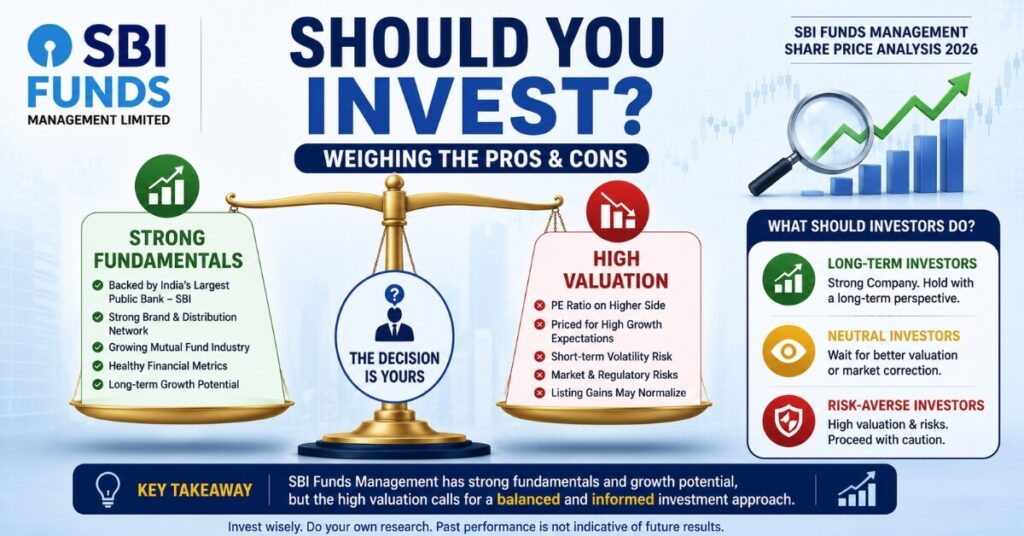
This is one of the most common questions investors are asking as they track SBI Funds Management Share Price following its recent listing. For long-term investors, the company’s strong brand, extensive distribution network, consistent revenue growth, and healthy return ratios present a fairly compelling case for consideration, provided the current valuation aligns with individual risk appetite and investment horizon. Since the stock currently trades at a relatively high price-to-earnings multiple, investors who are particularly valuation-sensitive may prefer to wait for a more attractive entry point rather than investing purely based on recent listing momentum.
For investors specifically interested in gaining exposure to India’s growing asset management and wealth management industry through a listed, liquid instrument, SBI Funds Management Share Price offers a relevant option worth evaluating as part of a diversified long-term portfolio strategy, alongside careful consideration of broader market conditions and personal financial goals.
Analyst and Expert Commentary
Market analysts covering the asset management space have generally offered a constructive view following the company’s listing, citing its scale, brand strength, and diversified fund offerings as core positives supporting the current valuation. Several brokerage notes published around the time of listing pointed to the company’s consistent track record of assets under management growth over multiple years as a key differentiator compared to smaller, less established peers in the industry. At the same time, some analysts have flagged the relatively rich valuation multiple as a factor that could limit near-term upside unless supported by continued strong quarterly performance in the coming reporting periods.
This mixed but broadly constructive analyst sentiment reflects the balanced nature of the investment case, where strong fundamentals are weighed against valuation considerations, a dynamic that is fairly typical for recently listed, high-quality businesses entering the public markets after years of strong private growth.
How to Track SBI Funds Management Share Price Effectively
For investors who wish to closely monitor day-to-day movements, setting up price alerts through a trading platform or broker app can be a practical way to stay updated without needing to check prices manually throughout the trading day. Additionally, following quarterly result announcements, investor presentations, and any regulatory filings related to fee structures or expense ratio changes can provide meaningful context beyond just the headline price movement, helping investors make more informed decisions based on underlying business performance rather than short-term price fluctuations alone.
Dividend Policy and Shareholder Returns
Investors evaluating this asset management stock often also look closely at the company’s dividend history and payout policy, since asset management businesses typically generate strong free cash flows due to their relatively low capital expenditure requirements compared to manufacturing or infrastructure companies. As a recently listed entity, SBI Funds Management does not yet have an extensive track record of dividend payouts as a publicly traded company, though its parent business has historically maintained healthy profitability, which is generally viewed as a positive indicator for future shareholder return potential once the company establishes a formal dividend policy post-listing.
For income-focused investors specifically seeking regular dividend payouts, it may be prudent to monitor upcoming board announcements and annual general meeting outcomes before forming firm return expectations tied to the current share price, since dividend policies for newly listed companies often take a few quarters to stabilise.
Shareholding Pattern and Promoter Holding
Understanding the shareholding structure behind this listed entity is another useful data point for investors conducting due diligence. The State Bank of India, as the principal promoter, continues to hold a significant stake in the company following the listing, which is generally viewed positively by the market since strong promoter holding often signals continued confidence and long-term commitment from the parent organisation. Institutional investors, including domestic and foreign portfolio investors, have also shown steady participation in the stock since its listing, contributing to the overall trading liquidity reflected in daily volumes.
A well-diversified shareholding base spread across promoters, institutional investors, and retail shareholders is typically considered a healthy sign for any newly listed stock, as it reduces the risk of excessive price volatility driven by concentrated ownership, which is a factor worth considering alongside broader fundamentals when evaluating this stock for a long-term portfolio allocation.
Key Risks to Consider
While the overall growth story supporting this stock appears fairly strong, investors should remain mindful of certain risks. A prolonged downturn in equity markets could reduce assets under management across the industry, directly impacting the fee-based revenue that asset management companies like SBI Funds Management rely on for growth. Additionally, regulatory changes around expense ratios and fee structures, which are periodically reviewed by market regulators, could also influence future profitability if implemented in a manner that compresses industry-wide margins.
Increasing competition from newer, technology-driven investment platforms and direct mutual fund distribution channels is another factor that could gradually influence market share dynamics within the industry over the coming years, which investors should factor into their long-term expectations for the stock’s performance.
If you are also tracking other major stock movements alongside asset management sector news, you may find it useful to read our detailed coverage on Bandhan Bank Share News Today, which covers the recent sharp stock movement and quarterly results of one of India’s leading private sector banks.
For official, verified financial disclosures, shareholding patterns, and regulatory filings related to SBI Funds Management, investors can always refer to the National Stock Exchange of India website, which publishes real-time data and corporate announcements directly from listed companies.
Frequently Asked Questions
Q1.What is the current SBI Funds Management Share Price?
SBI Funds Management Share Price has recently been trading in the range of approximately ₹594 to ₹625, depending on the exchange and time of trading, with a 52-week high of ₹624.95 and a 52-week low of ₹598.20.
Q2.Is SBI Funds Management Share Price expected to rise further?
While no stock price movement can be guaranteed, SBI Funds Management Share Price is supported by consistent revenue growth, strong return ratios, and a favourable long-term outlook for India’s asset management industry, though investors should also factor in valuation and competitive risks.
Q3.Why does SBI Funds Management Share Price vary across websites?
SBI Funds Management Share Price can appear slightly different across platforms due to timing differences in data updates and variations between NSE and BSE trading prices, which is common for recently listed stocks.
Q4.What was the IPO price band for SBI Funds Management?
The IPO price band for SBI Funds Management was fixed between ₹545 and ₹574 per share, and the current SBI Funds Management Share Price trades meaningfully above this listing range.
Q5.Is SBI Funds Management a good long-term investment?
SBI Funds Management Share Price reflects a company with strong brand recall, healthy return ratios, and consistent revenue growth, making it a relevant consideration for long-term investors, though the decision should always be based on individual financial goals and risk tolerance.
Conclusion
SBI Funds Management Share Price reflects the market’s overall positive assessment of one of India’s largest and most established asset management companies following its recent stock exchange listing. With healthy revenue growth of around 17.4% year-on-year, strong return ratios, and a trusted brand backed by the State Bank of India’s extensive network, the company presents a fundamentally sound business, even though its current valuation runs on the higher side compared to some traditional financial services peers.
Investors evaluating SBI Funds Management Share Price should weigh these strong fundamentals against valuation levels, competitive industry dynamics, and their own investment horizon before making a final decision. As with any recently listed stock, keep tracking SBI Funds Management Share Price closely over the coming quarters for further clarity on its long-term trading trend.
Disclaimer
This article is for informational and educational purposes only and should not be treated as investment or financial advice. Stock prices, financial figures, and valuation metrics mentioned here are based on publicly available information at the time of writing and are subject to change. Please consult a certified financial advisor and review official company disclosures before making any investment decisions. Stock market investments are subject to market risks.


Pingback: IndusInd Bank Share Price Today Falls 5% Now