
HDFC Bank Share Price Today extended its slide for a second consecutive session, with the stock now down nearly 5% in two days as investors reacted sharply to a disappointing Q1 earnings report. Market watchers are calling this the worst single-session fall for the stock since 2008, and the sell-off has wiped out roughly ₹1 lakh crore in market capitalisation.
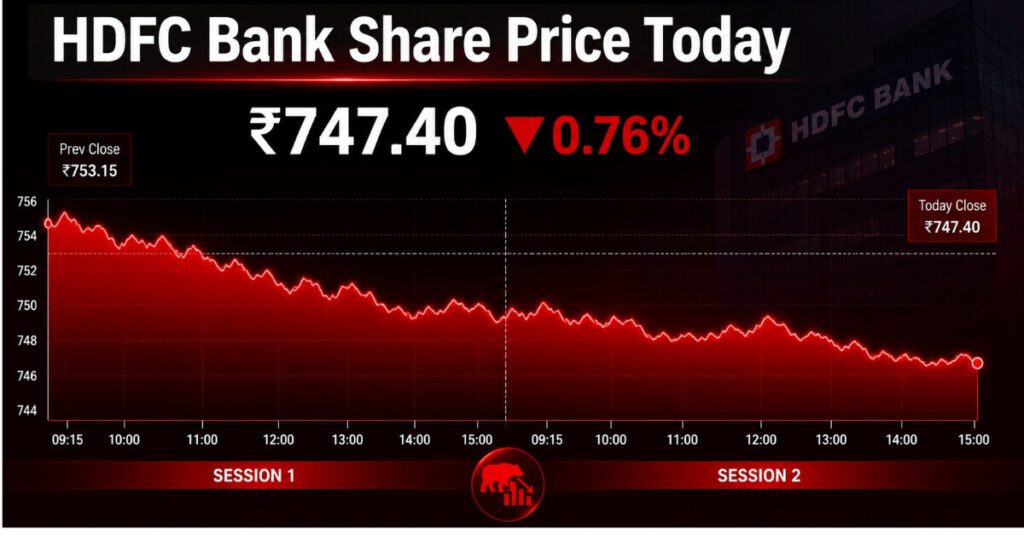
As of 10:29 AM IST on 23 July 2026, HDFC Bank Share Price Today stood at ₹747.40 on the NSE, down ₹5.75 or 0.76% from the previous close of ₹753.15. The stock opened at ₹749.40, touched an intraday high of ₹750.00, and slipped to a low of ₹744.80. Over the last two trading sessions combined, the stock has fallen close to 7%, making it one of the top losers on the Nifty today.
HDFC Bank Share Price Today: Key Numbers at a Glance
Before understanding why HDFC Bank Share Price Today is under pressure, here is a quick snapshot of the numbers investors are watching closely right now.
Current Price: ₹747.40 (down 0.76%)
Previous Close: ₹753.15
Day’s Open: ₹749.40
Day’s High: ₹750.00
Day’s Low: ₹744.80
Market Cap: ₹11.51 LCr
P/E Ratio: 14.60
Dividend Yield: 1.74%
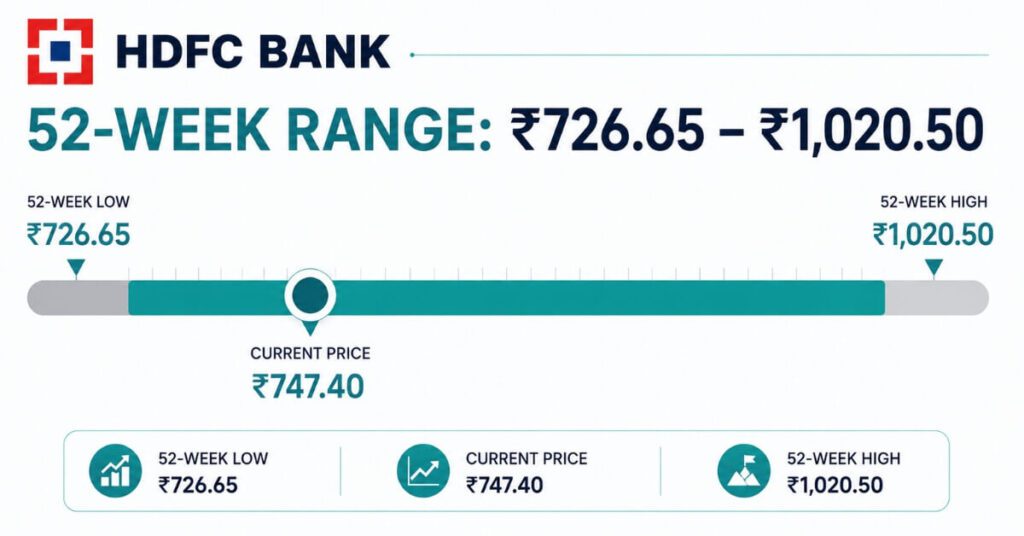
52-Week High: ₹1,020.50
52-Week Low: ₹726.65
These numbers explain why HDFC Bank Share Price Today has become one of the most searched finance queries this morning. With the stock trading barely ₹20 above its 52-week low, sentiment has clearly turned cautious after being close to its yearly high just months ago.
Why Is HDFC Bank Share Price Today Falling Sharply?
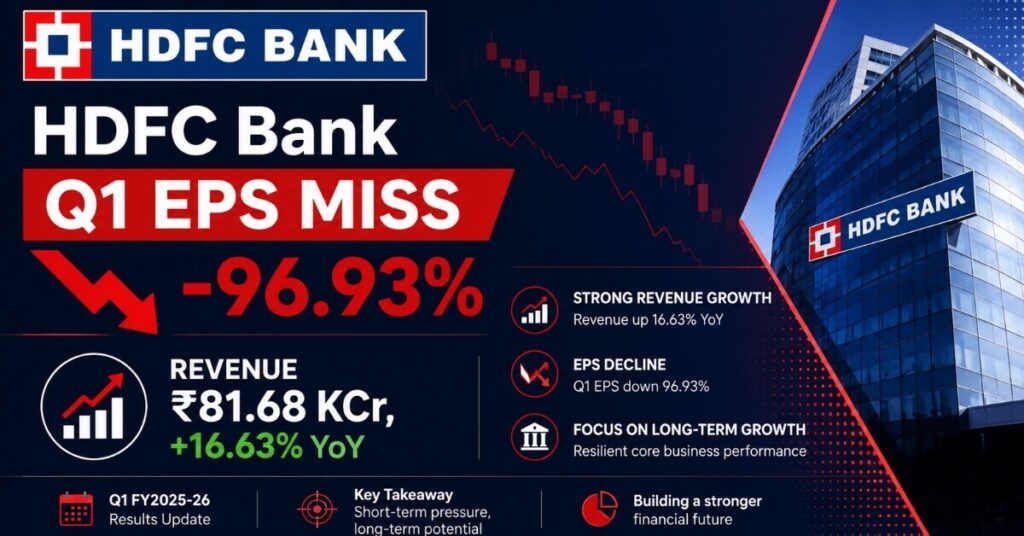
The biggest reason behind today’s fall in HDFC Bank Share Price Today is a significant earnings miss reported for Q1 2027. According to the latest quarterly data, the bank missed EPS estimates by a steep 96.93% and missed revenue estimates by 3.15%, even though quarterly revenue itself grew 16.63% year-on-year to ₹81.68 KCr. A miss of this scale on the bottom line has rattled investors who were expecting steadier earnings from India’s largest private sector lender.
Brokerages and analysts have pointed to a combination of factors weighing on HDFC Bank Share Price Today, including margin pressure from the ongoing merger integration with its erstwhile parent HDFC Ltd, higher provisioning, and slower-than-expected loan growth in certain segments. News reports describing the stock as “hammered worst since 2008” reflect just how unusual this scale of single-day and two-day decline is for a large, historically stable banking stock.
Unlike a typical one-day dip driven by profit booking, HDFC Bank Share Price Today has now fallen for two straight sessions, suggesting sustained selling pressure from both retail and institutional investors rather than a short-lived reaction.
HDFC Bank Share Price Today vs Peer Banks
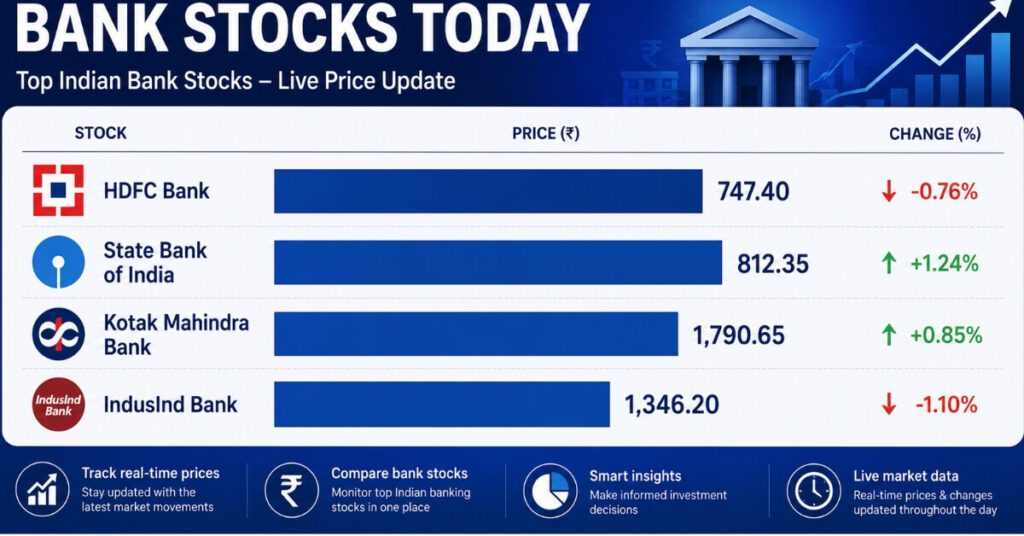
To understand whether the fall in HDFC Bank Share Price Today is isolated or part of a broader banking sector trend, it helps to compare it against other major banks trading on the same day.
State Bank of India: ₹1,021.90, down 0.30%
Kotak Mahindra Bank: ₹384.45, up 0.87%
IndusInd Bank: ₹1,014.80, down 5.10%
While State Bank of India is also trading marginally lower, Kotak Mahindra Bank is actually up on the day, showing that the sell-off is not uniform across the entire banking sector. This reinforces that HDFC Bank Share Price Today is reacting primarily to its own Q1 earnings miss rather than any broad market-wide correction. Broader indices such as BSE Sensex (76,641.41, down 0.15%) and NIFTY 50 (23,970.90, down 0.11%) were only mildly lower, further confirming that today’s steep move in HDFC Bank Share Price Today is largely stock-specific.
Technical Analysis: What the Charts Are Showing
The intraday chart shows HDFC Bank opening close to its previous close and drifting lower through the session, without the sharp single gap-down seen in some other stocks reacting to bad news. This slower, grinding decline over two sessions suggests that selling has been steady rather than panic-driven, which some technical analysts view as a sign of methodical institutional exit rather than retail panic selling.
HDFC Bank Share Price Today is now trading well below the midpoint of its 52-week range of ₹726.65 to ₹1,020.50, having spent much of the past year closer to its highs. The ₹745 zone is emerging as a short-term support level, given today’s intraday low of ₹744.80, while ₹753 (the previous close) could act as immediate resistance if the stock attempts any near-term recovery. A decisive break below ₹744 could open the door to a retest of levels closer to the 52-week low, so traders are watching this zone closely over the next few sessions.
Volume has reportedly been elevated over the past two trading days, which typically signals genuine conviction behind the move rather than a temporary, low-volume blip. Sustained high volume on further down days would indicate continued institutional selling, while a tapering of volume could suggest the current leg of the decline is nearing exhaustion.
Quarterly Financial Performance
HDFC Bank’s Q1 2027 quarterly revenue came in at ₹81.68 KCr, up 16.63% year-on-year, which on its own looks like healthy topline growth. However, the EPS miss of 96.93% and revenue miss of 3.15% against analyst estimates tell a very different story about the quality and predictability of earnings this quarter. Such a large EPS miss, especially for a bank of HDFC’s size and market weight, tends to trigger outsized reactions in the stock because it raises questions about forecasting reliability and near-term profitability trends.
Investors should be careful not to read the headline revenue growth number in isolation. A bank can report growing revenue while still disappointing on profitability if provisioning costs rise, treasury losses widen, or integration-related expenses from the HDFC Ltd merger continue to weigh on margins.
What Brokerages and Analysts Are Saying
Following the Q1 results, brokerage commentary on the stock has been mixed but leans cautious in the near term. Some analysts continue to view the bank as a long-term core holding given its scale, deposit franchise, and market leadership position, while others have flagged the earnings miss as a reason to trim near-term target prices or downgrade ratings until there is more clarity on merger-related cost normalisation.
A few brokerages have also pointed out that HDFC Bank’s fall comes at a time when the stock had already underperformed broader banking indices over the past year, meaning today’s decline adds to an existing pattern of relative underperformance rather than representing a completely new development.
Key Risks to Watch
Investors evaluating the stock going forward should keep an eye on a few key risk factors. First, continued integration costs and balance sheet adjustments related to the 2023 HDFC Ltd merger could keep pressuring margins for a few more quarters. Second, competitive pressure in retail lending from both private and public sector banks may limit the pace of loan growth recovery. Third, any further downward revision in earnings guidance from management could extend the current period of underperformance.
On the positive side, the bank continues to hold a dominant position in India’s private banking sector, with a strong deposit base, healthy capital adequacy, and a dividend yield of 1.74% that offers some cushion for long-term shareholders even during periods of price weakness.
About HDFC Bank Ltd
HDFC Bank Limited is an Indian banking and financial services company headquartered in Mumbai. Founded in August 1994 by Deepak Parekh, the bank is India’s largest private sector bank by assets and market capitalisation, and in 2025 it became the 10th largest bank in the world by market capitalisation. Sashidhar Jagdishan has served as CEO since 27 October 2020. The bank employs over 2,12,958 people as of 2026 and operates key subsidiaries including HDFC Securities and HDFC Life Insurance. This scale and market leadership are important context for understanding why any earnings surprise tends to move the broader market, not just the stock itself.
HDFC Bank’s Business Segments Explained
To understand today’s stock reaction fully, it helps to look at how HDFC Bank actually generates its revenue. The bank operates primarily across three segments: retail banking, wholesale banking, and treasury operations. Retail banking includes home loans, personal loans, credit cards, and deposit products, and remains the bank’s largest revenue contributor following its merger with erstwhile parent HDFC Ltd, which significantly expanded its mortgage lending book.
The wholesale banking segment serves large corporates and institutions with working capital finance, trade services, and corporate deposits, and tends to be more stable but also more sensitive to broader economic cycles. The treasury segment manages investments and market-making activities, contributing to fee income but also introducing quarter-to-quarter earnings volatility depending on interest rate and bond market movements.
Given the scale of the HDFC Ltd merger completed in 2023, integration-related costs and balance sheet realignment across these segments remain a key factor investors are watching when evaluating quarterly results and near-term profitability trends.
Long-Term Outlook for the Stock
Looking past the current volatility, the long-term outlook for the bank depends largely on how quickly merger-related integration costs normalise, whether loan growth reaccelerates across retail and wholesale segments, and how management addresses the earnings miss in upcoming investor communications. Bulls on the stock point to its dominant franchise, strong deposit base, and historically consistent execution as reasons the current weakness could prove temporary.
Bears, on the other hand, argue that a large private bank missing EPS estimates by nearly 97% is not a minor slip and may reflect deeper structural challenges from the merger integration that could take several more quarters to fully resolve. As with most large-cap banking stocks going through a rough patch, the truth is likely to emerge gradually over the next two to three quarters as fresh earnings data becomes available.
Long-term investors with a multi-year horizon may see the current price, closer to the 52-week low, as a reasonable accumulation zone, provided they are comfortable holding through continued near-term volatility. Shorter-term traders may prefer to wait for signs of stabilisation, such as two or three consecutive sessions of flat-to-positive price action, before considering fresh positions.
Historical Price Trend: Where the Stock Stands Now
Zooming out from today’s session, the stock’s trajectory over the past year tells an interesting story. It touched its 52-week high of ₹1,020.50 several months ago, driven by optimism around merger synergies and steady loan book growth following the integration with HDFC Ltd. Since then, however, the stock has gradually drifted lower, weighed down by periodic concerns about net interest margin compression and the pace of cost synergies materialising from what remains one of the largest financial sector mergers in Indian corporate history.
The current price of ₹747.40 places the stock roughly 27% below its 52-week high and only marginally above its 52-week low of ₹726.65. This positioning near the lower end of the yearly range is significant because it suggests the market has already priced in a fair amount of pessimism, even before today’s earnings-driven decline. Whether this represents a bottoming-out process or the start of a deeper correction will likely become clearer over the next few quarters as merger integration costs continue to normalise and loan growth trends become more visible in reported numbers.
It is also worth noting that large-cap banking stocks of this size rarely move 5% or more in a single session without a significant catalyst, which underscores just how impactful today’s earnings miss has been in shaping investor sentiment across the sector.
How Retail Investors Are Reacting
Social media chatter and retail trading forums have seen a spike in discussion volume around the stock following today’s price action, with opinions sharply divided. Some retail investors view the sell-off as an overreaction to a single quarter’s earnings miss, pointing out that the bank’s underlying deposit growth and branch network expansion remain intact. Others are more cautious, arguing that repeated earnings disappointments since the merger suggest the integration process is taking longer than initially communicated to shareholders, and that further downside cannot be ruled out until clearer guidance is provided.
This divided sentiment is fairly typical during periods of heightened volatility in large, widely-held stocks, and it usually settles down once the company provides additional clarity through investor calls, analyst meetings, or subsequent quarterly results.
Should You Buy HDFC Bank Shares Today?
Many readers searching for HDFC Bank Share Price Today are essentially asking whether this fall represents a buying opportunity or a red flag. Given the scale of the earnings miss, some caution is warranted in the near term, and it would be reasonable to wait for further management commentary and brokerage updates before making a large allocation. At the same time, long-term investors who believe in the bank’s scale, franchise strength, and eventual normalisation of merger-related costs may consider this dip as a potential opportunity to accumulate gradually rather than all at once.
As always, before acting on any movement in HDFC Bank Share Price Today, it is wise to do your own research, read the full earnings transcript, and consult a certified financial advisor rather than relying solely on price action or headlines. Watching how the stock behaves over the next two to three sessions will offer a clearer signal than reacting to a single volatile day in isolation.
For readers also tracking other banking stocks, you may find our recent article on IndusInd Bank Share Price Today useful for comparing how different private banks are reacting to their respective Q1 results this week. You can also check live, verified data directly on the NSE India official website for real-time updates on HDFC Bank Share Price Today.
Frequently Asked Questions (FAQs)
Q1. What is HDFC Bank Share Price Today?
HDFC Bank Share Price Today is ₹747.40 as of 10:29 AM IST on 23 July 2026, down 0.76% from the previous close of ₹753.15.
Q2. Why is HDFC Bank Share Price Today falling?
HDFC Bank Share Price Today is falling mainly due to a steep Q1 2027 earnings miss, with EPS missing estimates by 96.93% and revenue missing by 3.15%, alongside concerns about merger-related integration costs.
Q3. What is the 52-week high and low for HDFC Bank shares?
The 52-week high is ₹1,020.50 and the 52-week low is ₹726.65, which gives useful context to today’s move in HDFC Bank Share Price Today.
Q4. Is HDFC Bank a good stock to buy now?
This depends on individual risk appetite. Long-term investors may see the current dip as a potential accumulation opportunity, while short-term traders may prefer to wait for signs of stabilisation before acting on HDFC Bank Share Price Today movements.
Q5. Who is the CEO of HDFC Bank?
Sashidhar Jagdishan has been serving as CEO of HDFC Bank since 27 October 2020.
Conclusion
HDFC Bank Share Price Today has come under heavy selling pressure, falling for a second straight session and wiping out close to ₹1 lakh crore in market capitalisation after a sharp Q1 earnings miss. While the bank’s revenue growth of 16.63% year-on-year shows the underlying business is still expanding, the scale of the EPS miss has clearly rattled investor confidence in the near term. Anyone tracking HDFC Bank Share Price Today should watch upcoming brokerage revisions, management commentary on merger integration costs, and broader banking sector trends before making fresh investment decisions. As always, relying on verified, real-time data remains the safest way to navigate volatile sessions like today’s move in HDFC Bank Share Price Today.
Data and figures referenced in this article, including price, volume, market capitalisation, and quarterly financials, were accurate as of the time of publishing on 23 July 2026 and may change with subsequent trading sessions.
Disclaimer
This article is for informational purposes only and does not constitute investment advice. Stock prices, financial data, and figures mentioned regarding HDFC Bank Share Price Today are based on publicly available information as of the time of writing and are subject to change. Please consult a certified financial advisor and conduct your own research before making any investment decisions.

Pingback: NTPC Green Share Price Today Jumps 9% in 5 Days