
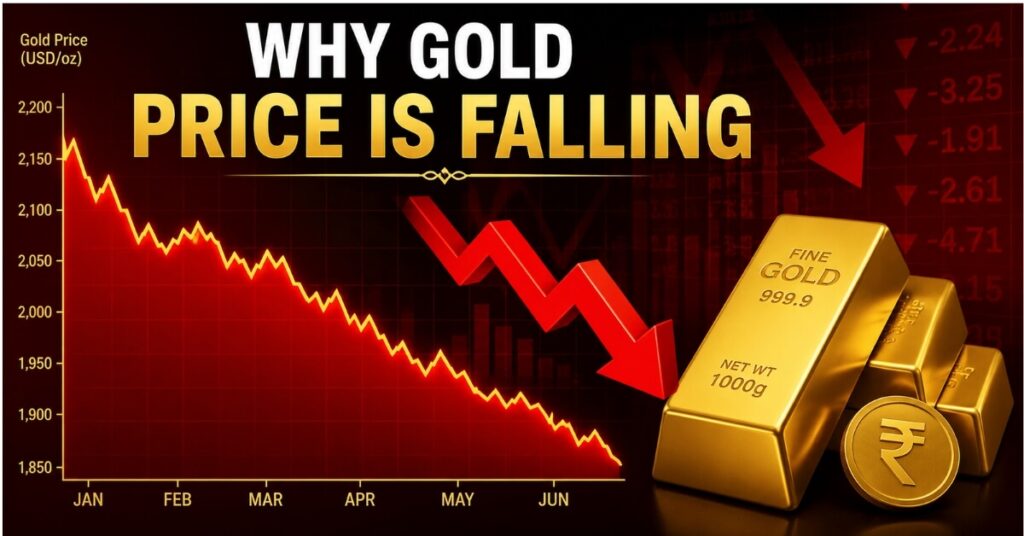
Gold has always been seen as a safe investment in India, but recent months have left many investors asking the same question: why gold price is falling so sharply after reaching record highs earlier this year. If you have been tracking gold rates and noticed a steady decline, you are not alone. Millions of Indian households, jewellers, and investors are trying to understand why gold price is falling and whether this trend will continue in the coming months.
This article covers all the major reasons why gold price is falling, how the correction has played out across Indian cities, and what practical steps investors can consider during this period of volatility.
In this article, we will break down why gold price is falling in simple terms, look at the key global and domestic factors behind the correction, and help you decide what steps you should take as an investor. Whether you hold physical gold, gold ETFs, or Sovereign Gold Bonds, understanding why gold price is falling can help you make informed financial decisions rather than reacting out of panic.
Understanding the Current Gold Price Trend
Gold prices had touched record highs in early 2026, with international rates crossing 5,400 US dollars per troy ounce at their peak. Since then, prices have corrected by more than 25 to 30 percent, and MCX gold futures in India have also dropped significantly from their all-time high levels. This sudden reversal is exactly why gold price is falling has become one of the most searched financial questions among Indian investors this year.
For decades, gold has been considered a hedge against inflation, currency depreciation, and global uncertainty. So when the price starts dropping instead of rising, it naturally creates confusion. To understand why gold price is falling, we need to look beyond the headlines and examine the underlying economic forces that drive gold prices up or down.
It also helps to remember that gold rarely moves in a straight line. Over the past two decades, gold has gone through multiple phases of sharp rallies followed by extended periods of consolidation or decline. The current correction, while sudden and steep, fits into this broader historical pattern of boom and correction cycles that commodity markets typically experience.
Key Reasons Why Gold Price Is Falling
1. Rising US Interest Rates and Bond Yields
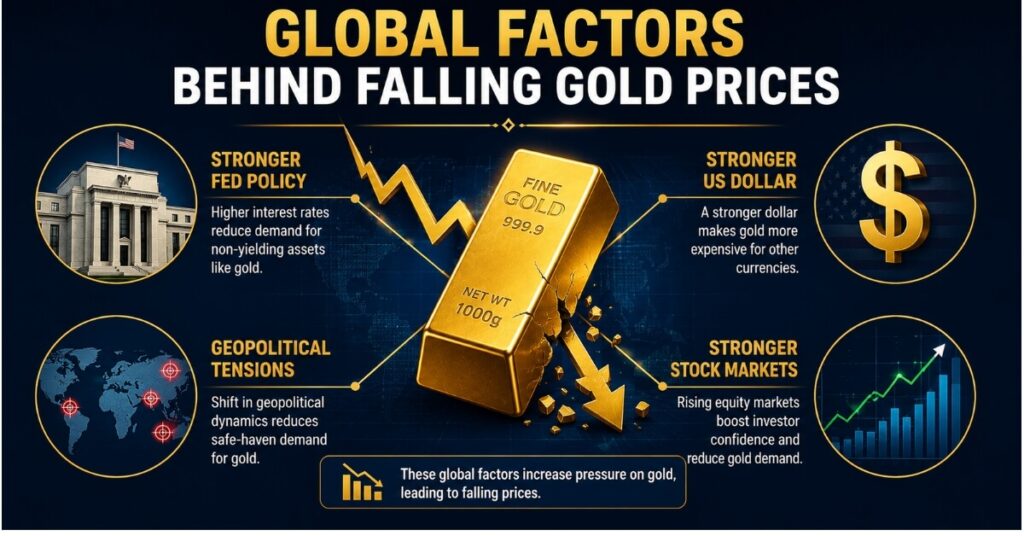
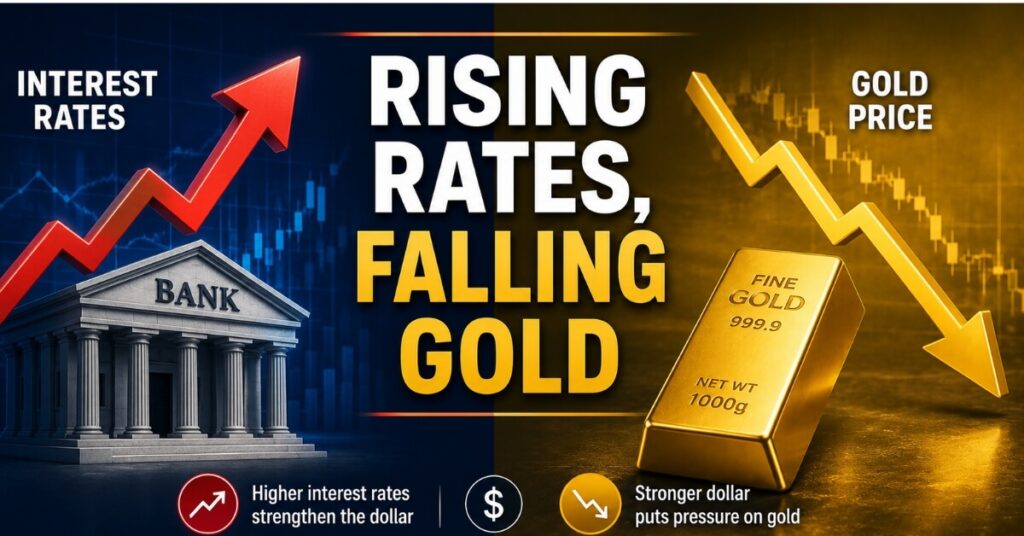
One of the biggest reasons why gold price is falling is the expectation of higher interest rates from the US Federal Reserve. Gold is a non-yielding asset, meaning it does not pay any interest or dividend. When interest rates rise, government bonds and fixed deposits become more attractive because they offer guaranteed returns. Investors then shift their money away from gold toward interest-bearing instruments, which reduces demand and pushes gold prices lower.
Higher bond yields increase the opportunity cost of holding gold. This relationship between interest rates and gold prices is one of the most consistent patterns in commodity markets, and it explains a large part of why gold price is falling in the current cycle.
2. A Stronger US Dollar
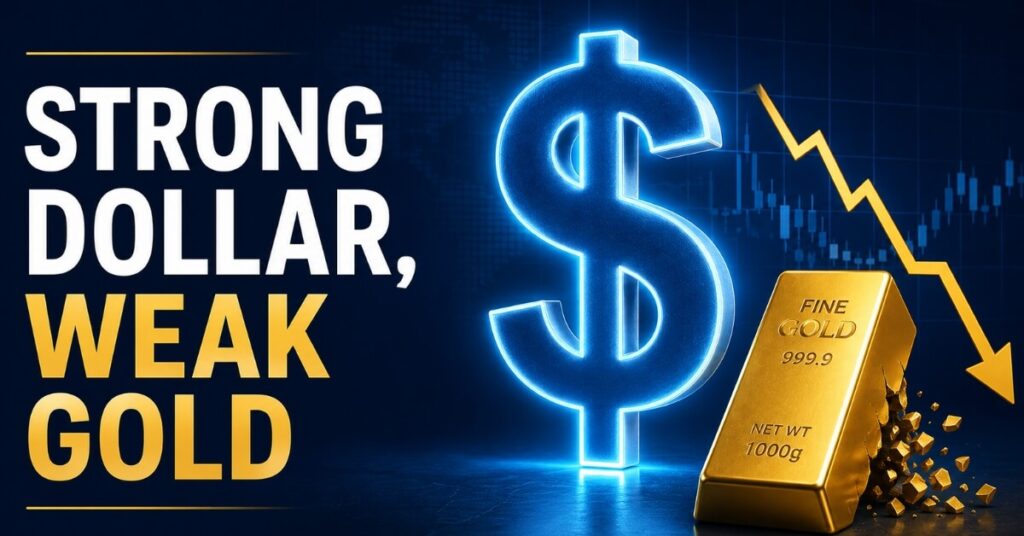
Gold is priced globally in US dollars, so the strength of the dollar has a direct impact on gold rates. When the dollar strengthens against other currencies, gold becomes more expensive for buyers using other currencies, which reduces global demand. A stronger dollar is another major factor behind why gold price is falling this year, as the US currency has gained strength due to hawkish Federal Reserve policy and relatively strong American economic data.
3. Easing Geopolitical Tensions
Gold is traditionally viewed as a safe-haven asset during times of war, conflict, and political instability. Earlier in 2026, heightened geopolitical tensions pushed many investors toward gold as a protective asset. However, as some of these tensions have eased, the urgency to hold gold for safety has reduced. This cooling down of safe-haven demand is a significant reason why gold price is falling from its earlier peak levels.
4. Profit Booking After Record Highs
After gold touched all-time high prices, many large investors, funds, and traders began booking profits. When a large number of market participants sell at the same time to lock in gains, it creates downward pressure on prices. This wave of profit booking is another practical explanation for why gold price is falling after such a strong rally over the past year.
5. Stock Market Volatility and Liquidity Needs
Interestingly, a selloff in equity and technology stocks has also contributed to why gold price is falling. When stock markets become volatile, some investors are forced to sell their gold holdings to raise cash and meet margin requirements on other investments. This cross-asset liquidity pressure adds to the selling activity in the gold market.
6. Revised Forecasts from Global Financial Institutions
Several major banks and research firms have revised their gold price forecasts downward for the rest of 2026. When influential institutions lower their price targets, it can influence market sentiment and trading behaviour, adding further momentum to the decline. This shift in institutional outlook is one more layer explaining why gold price is falling in recent weeks.
How Much Have Gold Prices Fallen in India?
In India, gold rates are influenced by international prices, the rupee-dollar exchange rate, import duties, and local demand. MCX gold futures, which had crossed 1.45 lakh rupees per 10 grams earlier this year, have since corrected meaningfully. Retail gold rates for 22 karat and 24 karat gold have also softened across major cities including Delhi, Mumbai, Chennai, and Vijayawada. This visible drop at the local jewellery shop level is a real-world confirmation of why gold price is falling on a global scale.
It is worth noting that gold price movements in India do not happen in isolation. They closely track international trends while being adjusted for the rupee’s exchange rate against the dollar. If the rupee weakens even as international gold prices fall, the drop in Indian gold rates may be smaller than the global correction.
Import duties and local taxation also play a role in shaping domestic gold prices. Even a small change in customs duty or GST on gold jewellery can influence the final price paid by consumers, sometimes offsetting or amplifying the impact of the international price movement. This is why the extent of the correction can vary slightly between cities depending on local demand, festival buying patterns, and jeweller margins.
Is This a Temporary Correction or a Long-Term Trend?
This is perhaps the most important question for investors. Market analysts remain divided on this point. Some believe the current decline is a healthy correction after an unsustainable rally, and that gold could stabilise or even recover once interest rate expectations settle. Others argue that if US interest rates remain elevated for a longer period and the dollar continues to strengthen, gold prices could stay under pressure for several more months.
Several global banks have offered a wide range of forecasts, from conservative year-end targets to more optimistic projections, showing just how uncertain the outlook currently is. This divergence in expert opinion is itself a reflection of why gold price is falling in an unpredictable and complex manner rather than following a simple, single-cause pattern.
What Should Indian Investors Do Now?
If you are wondering how to respond to falling gold prices, here are some general points to consider. This is not personalised financial advice, and you should evaluate your own goals and risk appetite, ideally with the help of a certified financial advisor.
Avoid panic selling. Gold is typically meant to be a long-term portfolio diversifier rather than a short-term trading instrument. Short-term price corrections do not necessarily change gold’s long-term role in a balanced portfolio.
Consider staggered buying. Rather than trying to time the market perfectly, some investors prefer to buy gold in smaller amounts over time. This approach can help average out purchase costs during volatile periods.
Review your asset allocation. If gold formed a very small or very large portion of your overall investment portfolio, a price correction is a good time to review whether your allocation still matches your financial goals.
Keep an eye on interest rate decisions. Since interest rate expectations are closely linked to why gold price is falling, tracking central bank policy announcements can give you useful signals about where gold prices might head next.
Do not ignore your credit profile while managing investments. Just as your investment portfolio needs regular review, your credit health matters too, especially if you rely on loans for major expenses. For instance, understanding your CIBIL score for personal loan approval can help you plan better if you ever need to borrow against or alongside your investment strategy.
Diversify across gold formats. Investors who want exposure to gold do not always need to buy physical jewellery or coins. Sovereign Gold Bonds, gold ETFs, and digital gold each come with different cost structures, liquidity levels, and taxation rules. Comparing these options can help you choose the format that best matches your investment horizon and convenience needs during a period when gold price is falling and buying decisions feel more sensitive.
Avoid making decisions purely based on short-term price charts. It is easy to get influenced by daily price movements shown on financial news channels and apps, but long-term investment decisions should ideally be based on your overall financial plan rather than short-term sentiment.
The Role of Gold in a Diversified Portfolio
Despite the recent correction, gold continues to play an important role in most well-diversified portfolios. It has historically shown low correlation with equity markets, meaning it can help cushion a portfolio during stock market downturns. This is one of the core reasons financial planners continue to recommend a modest allocation to gold, typically in the range of five to fifteen percent of a portfolio, depending on individual risk tolerance.
Understanding why gold price is falling in the short term does not take away from gold’s long-term value as a store of wealth and a hedge against currency depreciation. Markets move in cycles, and gold has historically recovered from previous corrections over multi-year periods.
Global Factors to Watch Going Forward
Investors trying to understand why gold price is falling should keep an eye on a few key global indicators in the coming months. These include upcoming Federal Reserve meetings and interest rate decisions, US inflation data releases, movements in the US Dollar Index, central bank gold buying patterns, particularly from countries like China and India, and any escalation or resolution of ongoing geopolitical situations.
Each of these factors can shift market sentiment quickly, and gold prices often react within hours of major economic announcements. Staying informed through reliable financial news sources can help investors avoid making emotional decisions based on short-term price swings.

Historical Context: How Gold Has Behaved After Past Corrections
Looking at previous gold market cycles can offer useful perspective on the current situation. In earlier decades, gold has experienced multiple corrections of fifteen to thirty percent after strong multi-year rallies, only to stabilise and eventually resume its upward trend over subsequent years. While past performance is never a guarantee of future results, this historical pattern is one reason many long-term investors are not overly alarmed by the current decline.
At the same time, every correction has its own unique combination of triggers, and the current cycle is being shaped by a distinct mix of monetary policy tightening, currency strength, and shifting geopolitical dynamics. This is why gold price is falling in a manner that some analysts describe as a necessary reset after an unusually rapid and steep rally earlier in the year, rather than a sign of gold losing its long-term relevance as an asset class.
Frequently Asked Questions
Q1.Why gold price is falling despite global uncertainty?
Even though gold is traditionally a safe-haven asset, rising interest rates and a stronger US dollar can outweigh the safe-haven demand created by global uncertainty. This is one of the main reasons why gold price is falling even when some geopolitical risks remain present.
Q2.Will gold prices recover soon?
It is difficult to predict exact timing, but many analysts expect gold to stabilise once interest rate expectations become clearer. Long-term forecasts from various institutions remain mixed, ranging from cautious to optimistic.
Q3.Is it a good time to buy gold after the price fall?
This depends on your individual financial goals, investment horizon, and risk appetite. Some investors view price corrections as buying opportunities, while others prefer to wait for further clarity. It is advisable to consult a financial advisor before making investment decisions.
Q4.How does the US dollar affect gold prices in India?
Since gold is priced internationally in US dollars, a stronger dollar generally makes gold more expensive for buyers in other currencies, reducing global demand and pressuring prices lower, which also affects Indian gold rates after adjusting for the rupee exchange rate.
Q5.Does the interest rate really impact gold prices that much?
Yes. Interest rates have a strong inverse relationship with gold prices because gold does not generate any yield. When rates rise, interest-bearing assets become more attractive, reducing demand for gold and contributing to why gold price is falling during periods of monetary tightening.
Should I stop my gold SIP or systematic investment during this correction?
Stopping a systematic investment plan purely because of a short-term price decline can actually work against the core principle of rupee-cost averaging, since lower prices allow you to accumulate more grams for the same investment amount. Many investors choose to continue their existing gold investment plans through corrections rather than pausing them, though this decision should always be based on individual financial goals and risk tolerance.
Conclusion
To summarise, why gold price is falling can be explained through a combination of rising US interest rates, a stronger dollar, easing geopolitical tensions, profit booking after record highs, stock market volatility, and revised forecasts from major financial institutions. While the short-term correction may feel unsettling, gold has historically remained a reliable long-term store of value across multiple market cycles.
For Indian investors, the key takeaway is to avoid emotional decision-making, review your overall portfolio allocation, and stay updated on the global economic indicators that explain why gold price is falling and where it may head next. Whether you choose to buy, hold, or wait, make sure your decisions are backed by research and, where needed, professional financial guidance.
Markets can remain volatile for extended periods, and patience combined with a clear financial plan usually serves investors better than reacting to every headline. For more detailed market analysis, you can also refer to trusted sources such as the World Gold Council, which regularly publishes global gold market research and outlook reports.
Disclaimer
This article is for informational and educational purposes only and should not be considered financial or investment advice. Gold prices are subject to market risks and can be volatile, and past trends do not guarantee future performance. Please consult a certified financial advisor before making any investment decisions based on the information provided in this article.


Pingback: EPF Passbook Portal Restored: 5 Easy Steps to Check