
Introduction
Every year, lakhs of Indian taxpayers miss the income tax return filing deadline, and every year, the same panic follows. If you are one of them, understanding the ITR Late Filing Penalty 2026 is the first step to knowing exactly where you stand. Missing the July 31 deadline does not mean the end of the world, but it does mean extra money out of your pocket, added interest, and a few rights you lose along the way. This guide breaks down the ITR Late Filing Penalty 2026 in plain language, covers the exact fee structure under Section 234F, explains the interest charges you may face, and shows you how to file a belated return without further trouble.
Whether you are a salaried employee who forgot the date, a freelancer juggling multiple deadlines, or a small business owner who simply ran out of time, this article covers everything about the ITR Late Filing Penalty 2026 that you need to know right now.
What Is the ITR Late Filing Penalty 2026 Under Section 234F
The ITR Late Filing Penalty 2026 is governed by Section 234F of the Income Tax Act. This section was introduced to encourage timely compliance, and it applies automatically the moment you file your return after the original due date. For Assessment Year 2026-27, the rules work like this:
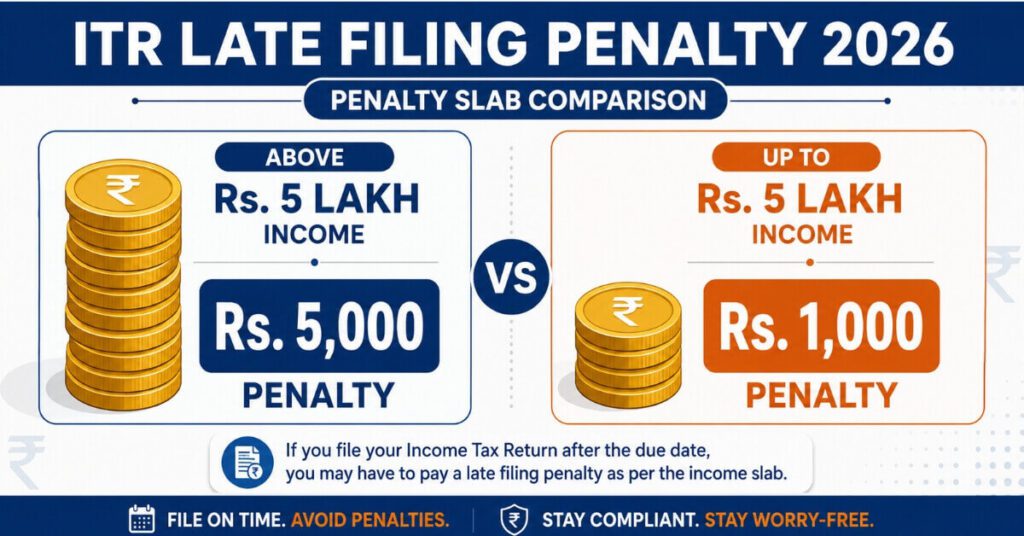
If your total income exceeds Rs. 5 lakh in a financial year and you file after the due date, the late fee is Rs. 5,000. If your total income is up to Rs. 5 lakh, the late fee is reduced to Rs. 1,000. If your total income falls below the basic exemption limit, no late fee applies at all, although you may still want to file to claim a refund or maintain a clean financial record.
It is important to understand that the ITR Late Filing Penalty 2026 is separate from any interest you may owe on unpaid tax. The penalty is a flat fee for filing late, while interest is calculated on the tax amount itself. Many taxpayers confuse the two and end up underestimating their total liability.

How Much Is the ITR Late Filing Penalty 2026 Exactly
Let’s break the numbers down clearly so there is no confusion about how much you might owe.
Income above Rs. 5 lakh: Late fee of Rs. 5,000 under Section 234F.
Income up to Rs. 5 lakh: Late fee reduced to Rs. 1,000.
Income below the basic exemption limit: No late fee, though filing may still be beneficial.
This flat structure means the ITR Late Filing Penalty 2026 does not increase the longer you delay within the belated return window. However, delaying further brings additional consequences that cost far more than the fixed fee itself, which we will cover shortly.
Interest Charges You Cannot Ignore
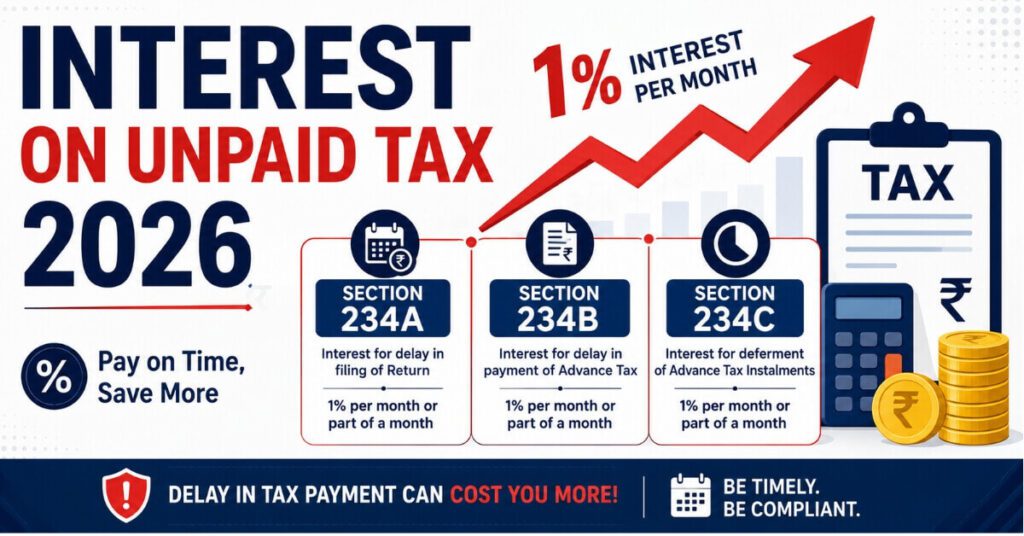
Beyond the ITR Late Filing Penalty 2026, the Income Tax Department also charges interest if you have unpaid tax dues. Under Section 234A, interest is charged at 1% per month or part of a month on the outstanding tax amount, calculated from the original due date until the date you actually file. This interest keeps accumulating, so the longer you wait, the more expensive it becomes.
If you also missed paying advance tax on time, Sections 234B and 234C may add further interest for shortfalls or defaults in advance tax payments. This means someone with a large pending tax liability could end up paying significantly more than just the flat late fee, once all the interest components are added together.
What Happens If You Miss the Belated Return Deadline Too
Filing late does not mean you have unlimited time. After the original due date passes, you can still file what is called a belated return, but this option also has a cutoff. For AY 2026-27, the belated return deadline is 31 December 2026. Missing this second deadline creates a much bigger problem than the standard ITR Late Filing Penalty 2026, because after this date, filing becomes far more complicated and may require special permission from the tax department in genuine hardship cases.
This is why understanding the full timeline matters just as much as understanding the penalty itself. Waiting until the very last moment of the belated window is risky, since technical glitches, document delays, or simple procrastination could push you past the point of no return.
Other Consequences Beyond the Late Fee
The ITR Late Filing Penalty 2026 is often just the beginning of the story. Filing late brings several other consequences that many taxpayers overlook:
Loss of carry-forward rights: If you have business losses or capital losses, filing after the due date means you lose the right to carry these forward to future years to offset against future profits. This can be a significant financial setback for traders and business owners.
Delayed refund processing: If you are owed a refund, it will only be processed after your belated return is filed and verified, which pushes back the timeline for receiving your money.
Increased scrutiny: Consistently filing late over multiple years can draw closer attention from the Income Tax Department, especially if there are discrepancies in reported income.
No option to file the original ITR form: Once the due date passes, some specific benefits tied to on-time filing under certain schemes may no longer be available.
How to Avoid the ITR Late Filing Penalty 2026 Next Year
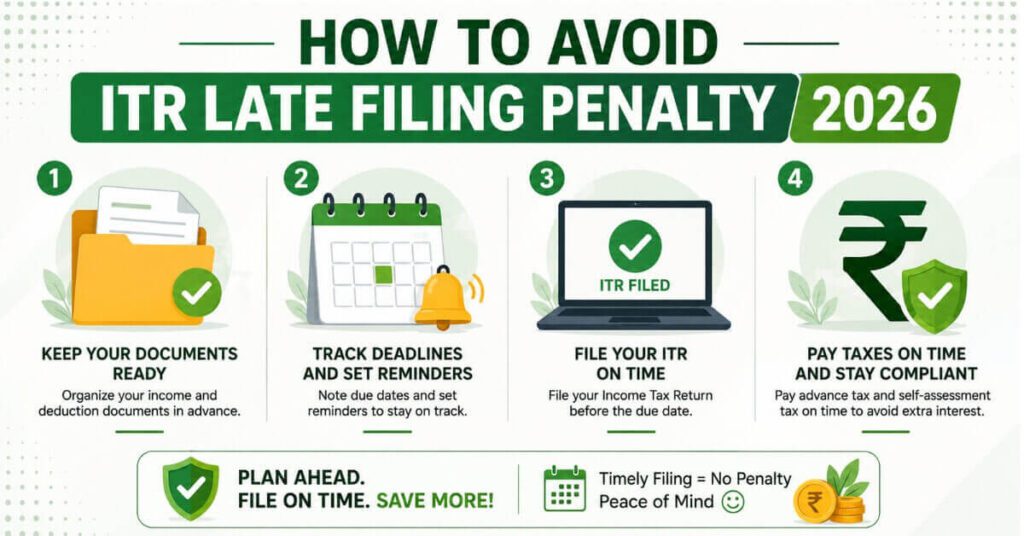
The best way to deal with the ITR Late Filing Penalty 2026 is to avoid it altogether. Here are practical steps that genuinely help:
Mark the due date early: Set a reminder at least a month before July 31 so you have buffer time for document collection and portal issues.
Keep documents ready in advance: Form 16, interest certificates, capital gains statements, and investment proofs should be organized well before the deadline, not scrambled together at the last minute.
File in the first week of the season: The income tax portal often faces heavy traffic and technical glitches closer to the deadline. Filing early avoids this stress entirely.
Use professional help if your finances are complex: If you have multiple income sources, foreign income, or capital gains, a tax professional can help you file accurately and on time, avoiding both the ITR Late Filing Penalty 2026 and costly errors.
Track government announcements: Deadlines can sometimes be extended due to portal issues or other reasons, similar to how the government recently announced the PMFBY Last Date Extended 2026 for crop insurance enrollment. Staying updated on official announcements ensures you never file later than necessary just because of confusion around dates.
Step-by-Step Guide to File Your Belated Return
If you have already missed the deadline and are staring at the ITR Late Filing Penalty 2026, here is how to file a belated return correctly:
Log in to the official Income Tax e-Filing Portal using your PAN and password.
Select the belated return option under the relevant assessment year.
Choose the correct ITR form based on your income sources.
Fill in all income details accurately, including any income you may have missed reporting initially.
Calculate your total tax liability, including the applicable ITR Late Filing Penalty 2026 and any interest under Sections 234A, 234B, or 234C.
Pay any outstanding tax along with the penalty and interest through the portal.
Submit the return and complete e-verification within the required time frame, since an unverified return is treated as not filed at all.
Documents You Need Before You File
Having the right documents ready in advance is one of the simplest ways to avoid the ITR Late Filing Penalty 2026 altogether. Before you sit down to file, make sure you have your Form 16 from your employer, bank interest certificates from all savings and fixed deposit accounts, capital gains statements from your broker if you invest in stocks or mutual funds, proof of tax-saving investments under Section 80C and other deductions, your Aadhaar and PAN details, and details of any other income such as rent received or freelance earnings.
Missing even one of these documents can force you to pause halfway through filing, which often turns into a delay of days or weeks, and before you know it, the due date has passed and the penalty applies.
It also helps to check your Annual Information Statement and Form 26AS on the income tax portal well before the deadline. These documents show the income and tax deducted at source that the department already has on record for you, and comparing them against your own records helps catch mismatches early. Discovering a mismatch on the last day, when you are also racing against the ITR Late Filing Penalty 2026, is far more stressful than catching it a few weeks in advance with time to sort it out calmly.
Real-Life Scenario: How the Numbers Add Up
Consider a salaried employee with a total annual income of Rs. 8 lakh who files their return two months after the due date. Since their income exceeds Rs. 5 lakh, the flat late fee is Rs. 5,000. If they also had Rs. 20,000 in unpaid tax at the time of the original due date, interest under Section 234A would add roughly 2% of that amount, since the interest is calculated at 1% per month for the two months of delay.
That works out to an additional Rs. 400 or more, depending on the exact number of days involved. Suddenly, a delay that seemed minor at first has cost this taxpayer over Rs. 5,400 in penalty and interest combined, money that could have been avoided entirely with timely filing.
Now consider a freelancer with an annual income of Rs. 4.5 lakh who files three months late. Since their income is below Rs. 5 lakh, the late fee is capped at Rs. 1,000. However, if there were any tax dues pending, interest would still apply on top of that amount. These examples show why the actual cost of missing your deadline depends heavily on both your income bracket and how much tax you still owe at the time of the original due date.
Who Needs to Worry About This the Most
Certain categories of taxpayers should pay particularly close attention to their filing timelines. Freelancers and consultants with irregular income often underestimate their total earnings across multiple clients until it is too late to file comfortably. Small business owners juggling GST returns alongside income tax deadlines sometimes lose track of which filing is due when. Salaried employees who switch jobs mid-year may end up with two Form 16 documents and need extra time to consolidate the details correctly.
NRIs with income in India often face additional complexity around foreign income disclosure, which can extend the time needed to file accurately. In each of these situations, starting early is the single most effective way to sidestep unnecessary stress and unnecessary cost.
Common Mistakes That Lead to the ITR Late Filing Penalty 2026
Many taxpayers end up paying this fee not because they intentionally delay, but because of avoidable mistakes. Some of the most common ones include waiting for Form 16 without checking the portal for pre-filled data, assuming an extension will automatically be announced, underestimating how long document collection takes, and forgetting that freelancers and consultants also have the same deadline as salaried employees. Being aware of these patterns can help you plan better and reduce your chances of facing the ITR Late Filing Penalty 2026 in future years.
Old Rules vs Current Rules
Under earlier provisions before Section 234F was introduced, late filing penalties were discretionary and often not strictly enforced. The current system removes this ambiguity, making the ITR Late Filing Penalty 2026 automatic and non-negotiable once you file after the due date, which is why proactive planning matters more today than it did in the past.
A Quick Pre-Filing Checklist
Before you close this article, run through this short checklist to make sure you are on track. Confirm your total income across all sources for the financial year. Cross-check your Form 26AS and Annual Information Statement against your own records. Gather Form 16, interest certificates, and investment proofs in one place. Decide whether you need professional help based on the complexity of your income. Set a personal deadline at least a week before the official due date so you have room for last-minute surprises. Following this simple routine every year is the most reliable way to make sure you never have to think about penalties or interest again.
Frequently Asked Questions
Q1.What is the ITR Late Filing Penalty 2026 for income above Rs. 5 lakh?
The penalty is a flat Rs. 5,000 under Section 234F if your total income exceeds Rs. 5 lakh and you file after the due date.
Q2.Is there any ITR Late Filing Penalty 2026 for income below the exemption limit?
No, if your total income is below the basic exemption limit, no late fee applies, though filing may still be advisable for record purposes.
Q3.Can I still file my return after missing the July 31 deadline?
Yes, you can file a belated return until 31 December 2026 for AY 2026-27, but the ITR Late Filing Penalty 2026 and applicable interest will still apply.
Q4.Does the ITR Late Filing Penalty 2026 include interest on unpaid tax?
No, the penalty is separate from interest. Interest under Section 234A is charged at 1% per month on any outstanding tax amount.
Q5.What happens if I miss the belated return deadline as well?
Filing becomes significantly more difficult and may require special permissions from the tax department, so it is best to file well before 31 December 2026.
Q6.Will filing late affect my ability to carry forward losses?
Yes, filing after the original due date means you lose the right to carry forward business or capital losses to future years.
Q7.Does this penalty apply to senior citizens as well?
Senior citizens above 75 years with only pension and interest income and no other source may be exempt from filing altogether in specific cases, but if a return is required and filed late, the standard penalty rules under Section 234F still apply based on their total income.
Q8.Can I revise a belated return if I made a mistake while filing after the due date?
Yes, a belated return can still be revised before the end of the relevant assessment year or before the assessment is completed by the tax department, whichever is earlier, so errors can be corrected even after paying the late f
ee.
Conclusion
The ITR Late Filing Penalty 2026 is a straightforward but costly consequence of missing your tax deadline. Between the flat fee under Section 234F, the interest charges under Sections 234A, 234B, and 234C, and the loss of carry-forward benefits, the real cost of delay adds up quickly. The good news is that with a little planning, organizing your documents early, and staying updated through official government announcements, you can avoid the ITR Late Filing Penalty 2026 entirely next year.
If you have already missed the deadline this year, filing your belated return as soon as possible remains your best option to limit further costs. Treat this year’s experience as a lesson for next year, mark your calendar early, and make timely filing a habit rather than a last-minute scramble. A few hours of preparation today can save you thousands of rupees and a great deal of unnecessary stress down the line.
Disclaimer
This article is for informational purposes only and does not constitute professional tax or financial advice. Tax laws and rates are subject to change, and readers should consult a qualified tax professional or refer to official income tax department resources before making financial decisions.

Pingback: FCNR Deposit Interest Rate 2026: 7 Best Bank Rates Revealed