

Introduction
If you are an NRI looking for a safe place to park your foreign earnings, the FCNR Deposit Interest Rate 2026 is probably the single most important number on your mind right now. Thanks to a special swap window opened by the Reserve Bank of India earlier this year, banks across the country are offering some of the most attractive FCNR rates seen in years. This guide breaks down the FCNR Deposit Interest Rate 2026 bank by bank, explains why rates have suddenly jumped, and helps you decide whether now is the right time to lock in your deposit.
Whether you are comparing offers from SBI, HDFC, ICICI, or smaller private banks, understanding the FCNR Deposit Interest Rate 2026 landscape will help you make a more informed decision about where to park your dollars, pounds, or euros.
What Is an FCNR Deposit and Why Does the Rate Matter
An FCNR, or Foreign Currency Non-Resident deposit, allows NRIs to hold fixed deposits in foreign currency instead of converting their money into rupees. This means you are protected from currency fluctuation risk while your money still earns interest. The FCNR Deposit Interest Rate 2026 determines exactly how much you earn on that deposit, and because rates vary significantly between banks and tenures, comparing them carefully can make a real difference to your returns over a three to five year period.
Unlike NRE or NRO accounts, FCNR deposits are held in currencies such as USD, GBP, or EUR, and the interest earned is tax-free in India. This tax-free status, combined with the current elevated rates, is exactly why the FCNR Deposit Interest Rate 2026 has become such a hot topic among NRIs this year.
Why Have FCNR Rates Suddenly Increased in 2026
The jump in the FCNR Deposit Interest Rate 2026 is directly linked to a special forex swap facility launched by the RBI on June 8, 2026. NRI deposit inflows had fallen sharply in the months before this, dropping to just a few hundred million dollars in April and May. To reverse this trend and attract more foreign currency into the country, the RBI introduced a concessional swap window that allows banks to offer significantly higher interest rates on fresh three to five year FCNR(B) deposits.
Under this facility, the RBI absorbs a portion of the currency hedging risk that banks would normally have to bear, which in turn allows banks to pass on higher returns to depositors. This is the single biggest reason behind the current spike in the FCNR Deposit Interest Rate 2026 across nearly every major bank in India.
How Long Will These Higher Rates Last
This is one of the most important things to understand about the FCNR Deposit Interest Rate 2026. The RBI’s concessional swap window is a temporary measure, available only for fresh deposits mobilised between June 8, 2026 and September 30, 2026. Deposits booked after this window closes will not qualify for the special swap benefit, and banks are likely to revert to their earlier, lower rate structures once the facility ends.
This means the current FCNR Deposit Interest Rate 2026 environment is essentially a limited-time opportunity. NRIs who are considering locking in a deposit should factor in this deadline, since waiting too long could mean missing out on the elevated rates entirely.
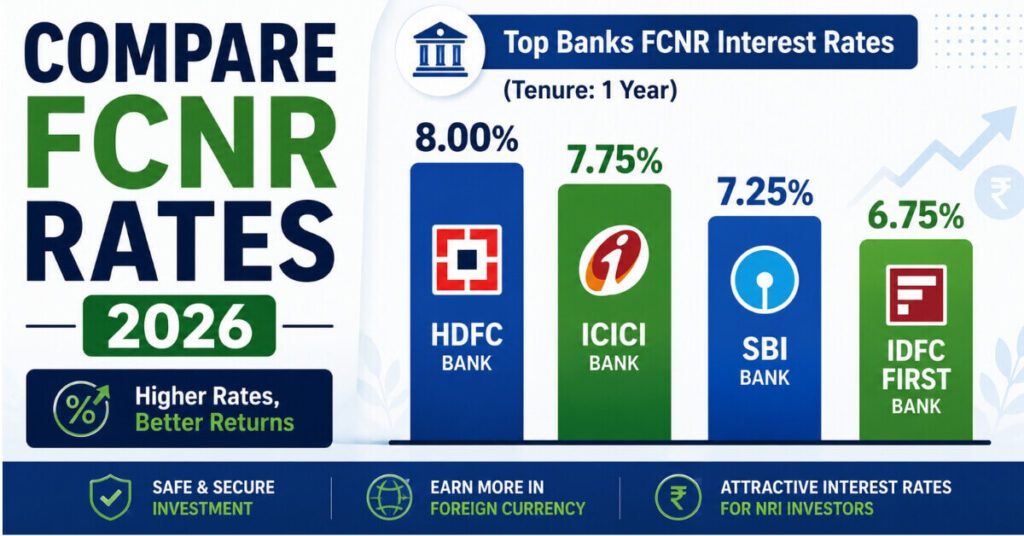
Current FCNR Deposit Interest Rate 2026 Across Major Banks
Let’s look at how different banks are currently pricing their FCNR(B) deposits under the new swap window.
HDFC Bank is offering up to 6.25 percent per annum on USD deposits across three to five year tenures, among the more competitive rates from a large private bank.
ICICI Bank offers FCNR interest rates ranging from around 3.85 percent for shorter tenures up to 6.00 percent for deposits held between four and five years.
SBI, being a public sector bank, tends to offer slightly more conservative rates, with USD deposit rates ranging depending on the exact tenure chosen, though NRIs often still prefer SBI for its extensive branch network and trust factor.
IDFC FIRST Bank has positioned itself aggressively in this space, advertising FCNR deposit rates starting from a notably higher base for select tenures, making it worth comparing directly against the larger banks.
Smaller and specialised players such as Equitas Bank have also entered the competitive FCNR space, with rates that can reach as high as 7.1 percent for select currencies and tenures, reflecting just how competitive the FCNR Deposit Interest Rate 2026 landscape has become since the swap window opened.
It is worth noting that rates can vary not just bank to bank but also by deposit size, currency chosen, and exact tenure, so always confirm the latest published rate directly with the bank before booking.
Which Currencies Are Covered Under FCNR Deposits
While USD remains the most commonly chosen currency for FCNR deposits, banks also accept GBP, EUR, JPY, AUD, and CAD in many cases. The FCNR Deposit Interest Rate 2026 differs across these currencies because each is tied to its own interest rate benchmark and market conditions. NRIs earning in currencies other than USD should specifically check the rate table for their currency of choice, since the headline USD rate advertised by most banks does not automatically apply to other currencies.

How the Swap Facility Actually Works
Understanding the mechanics behind the improved FCNR Deposit Interest Rate 2026 can help you appreciate why this window is so time-limited. Under the RBI’s facility, eligible banks can access a special buy or sell foreign exchange swap directly with the central bank, covering only the principal amount of fresh FCNR(B) deposits, External Commercial Borrowings, and Overseas Foreign Currency Borrowings. You can find the complete eligibility rules and mechanics in the RBI Official Swap Facility FAQ. This swap effectively shields banks from the currency risk they would otherwise need to hedge in the open market, which is often expensive during periods of rupee volatility.
By absorbing this hedging cost, the RBI enables banks to offer NRIs a meaningfully higher return without exposing the bank itself to additional currency risk. As of July 31, 2026, total inflows under this scheme had already reached over 40 billion dollars, with FCNR(B) deposits alone contributing more than 90 percent of that figure, a clear sign of just how much demand this improved FCNR Deposit Interest Rate 2026 has generated among NRIs worldwide.
Tax Benefits of FCNR Deposits
One of the most attractive features of FCNR deposits, beyond the currently elevated FCNR Deposit Interest Rate 2026, is that the interest earned is completely tax-free in India for as long as the depositor maintains NRI status. This is a significant advantage compared to NRO deposits, where interest is taxable. Additionally, FCNR deposits are fully repatriable, meaning both the principal and the interest earned can be transferred back abroad without restriction, making them one of the most flexible options available to NRIs looking to park foreign currency savings safely.
Should You Lock In Your FCNR Deposit Now
Given that the FCNR Deposit Interest Rate 2026 is significantly elevated compared to typical years, and that the window for these enhanced rates closes on September 30, 2026, many financial advisors are suggesting that NRIs with idle foreign currency should seriously consider locking in a deposit before the deadline. Once the swap facility ends, there is no guarantee that banks will continue offering rates anywhere close to current levels, since the underlying subsidy from the RBI will no longer be available.
That said, every NRI’s financial situation is different. If you expect to need the funds within the next year or two, a shorter tenure might make more sense even at a slightly lower FCNR Deposit Interest Rate 2026, since early withdrawal penalties can eat into your returns significantly
How to Compare FCNR Rates Before You Decide
Before committing to any bank, it helps to build a simple checklist. Start by confirming the exact FCNR Deposit Interest Rate 2026 for your chosen currency and tenure directly on the bank’s official website, since third-party comparison sites are not always updated in real time. Next, check whether the rate quoted includes any promotional bump tied specifically to the RBI swap window, since this portion may not apply once the window closes.
Also compare minimum deposit requirements, since some banks require a significantly higher minimum for their best rates. Finally, factor in the bank’s reputation for customer service and ease of online account management, since NRIs are often managing these accounts from a different country and time zone.
If you are also planning your tax filings around the same time, it is worth staying on top of related deadlines. For instance, taxpayers who miss their return filing deadline should be aware of the ITR Late Filing Penalty 2026 and how quickly those charges can add up, since good financial planning covers both your investments and your compliance obligations together.
Step-by-Step Guide to Opening an FCNR Deposit
Opening an FCNR deposit is generally a straightforward process for most NRIs. First, choose a bank and confirm the current FCNR Deposit Interest Rate 2026 for your preferred currency and tenure. Next, complete the KYC process, which typically requires your passport copy, visa or residency proof, PAN card, and an overseas address proof.
Then transfer funds into the account either through an inward remittance from your overseas bank account or by converting funds already held in an NRE account. Once the deposit is booked, you will receive a deposit receipt confirming the tenure, currency, and applicable interest rate. Keep this document safe, since you will need it at maturity or if you wish to take a loan against the deposit.
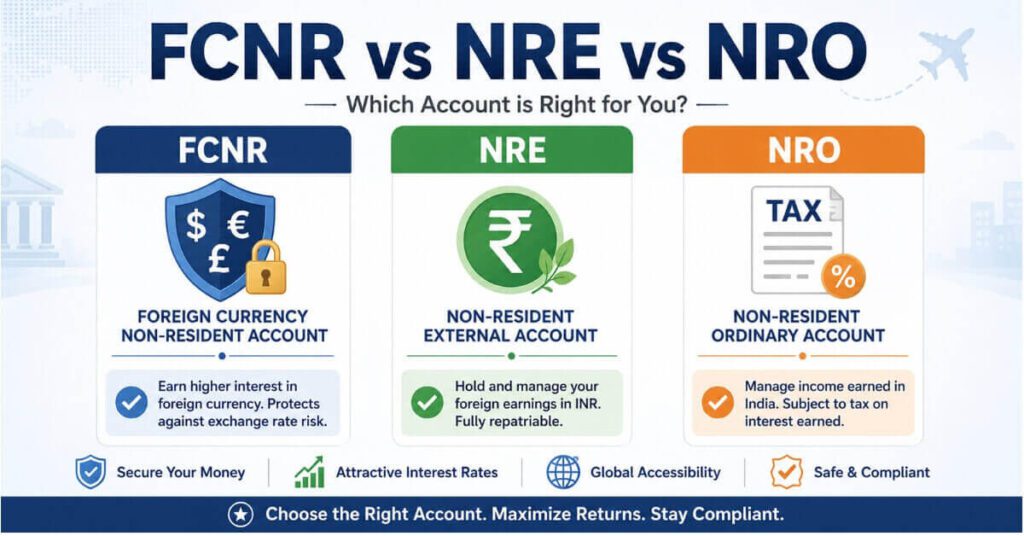
FCNR vs NRE vs NRO: Which Account Type Makes Sense
NRIs often get confused between FCNR, NRE, and NRO accounts, so it helps to understand the key differences before deciding where to park your money. An NRE account holds your foreign earnings in rupees, which means you carry currency conversion risk since the rupee value can fluctuate against your home currency.
An NRO account is meant for income earned within India, such as rent or dividends, and interest on it is taxable. An FCNR deposit, by contrast, lets you hold your money in the original foreign currency, eliminating conversion risk entirely while still earning tax-free interest. For NRIs who are unsure whether they will return to India or convert their savings to rupees in the near future, the current elevated rate environment makes this option particularly appealing, since it protects your purchasing power in your currency of choice while still delivering a strong return.
A Real-World Example of How the Numbers Work
Consider an NRI based in the United States with 50,000 dollars sitting idle in a foreign bank account earning very little interest. By moving this amount into an FCNR deposit with a four-year tenure at a rate of 6.25 percent per annum, offered under the current swap window, this depositor would earn roughly 3,125 dollars in interest in the first year alone, compounding further over subsequent years depending on the payout structure chosen by the bank.
Since this interest is entirely tax-free in India, the effective return is considerably better than a comparable taxable investment offering a similar headline rate. This kind of calculation is exactly why so many NRIs are paying close attention to the current rate environment before the September 30 deadline arrives.
Now compare this to an NRI who delays their decision until after the swap window closes. If rates revert closer to their pre-2026 levels of around 3 to 4 percent, the same 50,000 dollar deposit would earn roughly half as much annual interest, illustrating just how meaningful the timing of this decision can be for anyone sitting on unused foreign currency savings.

Documents and Eligibility You Should Confirm in Advance
Before you approach a bank to book a deposit, it helps to have your documentation ready so you do not lose time while the window remains open. Most banks require a valid passport, proof of NRI status such as a visa, OCI card, or work permit, a recent overseas address proof, and a PAN card for KYC compliance. Some banks may also ask for a reference from your existing banking relationship if you are opening an account for the first time. Having all of this ready in advance means you can lock in the best available FCNR Deposit Interest Rate 2026 without unnecessary delays that could push your booking past the deadline.
Common Mistakes NRIs Make With FCNR Deposits
Many NRIs rush into booking a deposit purely based on the headline FCNR Deposit Interest Rate 2026 advertised by a bank, without checking whether that rate applies to their specific currency and tenure combination. Others overlook the fact that breaking an FCNR deposit early usually results in a penalty and a lower effective interest rate, which can significantly reduce expected returns. Some NRIs also fail to compare minimum deposit thresholds across banks, missing out on better rates available at institutions with lower entry requirements. Being aware of these common pitfalls can help you make a more confident decision when comparing offers.
Frequently Asked Questions
Q1.What is the current FCNR Deposit Interest Rate 2026 for USD deposits?
Rates currently range from around 3.85 percent to as high as 7.1 percent depending on the bank, tenure, and deposit amount, with most large banks offering between 6.00 percent and 6.25 percent for three to five year tenures.
Q2.Why did the FCNR Deposit Interest Rate 2026 increase so suddenly?
The RBI launched a special concessional forex swap facility on June 8, 2026, which allows banks to offer higher rates on fresh FCNR(B) deposits by absorbing part of the currency hedging cost.
Q3.Until when will the higher FCNR Deposit Interest Rate 2026 be available?
The RBI’s swap window is available only for fresh deposits mobilised between June 8, 2026 and September 30, 2026, after which rates are expected to revert closer to earlier levels.
Q4.Is interest earned on FCNR deposits taxable in India?
No, interest earned on FCNR deposits is tax-free in India for as long as the depositor maintains NRI status.
Q5.Can I withdraw my FCNR deposit before maturity?
Yes, but early withdrawal usually attracts a penalty and a lower applicable interest rate, so it is generally best to choose a tenure you are confident you will not need to break.
Q6.Which currencies are accepted for FCNR deposits?
Most banks accept USD, GBP, EUR, JPY, AUD, and CAD, though the exact list and rates can vary by bank.
Q7.Do FCNR rates differ significantly between banks?
Yes, the FCNR Deposit Interest Rate 2026 can vary by more than three percentage points between banks for the same currency and tenure, which makes comparison shopping genuinely worthwhile.
Conclusion
The FCNR Deposit Interest Rate 2026 represents one of the more attractive windows for NRIs to earn tax-free, currency-protected returns in recent memory, driven largely by the RBI’s temporary concessional swap facility. With rates from major banks ranging widely and the window closing on September 30, 2026, NRIs with foreign currency savings sitting idle have a clear incentive to compare offers and act before the deadline.
As with any financial decision, it is worth taking the time to compare the exact FCNR Deposit Interest Rate 2026 across a few banks for your specific currency and tenure, rather than settling for the first offer you come across, so that you can make the most of this limited-time opportunity.
Disclaimer
This article is for informational purposes only and does not constitute professional financial or tax advice. Interest rates, RBI policies, and scheme deadlines are subject to change, and readers should verify current rates directly with their bank and consult a qualified financial advisor before making investment decisions.


Pingback: Section 54F Exemption 2026: 5 Powerful Relief Facts