

Tax season is here, and if you have been wondering how to file ITR online in 2026, you are in the right place. Whether you are a salaried employee in India, a freelancer, or an NRI living in the US, UK, or Canada with Indian income — this step-by-step guide covers everything you need to know to file your Income Tax Return quickly, correctly, and without paying a CA.
The deadline for salaried individuals is July 31, 2026. That means the clock is already ticking. Let’s get started.
What Is ITR and Why Should You File It?
Before learning how to file ITR online, it helps to understand what it actually is. ITR — or Income Tax Return — is a form you submit to India’s Income Tax Department declaring your annual income, taxes paid, and deductions claimed.
Many people assume ITR filing is only for those with high incomes. That is not true. Here is why filing your ITR matters even if your tax liability is zero:
Claim your TDS refund — If your employer or bank deducted TDS, filing how to file ITR online is the only way to get that money back
Visa applications — Embassies in the US, UK, Canada, and Europe regularly ask for ITR copies as financial proof
Loan approvals — Banks and NBFCs require ITR for home loans, personal loans, and business loans
Carry forward losses — Stock market or business losses can only be carried forward if how to file ITR online is filed on time
NRI compliance — NRIs earning Indian income above the basic exemption limit are legally required to file ITR
Financial credibility — Filed ITRs build your financial profile for future investments and credit applications
Understanding how to file ITR online gives you full control over your finances — no dependency on a CA for basic filings.
ITR Filing Deadlines for AY 2026-27 — Do Not Miss These
Knowing the deadline is the first step in learning how to file ITR online. For Assessment Year 2026-27 (Financial Year 2025-26), the due dates are:
| Taxpayer Category | ITR Form | Deadline |
| Salaried individuals, pensioners | ITR-1, ITR-2 | July 31, 2026 |
| Non-audit businesses, freelancers | ITR-3, ITR-4 | August 31, 2026 |
| Businesses requiring tax audit | ITR-3, ITR-4 | October 31, 2026 |
| Transfer pricing cases | ITR-3 | November 30, 2026 |
| Belated return (with penalty) | All forms | December 31, 2026 |
Penalty for missing the deadline:
₹5,000 late fee if income exceeds ₹5 lakh
₹1,000 late fee if income is below ₹5 lakh
Interest under Section 234A on unpaid tax
NRI Note: NRIs filing from the US, UK, Canada, or any other country follow the same deadlines. However, verification options differ — more on that below.
How to file ITR Online in 2026?
Before diving into how to file ITR online, confirm whether you are required to file. ITR filing is mandatory if:
Your total income exceeds the basic exemption limit (₹2.5 lakh under old regime, ₹4 lakh under new regime)
TDS has been deducted and you want a refund
You have foreign assets or foreign bank accounts
You want to carry forward capital losses
Your electricity bill exceeds ₹1 lakh per year
You have made deposits exceeding ₹1 crore in a current account
You are an NRI with Indian rental income, interest income, or capital gains from Indian investments
Even if your income is below the exemption limit, filing how to file ITR online voluntarily is always a smart financial move.
Documents Required to File ITR Online
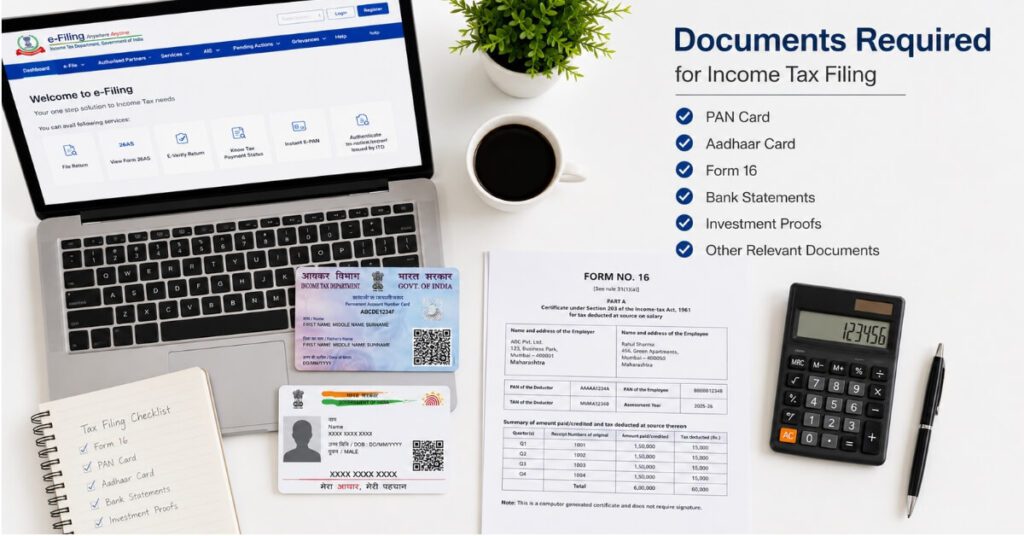
Getting your documents ready is a critical part of knowing how to file ITR online efficiently. Nothing slows down the process more than searching for documents mid-filing.
For Salaried Employees:
Form 16 (Part A and Part B) — from your employer
PAN card
Aadhaar card (linked to PAN)
Bank account details with IFSC code
Form 26AS — shows TDS deducted
Annual Information Statement (AIS) — available on the e-filing portal
Investment proofs — PPF, ELSS, LIC, home loan certificate
For Freelancers and Self-Employed:
Bank statements for the full financial year
All invoices raised
TDS certificates from clients
Business expense records
GST returns (if applicable)
For NRIs:
PAN card (mandatory)
Passport and visa details
NRE/NRO bank account statements
Form 67 (if claiming DTAA benefit)
DTAA certificate from your country of residence
TDS certificates on Indian income
Digital Signature Certificate or Indian bank Net Banking access for e-verification
Pro Tip: Download your AIS from the income tax portal before starting. It shows all high-value transactions the government already knows about — salary, dividends, mutual fund redemptions, bank interest — and helps you avoid mismatches.
Choosing the Right ITR Form — Critical Step
One of the biggest mistakes people make when learning how to file ITR online is choosing the wrong form. Filing with an incorrect form can make your return invalid and invite a tax notice.
Here is a quick guide:
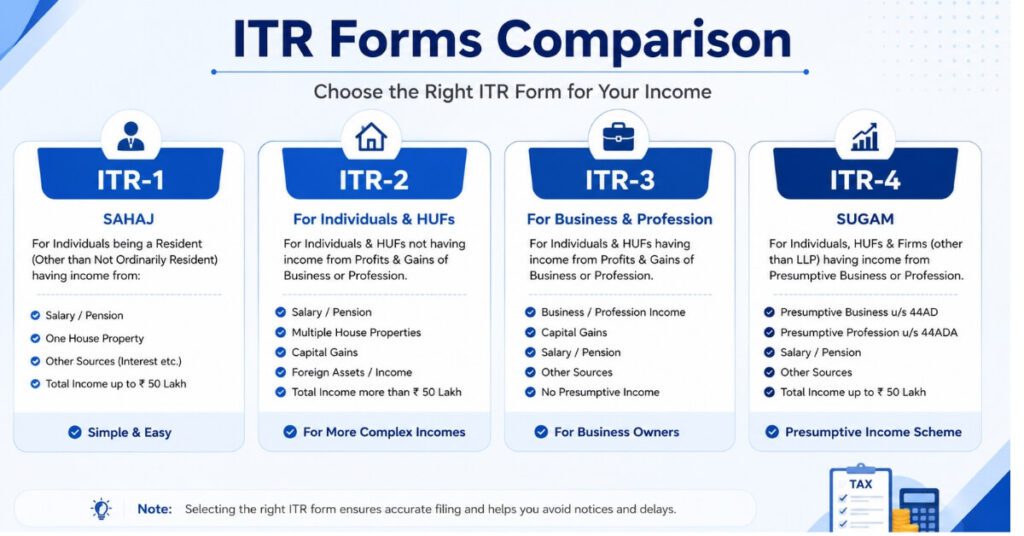
| ITR Form | Who Should File |
| ITR-1 (Sahaj) | Salaried individuals, pensioners with income up to ₹50 lakh, one house property, no capital gains above ₹1.25 lakh |
| ITR-2 | Individuals with capital gains, multiple house properties, foreign income/assets, or income above ₹50 lakh. NRIs must use ITR-2 |
| ITR-3 | Business owners, professionals (doctors, lawyers, consultants), traders with F&O income |
| ITR-4 (Sugam) | Small businesses and professionals under presumptive taxation scheme (Section 44AD/44ADA) |
NRI Important Note: NRIs cannot use ITR-1 (Sahaj). NRIs with salary, capital gains, or property income from India must file using ITR-2. The portal will auto-suggest a form based on your profile, but always verify manually.
How to File ITR Online — Complete Step-by-Step Process
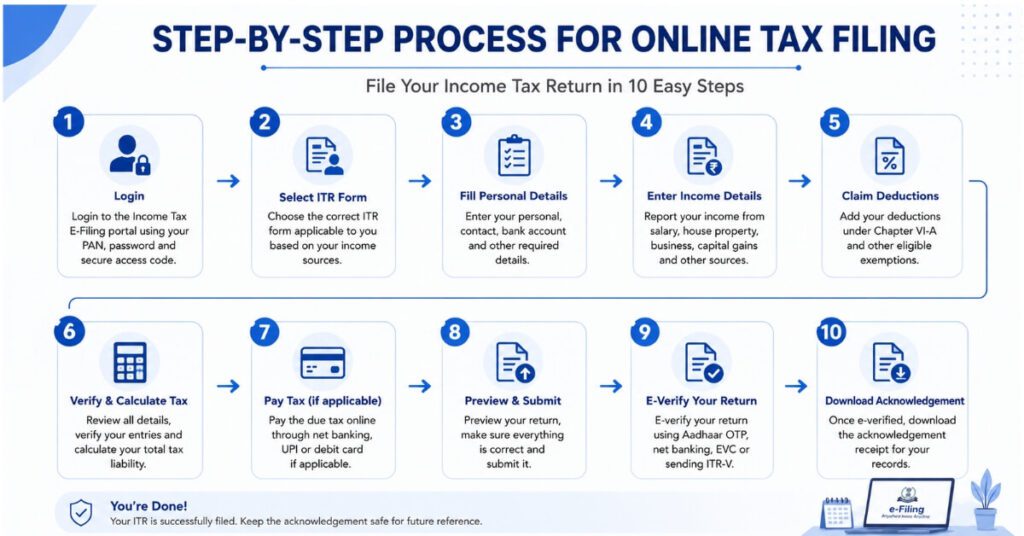
Now comes the core of this guide — exactly how to file ITR online on the official government portal incometax.gov.in. This portal is completely free to use.
Step 1 — Register or Log In to the Portal
Go to incometax.gov.in and click on “Login.” Go to the official Income Tax e-Filing Portal and click on Login.”
User ID: Your PAN number
Password: The one you set during registration
First-time user? Click “Register” and complete registration using your PAN, mobile number, and email ID
Once logged in, you will land on your dashboard showing your profile, pending actions, and filed returns history.
NRI Tip: If you are filing from abroad, ensure your registered mobile number is active. OTPs are sent to this number during login. If not, update your contact details using your Indian bank account or Digital Signature Certificate.
Step 2 — Download and Review Form 26AS and AIS
This step is non-negotiable when you are learning how to file ITR online correctly.
Go to e-File > Income Tax Returns > View Form 26AS
Also visit e-File > AIS (Annual Information Statement)
Form 26AS shows all TDS deducted on your behalf. AIS shows your complete financial picture — salary, dividends, interest income, mutual fund transactions, property purchases, and more.
Cross-check these with your actual income. Any mismatch between what you report and what the government already knows will trigger a notice.
Step 3 — Start Filing Your Return
On your dashboard:
Click e-File in the top menu
Select Income Tax Returns > File Income Tax Return
Choose Assessment Year: 2026-27
Select Filing Type: Original
Choose Mode: Online
Step 4 — Select Your ITR Form
The portal will suggest a form based on your income profile. Cross-verify this suggestion using the ITR form table above. Select the correct form and proceed.
Step 5 — Verify and Edit Pre-Filled Data
This is one of the most useful features of the e-filing portal. The system automatically pulls data from Form 26AS, AIS, and your employer’s TDS filings.
Pre-filled data typically includes:
Employer name and gross salary
TDS amounts deducted
Bank interest income
Dividend income
Mutual fund transactions
Do not skip this step. Go through each section carefully. If anything is missing or incorrect — for example, your employer filed incorrect TDS details — edit the data manually and keep documentary proof.
Step 6 — Choose Your Tax Regime
When you how to file ITR online in 2026, you must choose between the Old Tax Regime and the New Tax Regime. This decision directly impacts how much tax you pay.
Old Tax Regime:
Higher tax rates
Allows deductions under Section 80C (up to ₹1.5 lakh), 80D, 24(b), HRA, LTA, and more
Better if you have significant investments and loans
New Tax Regime:
Lower, simplified tax rates
Standard deduction of ₹75,000 for salaried employees
Very few additional deductions allowed
Tax-free income up to ₹4 lakh (basic exemption) with rebate up to ₹12 lakh
Better if you have fewer investments or prefer simplicity
The portal automatically computes tax under both regimes and shows a comparison. Choose the one with lower tax liability. You can switch between regimes every year if you are salaried — business owners have restrictions on switching.

Step 7 — Fill In Deductions (Old Regime Only)
If you chose the Old Tax Regime, now is the time to enter your deductions:
Section 80C — PPF, ELSS, LIC premium, EPF, home loan principal, children’s tuition fees (maximum ₹1.5 lakh)
Section 80D — Health insurance premium (₹25,000 for self, ₹50,000 for senior citizen parents)
Section 24(b) — Home loan interest (maximum ₹2 lakh for self-occupied property)
Section 80E — Education loan interest (no upper limit)
Section 80TTA — Savings account interest (maximum ₹10,000)
HRA exemption — If you receive HRA from employer
NRI Note: NRIs can claim deductions under Section 80C and 80D. However, NRIs cannot claim the Section 80TTA savings interest deduction or HRA exemption. NRIs may also benefit from DTAA (Double Taxation Avoidance Agreement) provisions to avoid being taxed on the same income in two countries.
Step 8 — Calculate and Pay Tax (If Applicable)
After entering all income and deductions, the portal calculates your total tax liability.
If tax is payable: Pay online using Challan 280 via Net Banking, UPI, or debit card. Enter the payment details (BSR code, challan number) back in the ITR form.
If refund is due: Verify that your bank account details are correct and pre-validated in the portal. Refunds are directly credited to your registered bank account.
Step 9 — Preview and Submit
Before submitting:
Click Preview and review every section carefully
Check that all income sources are declared
Verify deductions match your actual investment proofs
Confirm bank account is pre-validated for refund
Once satisfied, click Submit.
Step 10 — E-Verify Your ITR (Most Important Step!)
Submitting your ITR is not enough. You must verify it within 30 days of submission, otherwise the return becomes invalid — as if it was never filed.
Verification options for residents:
Aadhaar OTP — Fastest and easiest. Works instantly if your Aadhaar is linked to PAN
Net Banking EVC — Login via your bank’s net banking portal
Demat Account EVC — Through CDSL or NSDL
Bank Account EVC — Using your pre-validated bank account
Verification options for NRIs:
Net Banking — If you have an Indian bank account with internet banking
Digital Signature Certificate (DSC) — Recommended for NRIs without active Indian bank access
Physical ITR-V — Print, sign, and post the acknowledgement to CPC Bengaluru. Takes 4-6 weeks.
After successful verification, you will receive an acknowledgement (ITR-V) on your registered email. Save this document — it is proof of filing.
Old vs New Tax Regime 2026 — Quick Comparison
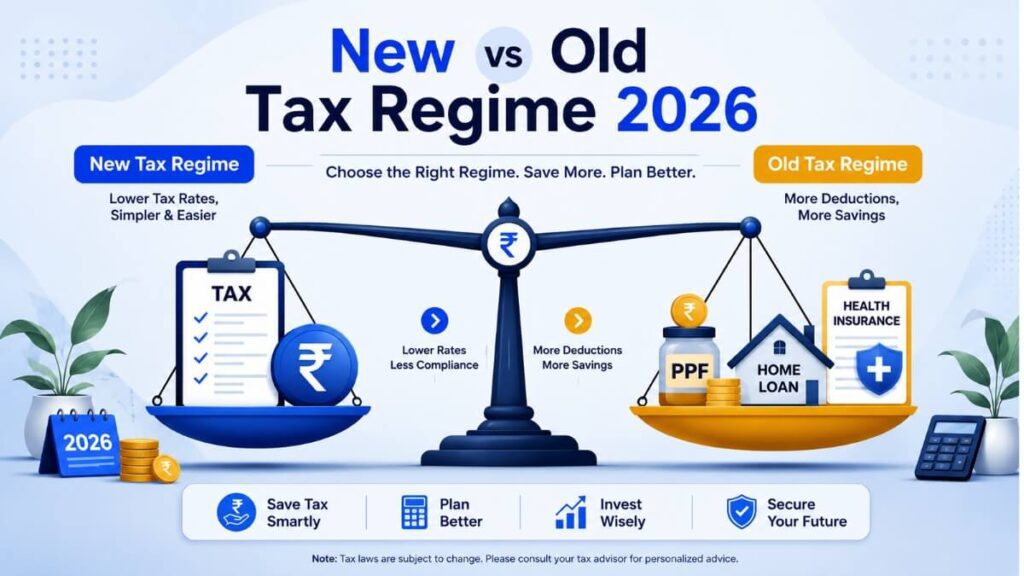
One of the most common questions when learning how to file ITR online is which tax regime to choose. Here is a clear comparison:
| Feature | Old Regime | New Regime |
| Basic Exemption | ₹2.5 lakh | ₹4 lakh |
| Tax-Free with Rebate | Up to ₹5 lakh | Up to ₹12 lakh |
| Standard Deduction | ₹50,000 | ₹75,000 |
| Section 80C | ₹1.5 lakh | Not available |
| HRA Exemption | Available | Not available |
| Home Loan Interest 24(b) | ₹2 lakh | Not available |
| Best For | High investment taxpayers | Low investment / simplicity |
Simple rule: If your total deductions under the old regime exceed ₹3.75 lakh, the old regime likely saves more tax. Otherwise, the new regime is better.
ITR Filing for NRIs — Special Considerations
If you are an NRI in the US, UK, Canada, Australia, or UAE reading this guide on how to file ITR online, here is what you specifically need to know:
Indian income (salary, rent, interest, capital gains) exceeds ₹2.5 lakh
When must NRIs file ITR?
TDS was deducted and you want a refund
You have Indian assets or bank accounts to declare
Which form must NRIs use?
Always ITR-2 — NRIs are not eligible for ITR-1
DTAA Benefits:
India has Double Taxation Avoidance Agreements with over 90 countries including the US, UK, Canada, and UAE. Under DTAA, you are not taxed on the same income twice. To claim DTAA benefits, file Form 67 before or along with your ITR. The DTAA certificate from your country of residence is required.
NRI-Specific income taxable in India:
Rental income from Indian property
Interest on NRO accounts (NRE account interest is tax-free)
Capital gains from Indian mutual funds, stocks, or property sale
Salary received in India
Key point: Your global income earned outside India is NOT taxable in India as an NRI. Only Indian-sourced income is taxable.
Common Mistakes to Avoid When Filing how to ITR Online
Even when you know how to file ITR online, these mistakes can cause problems:
1 .Choosing wrong ITR form — ITR-1 for someone with capital gains or NRI status is invalid
2 .Not checking AIS — High-value transactions the government knows about must match your declaration
3 .Skipping bank pre-validation — Without pre-validated bank account, refund will not credit
4 .Forgetting to verify — Submitted but unverified ITR is treated as not filed at all
5 .Missing deduction proofs — Always keep investment receipts for at least 6 years
6 .Not declaring all income — Bank interest, freelance income, and dividends are all taxable
7 .Missing the deadline — Penalty plus interest can significantly increase your tax outgo
What Happens After You how to File ITR Online?
Once you know how to file ITR online and have successfully submitted and verified, here is what happens next:
Processing — The Income Tax Department processes returns within 15 to 45 days
Intimation under Section 143(1) — You receive an email confirming whether your return is accepted, a refund is due, or additional tax is payable
Refund credit — If a refund is due, it is credited directly to your pre-validated bank account within 7 to 30 days of processing
Scrutiny — In rare cases, your return may be selected for detailed scrutiny. Keeping all proofs helps resolve these quickly
How Can International Investors Get Exposure to Indian Stocks?
For international investors seeking broader context on where institutional money is flowing in India, our detailed guide on Vanguard India Stocks 2026 breaks down exactly which sectors and companies are attracting billions in foreign capital.
Vanguard FTSE Emerging Markets ETF (VWO) provides broad emerging market exposure, with India being one of the largest country allocations. As India’s weight in global indices increases, VWO’s India exposure automatically grows.
iShares MSCI India ETF (INDA) is one of the most popular India-specific ETFs for international investors, providing direct exposure to Indian large-cap and mid-cap stocks.
WisdomTree India Earnings Fund (EPI) offers an alternative approach, weighting Indian stocks by earnings rather than market cap.
It is important to consult a qualified financial advisor before making any international investment decisions, as currency risk, tax implications, and regulatory considerations vary by country of residence.
Frequently Asked Questions
Q1. How to file ITR online — is there any fee?
No. Filing on the official incometax.gov.in portal is completely free. Third-party platforms like ClearTax or Tax2Win may charge fees for assisted filing.
Q2. Can how to file ITR online without Form 16?
Yes. You can use Form 26AS, AIS, and your salary slips to manually calculate and file ITR without Form 16.
Q3. How to file ITR online as an NRI from the US or UK?
NRIs file on the same portal — incometax.gov.in. Use ITR-2 form and verify using Net Banking or Digital Signature Certificate. DTAA benefit can be claimed via Form 67.
Q4. What is the last date file ITR online in 2026?
July 31, 2026 for salaried individuals and those filing ITR-1 or ITR-2. August 31, 2026 for non-audit businesses filing ITR-3 or ITR-4.
Q5. How to file ITR online if I have both salary and freelance income?
Use ITR-3 or ITR-4 depending on your income structure. Declare salary under Schedule S and freelance income under Schedule BP (business/profession).
Q6. What happens if how to file ITR online after the deadline?
You can file a belated return until December 31, 2026 with a penalty of ₹5,000 (₹1,000 if income is below ₹5 lakh) plus interest under Section 234A.
Q7. How to file ITR online and verify if I am abroad?
Use Net Banking EVC through an Indian bank or obtain a Digital Signature Certificate. You can also post the physical ITR-V to CPC Bengaluru.
Disclaimer
The information in this article is for educational purposes only and is based on Income Tax rules applicable for AY 2026-27 (FY 2025-26). Tax laws are subject to change. Please consult a qualified tax professional or chartered accountant for advice specific to your financial situation. SK Smart Digital Hub is not responsible for any financial decisions made based on this content.
The entire process how to file ITR online takes less than 60 minutes if your documents are ready. Millions of Indians — including salaried employees, freelancers, and NRIs in the US, UK, and Canada — successfully how to file ITR online every year without any professional help. With the government’s pre-filled data feature and step-by-step portal guidance, there is no reason to delay. The sooner you how to file ITR online, the sooner your refund gets processed.
Conclusion
Now you know exactly how to file ITR online in 2026 — from gathering documents and choosing the right form to submitting, verifying, and tracking your refund. The process has become significantly simpler with the pre-filled data feature on the income tax portal, making it possible for most salaried individuals and NRIs to file independently in under an hour.
“The process to file ITR online has become significantly simpler with the pre-filled data feature”
Have questions about a specific income situation? Drop them in the comments — we will help you out!

Pingback: Digital Fixed Deposit — Best Platforms & Returns 2026