
Introduction
The Central Board of Direct Taxes has opened a fresh compliance window for taxpayers holding undisclosed foreign assets, and the CBDT FAST-DS Scheme 2026 has quickly become one of the most searched tax topics in India this month. If you have a foreign bank account, an overseas property, or any offshore holding that was never reported to the Income Tax Department, the CBDT FAST-DS Scheme 2026 offers a structured, one-time route to come clean before automatic data-sharing systems flag it for you.
With international financial information exchange growing tighter every year, many ordinary taxpayers are trying to understand what this new disclosure window actually requires, who qualifies, and what the consequences are of letting the deadline pass. This article walks through the CBDT FAST-DS Scheme 2026 from start to finish, covering eligibility, timelines, the filing process, required documents, and the risks of staying silent, so you can decide with confidence whether the CBDT FAST-DS Scheme 2026 window applies to your situation.
What Is the CBDT FAST-DS Scheme 2026
FAST-DS stands for Foreign Assets of Small Taxpayers, Disclosure Scheme. Notified under Chapter IV of the relevant Finance legislation, it came into force on 16 August 2026. In simple terms, this is a one-time voluntary disclosure window that allows small taxpayers to declare foreign assets and foreign income that were left out of their earlier income tax returns, without inviting the harsher penalties that would otherwise apply under the Black Money Act.
Unlike routine annual tax filing, the CBDT FAST-DS Scheme 2026 window has been designed specifically for individuals whose foreign holdings are relatively modest in value, such as a small overseas savings account, a handful of foreign shares, or a single property abroad that was never declared. This scheme exists precisely because the government recognises that many of these cases stem from oversight rather than deliberate evasion, and it gives such taxpayers a fair chance to regularise their position before facing formal scrutiny.
Why Was This Disclosure Window Introduced
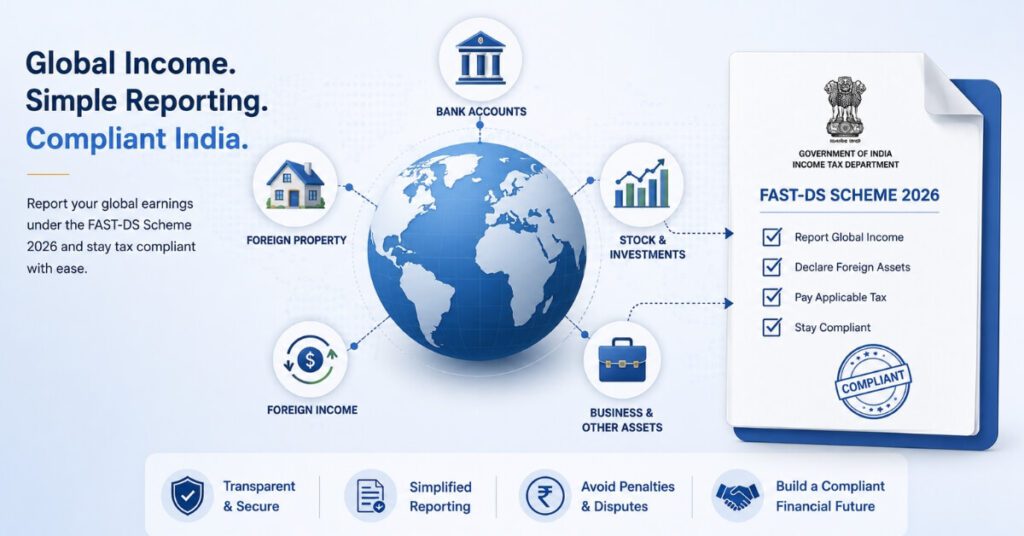
India has significantly expanded its access to foreign financial data over the past several years through global information-sharing frameworks such as the Common Reporting Standard and various bilateral tax treaties. As a result, the Income Tax Department now automatically receives details of foreign bank accounts, mutual funds, and other assets held abroad by Indian residents. A large number of ordinary taxpayers, not just high-net-worth individuals, have unknowingly failed to disclose small foreign holdings, whether it is an inherited overseas account, employee stock options from a foreign employer, or minor rental income from a property abroad.
Recognising that many of these cases involve genuine oversight rather than intentional evasion, the government introduced this disclosure route as a middle path. Instead of directly invoking the stringent provisions of the Black Money Act, which can carry penalties of up to 300 percent along with prosecution, the newly notified scheme offers a lower-penalty, low-friction option for taxpayers who come forward voluntarily within the specified window.
Who Is Eligible
Eligibility is limited to individuals classified as small taxpayers, meaning those whose undisclosed foreign assets fall below a specified value threshold set out in the notification. This route is not meant for large-scale offshore structures, shell companies, or assets already linked to an ongoing investigation, prosecution, or search-and-seizure action by tax authorities.
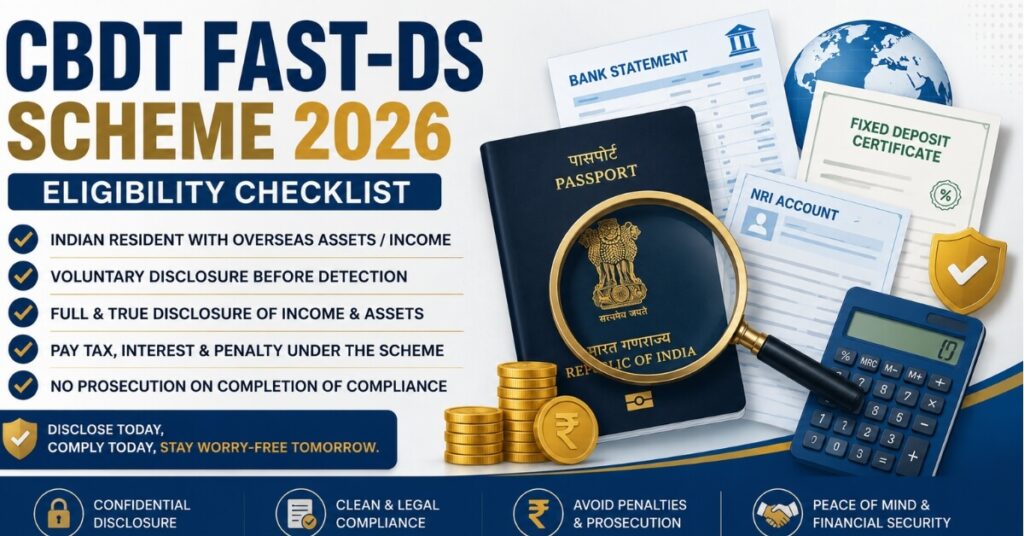
To qualify under the CBDT FAST-DS Scheme 2026, a taxpayer generally needs to meet the following broad conditions:
The foreign asset or income must not already be under scrutiny, notice, or investigation by the Income Tax Department.
The total value of undisclosed foreign assets should fall within the small taxpayer threshold defined by the notification.
The taxpayer must file a complete and accurate declaration, including the nature, location, and valuation of each asset.
The disclosure must be made within the prescribed window, with no scope for late or partial declarations once the deadline passes.
If any of these conditions are not met, the individual may not be eligible to use the CBDT FAST-DS Scheme 2026 and could instead face proceedings under the regular provisions of the Black Money Act, which are considerably more punitive in both financial and legal terms.
Key Features Worth Knowing
Several features set the CBDT FAST-DS Scheme 2026 apart from ordinary tax compliance requirements.
1.One-time window. This is not a recurring or annual facility. It is a single opportunity offered for this cycle, and once it closes, taxpayers will not get another chance under the same relaxed terms.
2.Fixed valuation date. The fair market value of any foreign asset declared must be computed as on 31 March 2026, regardless of when the declaration is actually filed. This standardises the process and removes ambiguity about which exchange rate or market value applies.
3.Reduced penalty structure. Taxpayers using the CBDT FAST-DS Scheme 2026 benefit from a substantially lower penalty compared to what would apply under standard black money provisions, provided the disclosure is complete and made within the deadline.
4.No prosecution for eligible disclosures. For assets and income properly declared, the risk of criminal prosecution under the Black Money Act is generally waived, subject to the accuracy of the filing.
5.Targeted at small holdings. The CBDT FAST-DS Scheme 2026 has been specifically framed to help retail taxpayers and salaried individuals with modest foreign assets, rather than large offshore entities or corporate structures.

Important Dates and Deadlines
Timing is one of the most critical aspects of the CBDT FAST-DS Scheme 2026, and taxpayers should keep the following in mind.
The CBDT FAST-DS Scheme 2026 officially came into force on 16 August 2026.
The last date for filing a declaration is 31 December 2026. No declaration will be accepted after this date under any circumstances.
The valuation date for foreign assets is fixed at 31 March 2026, irrespective of the actual date of filing.
Since the window runs for a little over four months, taxpayers who suspect they may have unreported foreign assets are advised not to wait until the final weeks. Gathering documentation, computing valuations, and establishing proof of source of funds can take considerably longer than expected, especially for accounts or properties abroad where records need to be requested from foreign institutions.
Step by Step Process to File a Declaration
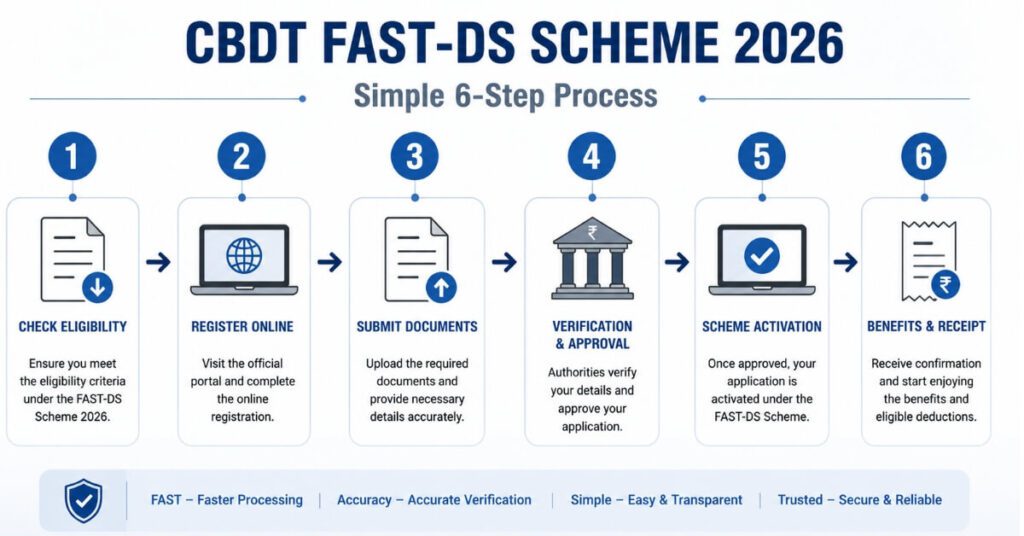
Filing a declaration involves a fairly structured sequence of steps. While the exact online utility and forms will be notified separately by the Income Tax Department, the general process expected is as follows.
Step one, identify all undisclosed foreign assets and income. List every foreign bank account, property, investment, or income stream that was not previously reported in your income tax returns. Even small, dormant, or seemingly minor accounts should be included, since partial disclosure can disqualify the entire filing.
Step two, gather supporting documentation. Collect bank statements, property deeds, investment certificates, and any correspondence that establishes ownership and the source of funds for each asset. This step often takes the longest, particularly for accounts held with foreign banks that require formal requests for historical statements.
Step three, compute the fair market value as on 31 March 2026. Since valuation under the CBDT FAST-DS Scheme 2026 is fixed to a specific date, taxpayers will need to work out the value of each asset accordingly, converting any foreign currency amounts using the applicable exchange rate as notified by the tax authorities.
Step four, file the declaration through the prescribed form. Submit the declaration using the format specified by the CBDT, along with details of assets, their computed valuation, and any tax already paid on related income, if applicable.
Step five, pay the applicable tax and reduced penalty. Once the declaration is processed, the taxpayer will be required to pay the tax due along with the reduced penalty amount prescribed under the rules.
Step six, retain proof of filing. Keep the acknowledgment receipt and payment confirmation safely, as these serve as proof of compliance and offer protection against future scrutiny on the same disclosed asset.
Documents Required for Filing
Before starting the declaration process, it helps to have the following documents ready in advance.
PAN card and Aadhaar details
Foreign bank account statements covering the relevant period
Property documents for any overseas real estate
Investment or brokerage statements for foreign shares, mutual funds, or employee stock options
Proof of source of funds, such as salary slips, gift deeds, or inheritance documents
Previous income tax returns, for cross-reference and consistency checks
Having these documents ready in advance can significantly reduce delays once the formal filing utility for the CBDT FAST-DS Scheme 2026 goes live on the department’s portal, since foreign banks and institutions can sometimes take weeks to issue historical statements on request.
Benefits of Using the CBDT FAST-DS Scheme 2026
For eligible taxpayers, there are several practical advantages to disclosing now rather than waiting for the department to detect the asset independently through automatic data exchange.
Lower penalty exposure. The reduced penalty rate is significantly more favourable than what would apply if the same asset were discovered later through cross-border information sharing.
Avoidance of prosecution risk. Coming forward voluntarily removes the possibility of criminal proceedings that can otherwise follow under the Black Money Act.
Peace of mind going forward. Once declared and regularised, the asset no longer poses a compliance risk in future assessments or scrutiny.
Simplified process for small holdings. Because the CBDT FAST-DS Scheme 2026 specifically targets small taxpayers, the documentation and procedural burden is generally lighter compared to large-scale disclosure cases involving corporations.
Risks of Not Disclosing in Time
Taxpayers who choose not to disclose eligible foreign assets during the CBDT FAST-DS Scheme 2026 window face considerably higher risk once the deadline passes. If an undisclosed asset is later detected through international data-sharing mechanisms, the individual could be assessed under the regular provisions of the Black Money Act, which allow for penalties of up to 300 percent of the tax payable, along with the possibility of prosecution and imprisonment in serious cases.
Since this reduced-penalty route will not reopen once the December deadline passes, taxpayers who are eligible but choose to delay may permanently lose access to the more lenient terms. Given how much financial data is now shared automatically between tax jurisdictions, treating non-disclosure as a viable long-term strategy carries meaningful and growing risk that is unlikely to ease in coming years.
How the CBDT FAST-DS Scheme 2026 Differs From Earlier Disclosure Windows
India has periodically offered voluntary disclosure windows in the past, but the CBDT FAST-DS Scheme 2026 differs in a few important respects. Earlier schemes were often broader in scope and applied uniformly across all categories of taxpayers, including large corporations and high-net-worth individuals with complex offshore structures. This particular window has instead been calibrated specifically for small taxpayers, with a defined asset value threshold and a comparatively simplified process intended to reduce the compliance burden on ordinary individuals rather than large offshore entities.
This targeted design reflects a broader shift in the government’s overall approach, relying on automatic financial data exchange to identify large-scale evasion, while offering a low-friction, lower-penalty compliance path to individuals whose non-disclosure more often stems from oversight than intent.
A Related Development Worth Noting
The introduction of the CBDT FAST-DS Scheme 2026 comes at a time when the government has also been actively reforming compliance frameworks for small businesses and individual taxpayers more broadly. For instance, the recent MSME Amendment Bill 2026 introduced several changes aimed at easing regulatory burdens for small business owners, reflecting a similar policy direction of simplifying compliance for smaller entities while tightening oversight elsewhere. Readers who run a small business alongside holding foreign assets may find it useful to review both developments together, since they share a common thread of reduced friction for genuinely small compliance cases.
For the official notification and the complete legal framework governing the CBDT FAST-DS Scheme 2026, taxpayers can refer to the Income Tax Department’s official page on Section 130, which lays out the statutory basis for the Foreign Assets of Small Taxpayers Disclosure Scheme in detail, including the exact list of assets that qualify and the manner of computing their value.
Common Mistakes to Avoid While Filing
Even a well-intentioned disclosure can run into trouble if basic errors creep in during preparation. One of the most frequent mistakes is under-reporting the value of an asset, either by using an incorrect exchange rate or by relying on outdated statements instead of the figures applicable on the fixed valuation date. Another common slip is leaving out smaller or dormant accounts on the assumption that they are too minor to matter, when in reality an incomplete declaration can disqualify the entire filing rather than just the omitted portion.
Taxpayers also sometimes misjudge their eligibility, assuming their holdings automatically qualify without checking the exact threshold defined in the official notification. It is equally important to avoid submitting documentation that does not clearly establish the source of funds, since gaps here often trigger follow-up queries that can delay processing well beyond the filing window. Finally, waiting until the last week of December to begin gathering paperwork is a mistake in itself, since foreign banks and institutions can take several weeks to issue the historical statements needed to support a clean, accurate declaration.
Frequently Asked Questions
Q1.What exactly is the CBDT FAST-DS Scheme 2026?
It is a one-time voluntary disclosure window that allows small taxpayers to declare previously unreported foreign assets and income, with a reduced penalty structure compared to standard black money provisions.
Q2.Who can apply under the CBDT FAST-DS Scheme 2026?
Individuals classified as small taxpayers with foreign assets below the specified threshold, provided the asset is not already under investigation or scrutiny, can apply.
Q3.What is the last date to file a declaration?
The declaration must be filed by 31 December 2026. No declarations will be accepted after this date.
Q4.How is the value of foreign assets calculated?
The fair market value must be computed as on 31 March 2026, regardless of when the actual declaration is filed.
Q5.What happens if I do not disclose and my asset is discovered later?
You could face assessment under the Black Money Act, with penalties of up to 300 percent of the tax payable and potential prosecution, since the CBDT FAST-DS Scheme 2026 window will not reopen once it closes.
Q6.Is the CBDT FAST-DS Scheme 2026 applicable to large corporations?
No. It is specifically designed for small taxpayers and is not intended for large corporate structures or assets already linked to ongoing investigations.
Conclusion
For anyone sitting on an unreported foreign bank account, a small overseas investment, or a property abroad that never made it into their tax returns, the CBDT FAST-DS Scheme 2026 offers a genuinely useful and time-limited opportunity to regularise things on favourable terms. With global financial data-sharing becoming more thorough each year, the odds of an undisclosed asset staying hidden indefinitely are shrinking steadily.
Taking stock of your foreign holdings now, gathering the required documentation, and filing before 31 December 2026 is a far less costly path than waiting for the department to find the asset independently. As with any compliance decision involving foreign assets, it is worth consulting a qualified tax professional to confirm eligibility and ensure the declaration is complete and accurate before the window closes for good.
Disclaimer
This article is for general informational purposes only and does not constitute tax, legal, or financial advice. Rules under the CBDT FAST-DS Scheme 2026 may be updated or clarified by the Income Tax Department, and readers should verify the latest official notifications before making any compliance decisions. Please consult a qualified chartered accountant or tax advisor for guidance specific to your situation.

Pingback: ITR Filing Penalty: 5 Shocking Rules You Must Know 2026