
The MSME Amendment Bill 2026 has become one of the most talked-about legislative updates for India’s small business community this month. Passed by Parliament in August 2026, it updates the existing MSMED Act, 2006 to better reflect the needs of a fast-growing MSME sector. For gig entrepreneurs, small manufacturers, exporters, and service providers, understanding this reform is essential because it directly affects payments, dispute resolution, and compliance.
This article breaks down the MSME Amendment Bill 2026 in simple terms so that small business owners across India can understand what has changed, why it matters, and how it may affect their day-to-day operations. Whether you run a small manufacturing unit, a service-based business, or a home-grown export venture, the provisions introduced through this reform are likely to touch some part of how you operate, get paid, and resolve disputes going forward.
What Is the MSME Amendment Bill 2026?
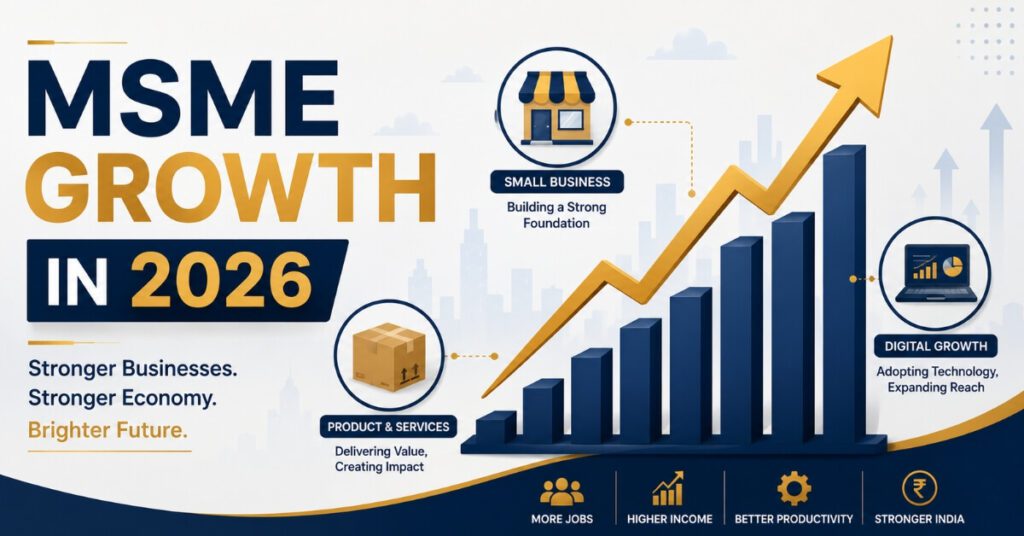
The MSME Amendment Bill 2026 is a legislative update to the MSMED Act, 2006, aimed at strengthening the legal and regulatory framework governing Micro, Small, and Medium Enterprises in India. According to the Economic Survey 2025-26, MSMEs contribute 31.1% to India’s GDP, 35.4% to manufacturing output, and 48.58% of exports. With more than 9.16 crore MSMEs registered on the Udyam platform as of August 2026, employing over 40 crore people, this reform was introduced to align the law with the sector’s expanding scale and digital reach.
The core objective of the MSME Amendment Bill 2026 is to reduce payment-related constraints, speed up dispute resolution, and simplify compliance for small businesses. Unlike the original 2006 Act, which was drafted when digital payments, e-commerce, and gig-based businesses were virtually non-existent in India, this newer framework reflects a business environment shaped by online platforms, remote work, and rapid formalisation of small enterprises across the country.
Why This Reform Was Needed
Since the original MSMED Act was notified in 2006, the MSME ecosystem has changed dramatically. Businesses now operate across rural, semi-urban, and urban India, and many participate in formal supply chains through digital platforms. Delayed payments from larger buyers have long been one of the biggest challenges faced by small enterprises, often affecting their working capital and ability to grow. The MSME Amendment Bill 2026 was drafted specifically to address these long-standing gaps in enforcement and accessibility.
Many small business owners have shared frustrations over the years about waiting months to receive payments from larger corporate clients, despite legal timelines already existing under the earlier Act. Enforcement remained weak, and the dispute resolution process was often too slow and expensive for small enterprises to pursue seriously. This is precisely the gap that the reform attempts to close through stronger, faster, and more digitally-enabled mechanisms designed for today’s business realities.
Background: How the MSME Sector Has Evolved
Before diving deeper into the specific changes, it helps to understand the scale of transformation the MSME sector has undergone. When the MSMED Act was first notified in 2006, most small businesses operated informally, with limited access to institutional credit or digital infrastructure. Two decades later, the landscape looks entirely different. Platforms like Udyam have brought millions of previously unregistered businesses into the formal economy, and digital payment systems have become the norm rather than the exception.
The MSME Amendment Bill 2026 recognises this shift by embedding digital-first mechanisms directly into law, rather than leaving them as optional government schemes. This is an important distinction because legal backing gives these mechanisms more permanence and enforceability compared to earlier voluntary initiatives that businesses could choose to ignore without consequence.
5 Key Changes You Should Know About
The MSME Amendment Bill 2026 introduces several structural reforms. Here are the five most important changes small business owners should know about.
1. Payment Through TReDS Platform
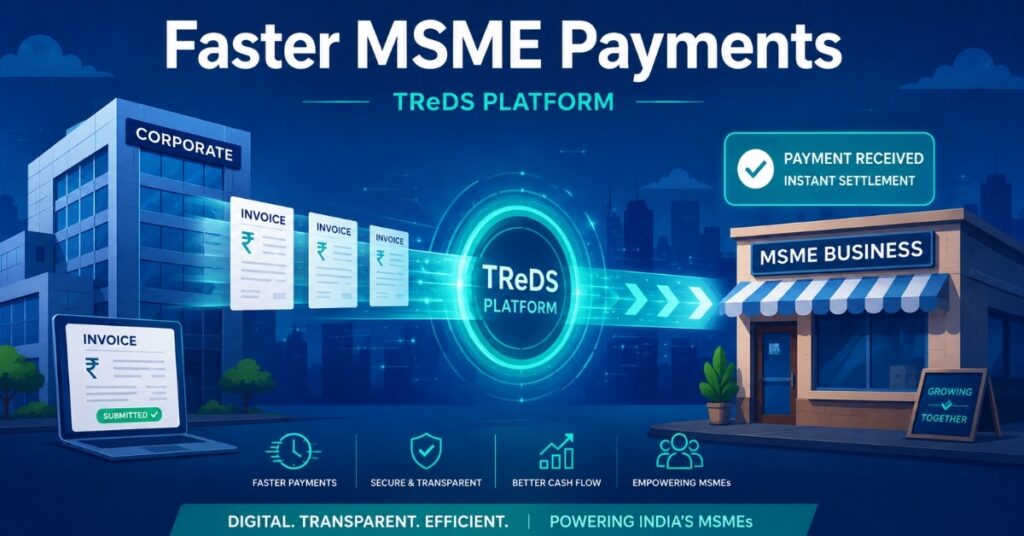
Under the new framework, Central Public Sector Enterprises are now required to route MSME invoice settlements through the RBI-authorised Trade Receivables Discounting System (TReDS). This electronic platform allows MSMEs to discount trade receivables and get paid faster instead of waiting for lengthy payment cycles. The value of invoices discounted through TReDS rose from ₹40,000 crore in 2022-23 to ₹3.47 lakh crore in 2025-26, showing rapid adoption even before the bill’s passage. Mandatory routing under the MSME Amendment Bill 2026 is expected to push this figure significantly higher in the coming years.
2. Strengthened Recovery of Dues
One of the most welcomed changes in the MSME Amendment Bill 2026 is a stronger mechanism for recovering delayed payments from buyers. Small enterprises previously had limited legal recourse when payments were delayed for months, often forced to choose between maintaining a business relationship and pursuing legal action. The revised framework aims to make recovery faster and more enforceable, reducing the financial strain caused by chronic late payments across supply chains.
3. Revised MSEFC Framework
The Micro and Small Enterprises Facilitation Councils (MSEFCs) have been strengthened as part of the reform. As of the bill’s passage, 161 MSEFCs have been established across states and union territories to adjudicate payment delay disputes, including small-value claims that were previously too costly to pursue through regular courts. This expanded network means small businesses in more regions now have local access to formal dispute redressal without long travel or heavy legal costs.
4. Online Dispute Resolution
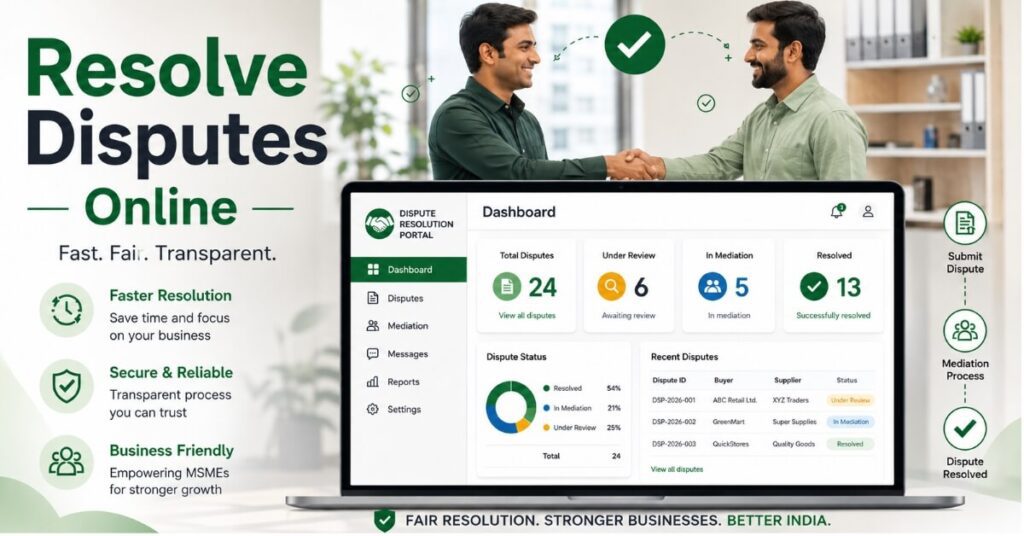
The Online Dispute Resolution (ODR) Portal, launched in June 2025, now plays a bigger role under the MSME Amendment Bill 2026. It offers a low-cost, end-to-end digital mechanism for resolving payment disputes without the delays of traditional litigation. For small business owners who previously avoided pursuing unpaid dues simply because litigation felt too expensive or time-consuming, this digital-first approach removes a significant barrier to seeking justice.

5. Simplified Classification and Digital Registration
The reform also updates classification criteria and expands the Udyam Registration Portal, which allows businesses to get official recognition through a free, paperless, self-declaration-based process. The Udyam Assist Platform additionally recognises informal micro enterprises that lack GST registration or Income Tax coverage, based on verified data from authorised partners, bringing even more small businesses under formal protection and government support schemes.
Impact of the MSME Amendment Bill 2026 on Small Businesses
For salaried professionals turned entrepreneurs, gig workers running small ventures, and traditional small manufacturers, the MSME Amendment Bill 2026 could meaningfully change how business is conducted. Faster payment cycles through mandatory TReDS routing mean improved cash flow, which is often the biggest constraint for small businesses trying to scale. Working capital stress, one of the most common reasons small businesses fail to grow beyond a certain size, may ease considerably as payment timelines shorten across the board.
The decriminalisation of certain offences under the bill also reduces the compliance burden that previously discouraged many small entrepreneurs from formalising their operations. Business owners who avoided formal registration out of fear of complex penalties may now find the environment more approachable and less risky.
Additionally, the mediation and arbitration provisions introduced under the MSME Amendment Bill 2026 give small businesses an alternative to costly and lengthy court proceedings when disputes with larger buyers or suppliers arise. This shift toward faster, cheaper dispute resolution is particularly valuable for micro enterprises that simply cannot afford prolonged legal battles stretching across multiple years.
MSMED Act 2006 vs the New Reform: What’s Different
The original MSMED Act, 2006 classified MSMEs based on prescribed investment thresholds for plant and machinery, without accounting for evolving digital business models. The MSME Amendment Bill 2026, on the other hand, modifies these classification criteria and removes certain rigid thresholds, empowering the central government to classify enterprises more flexibly based on a combination of investment and other relevant factors that better reflect modern business realities.
The bill also formally embeds mechanisms like TReDS payment routing and the ODR Portal into the law, which did not exist when the original Act was framed. Where the 2006 Act relied heavily on manual processes and state-level implementation that varied widely in effectiveness, this newer legislation creates more standardised, technology-driven systems that apply more uniformly across states and union territories, reducing regional inconsistencies in enforcement.
Sector-Wise Impact of the Reform
Different segments of the MSME sector are likely to feel the effects of the MSME Amendment Bill 2026 in different ways. Manufacturing units supplying to government departments and Central Public Sector Enterprises will see the most direct impact through mandatory TReDS routing, since a large share of their receivables often comes from public sector buyers. Export-oriented small businesses, who have historically dealt with longer payment cycles due to cross-border transactions, may also benefit indirectly as the broader push toward formal recognition strengthens their credibility with international buyers and financial institutions.
Service-based micro enterprises, including IT freelancers, consultants, and small agencies registered under Udyam, gain from simplified compliance and expanded dispute resolution access. Meanwhile, rural and semi-urban businesses, which previously had limited access to formal facilitation councils, stand to benefit from the expanded network of 161 MSEFCs now operating across the country.
Financial institutions and NBFCs are also expected to respond to the changes introduced under the MSME Amendment Bill 2026. As TReDS adoption becomes mandatory for a larger share of transactions, banks and financing platforms may design more tailored credit products around predictable, verified receivables. This could make it easier for small businesses with a strong TReDS transaction history to access working capital loans at more competitive rates, since lenders will have better visibility into payment reliability. Over time, this shift may reduce the dependency many MSMEs currently have on informal lending sources, which often carry higher interest costs and fewer borrower protections.
Who Benefits Most From This Reform?
Micro and small enterprises that regularly supply goods or services to larger buyers, including Central Public Sector Enterprises, stand to benefit the most from the MSME Amendment Bill 2026. Gig economy entrepreneurs registered on the Udyam platform, exporters dealing with delayed international payments, and small manufacturers facing chronic late payments from corporate clients are among the biggest beneficiaries of this reform.
Consider a small textile manufacturer in Andhra Pradesh who regularly supplies to a government-linked enterprise. Under the earlier framework, payments could take anywhere from 60 to 120 days despite legal timelines. With mandatory TReDS routing now in place, this manufacturer can expect faster settlement, better predictability of cash flow, and a formal recourse mechanism if delays still occur.
If you are also exploring other government-backed financial protections available to India’s growing workforce, it’s worth reading about how the NPS pension scheme is being extended to gig workers in 2026, which reflects a similar effort to formalise support for India’s informal and gig-based economy.
How Small Business Owners Can Prepare
Business owners should start by ensuring their enterprise is registered on the Udyam Registration Portal, as recognition under this system is central to accessing the protections offered by the MSME Amendment Bill 2026. Reviewing existing contracts with large buyers, particularly Central Public Sector Enterprises, to understand how TReDS-based payment routing will apply is also advisable for those preparing ahead of implementation.
Businesses currently facing payment disputes should explore the Online Dispute Resolution Portal rather than waiting for lengthy litigation, since this is one of the practical tools strengthened under the reform. It is also worth keeping documentation of past payment delays organised, as this can support faster claims through the strengthened MSEFC network established under the law. Consulting a chartered accountant or MSME advisor familiar with the MSME Amendment Bill 2026 can also help business owners understand how specific provisions apply to their situation.
It is also a good practice for business owners to periodically check official updates from the Ministry of Micro, Small and Medium Enterprises, since implementation guidelines, notification dates, and procedural details are likely to be released in phases. Staying informed early can help businesses avoid last-minute compliance issues and take fuller advantage of the protections and support mechanisms this reform is designed to offer.
For readers who want to study the bill in complete legal detail, the official bill-tracking summary is available on PRS India’s legislative tracker.
Common Misconceptions About the MSME Amendment Bill 2026
Some small business owners assume this reform only benefits large exporters or manufacturers, but the scope is far broader. Service-based micro enterprises, freelancers operating as registered businesses, and even informal traders recognised through the Udyam Assist Platform fall within its coverage. Another common misconception is that formal registration is complicated or costly. In reality, the process remains free, paperless, and based on self-declaration, making it accessible even for very small operations.
A third misconception is that the changes take effect immediately and automatically for every business. In practice, implementation is likely to be phased, and business owners should watch for official notifications from the Ministry of Micro, Small and Medium Enterprises regarding specific timelines and procedural requirements under the MSME Amendment Bill 2026.
Frequently Asked Questions
Q1. What is the MSME Amendment Bill 2026?
The MSME Amendment Bill 2026 is an update to the MSMED Act, 2006, passed by Parliament in August 2026 to strengthen payment recovery, dispute resolution, and compliance simplification for India’s MSME sector.
Q2. When was the MSME Amendment Bill 2026 passed?
The Lok Sabha passed the bill on 3rd August 2026, and it cleared Parliament shortly after in the same month.
Q3. How does the MSME Amendment Bill 2026 help with delayed payments?
It mandates that Central Public Sector Enterprises route MSME invoice settlements through the TReDS platform and strengthens recovery mechanisms and MSEFC dispute resolution processes.
Q4. Do I need to register on Udyam to benefit from the bill?
Yes, Udyam registration remains central to accessing formal recognition and the protections outlined under the reform.
Q5. Where can small businesses resolve payment disputes now?
Through the Online Dispute Resolution (ODR) Portal, launched in June 2025, or through their state’s Micro and Small Enterprises Facilitation Council (MSEFC).
Q6. Does the bill apply to service-based small businesses too?
Yes, the reforms are not limited to manufacturers. Service providers, freelancers operating as registered enterprises, and traders recognised under the Udyam Assist Platform are also covered.
Q7. How is this different from the earlier MSMED Act, 2006?
The earlier Act relied on rigid investment-based classification and largely manual, state-level enforcement. The MSME Amendment Bill 2026 introduces standardised digital mechanisms like TReDS and the ODR Portal directly into law.
Conclusion
The MSME Amendment Bill 2026 marks a significant step toward strengthening India’s small business ecosystem by addressing long-standing payment delays and simplifying dispute resolution. For millions of MSMEs contributing nearly a third of India’s GDP, this reform could meaningfully improve cash flow, reduce compliance stress, and support long-term business growth. Small business owners are encouraged to complete their Udyam registration if they haven’t already, review their payment terms with larger buyers, and stay updated on how implementation of this reform unfolds over the coming months.
Disclaimer
This article is for informational purposes only and does not constitute legal, financial, or professional advice. Readers should verify details from official government sources such as the Ministry of Micro, Small and Medium Enterprises and consult a qualified professional before making business or financial decisions based on this legislative update.


Pingback: CBDT FAST-DS Scheme 2026: 7 Shocking Facts to Know