

Losing a loved one is hard enough without the added stress of paperwork. For years, Indian families struggled to claim mutual fund investments after the death of an account holder because of small mismatches in address, name, or signature. The good news is that the mutual fund nominee rules have just been simplified by the Association of Mutual Funds in India (AMFI), and this change is set to make life easier for lakhs of nominees across the country.
If you have ever wondered how mutual fund units get transferred after death, or if you are currently trying to understand the mutual fund nominee rules that apply to your family’s investments, this article breaks everything down in simple language. We will cover what has changed, why it matters, and exactly how you can use these updated mutual fund nominee rules to claim your funds without unnecessary delays.
What Are Mutual Fund Nominee Rules?
Mutual fund nominee rules are the guidelines set by AMFI and SEBI that decide how mutual fund units are transferred to a nominee or legal heir when the original investor passes away. This process is officially called “transmission of units.” Under the mutual fund nominee rules, a nominee is treated as a trustee who holds the units on behalf of the legal heirs, unless the nominee is also the sole legal heir.
Every mutual fund investor is encouraged to add up to three nominees to their folio, and SEBI regulations require investors to either nominate someone or formally opt out of nomination. This step ensures that in the unfortunate event of death, the family does not face unnecessary legal hurdles while claiming the investment.
Why AMFI Updated the Mutual Fund Nominee Rules
Earlier, thousands of families faced rejection or delay in transmission requests simply because the name on the death certificate did not exactly match the name in the mutual fund folio, or the address on record was outdated. These minor documentation issues caused emotional and financial stress at a time when families were already grieving.
Recognising these operational difficulties, AMFI has revised its Standard Operating Procedure (SOP) for mutual fund transmission. The updated mutual fund nominee rules now allow Asset Management Companies (AMCs) to accept transmission requests even when there is a minor mismatch in address, name, or signature, as long as other supporting documents establish the claimant’s identity clearly. This is a major relief for nominees who previously had to run from pillar to post to correct small clerical errors.

Key Changes Under the New Mutual Fund Nominee Rules
1. Address Mismatch Relaxation
Under the revised mutual fund nominee rules, AMCs can now accept transmission requests even if the address mentioned in the application does not exactly match the address in official records. Claimants can submit alternate proof of address, such as Aadhaar or a utility bill, to complete the process smoothly.
2. Name Mismatch Relaxation
Small spelling differences or variations in how a name is written are no longer a reason for rejection. According to the updated mutual fund nominee rules, self-certified identity documents like Aadhaar or Passport can now be used to resolve name mismatches, instead of demanding a fresh set of notarised documents.
3. Signature Mismatch Relaxation
Signatures can change over the years, especially for elderly investors. The new mutual fund nominee rules recognise this reality and allow AMCs to accept transmission requests even when the signature on file looks slightly different from the current signature, provided the claimant’s identity is otherwise verified.
4. Faster Processing Timelines
Because AMCs no longer need to send back applications for small corrections, the overall transmission process is expected to move faster. Families completing the process correctly can now expect their claims to be processed with fewer back-and-forth requests.
5. Simplified Online Transfer
Many fund houses have also improved their online transmission portals. The transferor can log in using their PAN, select the scheme, and fill in the transferee’s details digitally, which reduces the dependency on physical paperwork and branch visits.
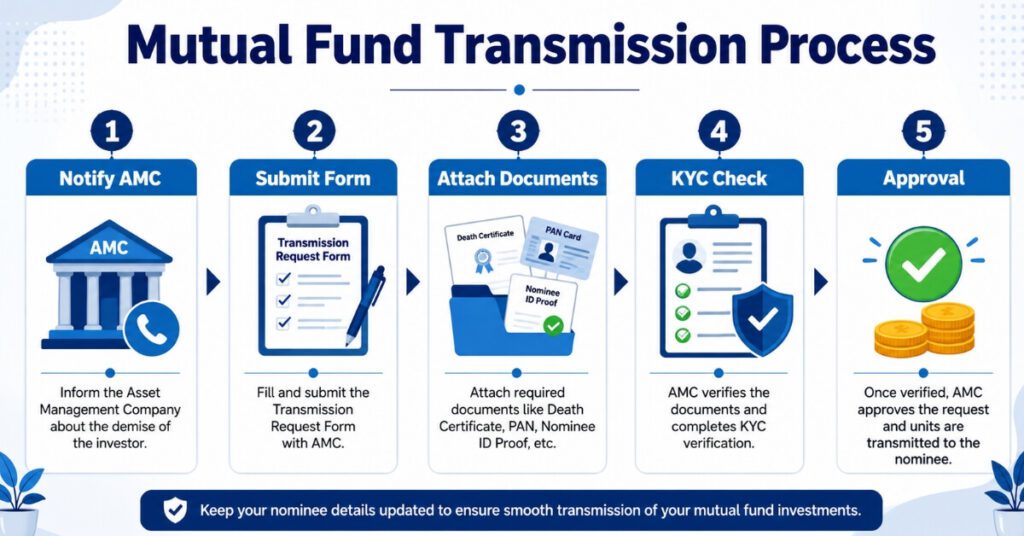
How to Claim Mutual Fund Units as a Nominee
If you are a nominee trying to claim mutual fund units after the death of an investor, here is the general process based on the current mutual fund nominee rules:
Step 1: Notify the AMC or RTA
Contact the Asset Management Company (AMC) or the Registrar and Transfer Agent (RTA), such as CAMS or KFin Technologies, and inform them about the death of the unit holder.
Step 2: Submit the Transmission Request Form
Fill out the transmission request form, commonly known as Form T1, T2, or T3, depending on whether the transfer is to a single nominee, joint nominees, or legal heirs.
Step 3: Attach Required Documents
You will typically need the death certificate, PAN card of the nominee, KYC documents, a cancelled cheque with the nominee’s name, and a copy of the nominee’s bank passbook. Under the relaxed mutual fund nominee rules, minor mismatches in these documents will no longer automatically block your claim.
Step 4: Complete KYC Verification
Ensure the nominee’s KYC status shows as “KYC Complied,” since transmission cannot be completed if the KYC is pending or on hold.
Step 5: Track the Transmission Status
Once submitted, you can track your application status directly with the AMC or RTA. Most fund houses now provide online tracking to keep the process transparent.

Documents Required for Mutual Fund Transmission
Duly filled transmission request form (T1, T2, or T3)
Original or attested copy of the death certificate
Nominee’s PAN card
Nominee’s KYC documents
Cancelled cheque or bank passbook copy with the nominee’s name
Self-certified identity proof such as Aadhaar or Passport, wherever mismatches exist
Joint Holder Transmission Under Mutual Fund Nominee Rules
If a mutual fund folio has joint holders and the first holder passes away, the units are automatically transmitted to the surviving joint holder. As per the mutual fund nominee rules, the surviving holder simply needs to submit a transmission request along with the death certificate, without needing to prove nomination separately, since they already have legal ownership rights over the folio.
What Happens If There Is No Nominee?
When an investor has not registered a nominee, the mutual fund nominee rules require the legal heirs to submit additional documentation, such as a legal heir certificate, succession certificate, or probate of will, depending on the value of the investment and applicable state laws. This process can take significantly longer, which is why AMFI strongly recommends every investor register at least one nominee at the time of investment.
Why You Should Update Your Nominee Details Today
Many investors set up their mutual fund nominee once and forget about it for years. However, life circumstances change through marriage, childbirth, or the passing of a previously nominated family member. Reviewing your nomination details periodically and updating them ensures your investments reach the right person without complications.
If you’re also managing other financial documents digitally, our related guide on how to upload your photo on the EPF passbook portal explains a similar step-by-step process for keeping your financial records updated and hassle-free.
For official and detailed guidance on nomination and transmission procedures, you can also refer to the AMFI nomination guidelines, which outlines the complete framework governing mutual fund nominee rules in India.
Common Mistakes to Avoid With Mutual Fund Nominee Rules
Many investors unknowingly delay their family’s claim process because of avoidable errors. Here are common mistakes to watch out for:
Not registering a nominee at all, leaving the folio without a designated claimant
Registering an outdated nominee whose details no longer match current KYC records
Forgetting to update the nominee’s contact information or bank account details
Assuming a will automatically overrides mutual fund nominee rules without formal succession documentation
Ignoring KYC compliance, which can stall the entire transmission process
How These Changes Benefit Investors
The revised mutual fund nominee rules are designed to reduce emotional and procedural burden on grieving families. Instead of rejecting applications for trivial mismatches, AMCs are now instructed to look at the overall picture and verify identity through alternate documents. This investor-friendly approach reflects a broader shift toward simplifying compliance while still protecting against fraud.
For everyday investors, this means peace of mind. Knowing that your family will not be stuck fighting paperwork battles during an already difficult time makes registering and reviewing your nominee details even more important.
Difference Between Nomination and Legal Heir Claims
It is important to understand that nomination and legal inheritance are two different concepts, even though they often get confused. A nominee is the person authorised to receive the mutual fund units on behalf of the family after the investor’s death, but this does not automatically make the nominee the legal owner of the money. The nominee acts as a trustee and is expected to distribute the proceeds according to the deceased investor’s will, or as per succession laws if there is no will.
Legal heirs, on the other hand, are determined by inheritance laws applicable to the deceased based on religion, marital status, and family structure. In cases where the nominee and the legal heir are different people, disputes can sometimes arise. This is exactly why AMCs recommend that investors keep their nomination updated and, wherever possible, align it with their overall estate planning to avoid confusion for their families later.
Role of RTAs Like CAMS and KFin Technologies
Registrar and Transfer Agents such as CAMS and KFin Technologies play a central role in processing transmission requests on behalf of Asset Management Companies. When a claimant submits documents, the RTA verifies the paperwork, checks KYC compliance, and coordinates with the AMC to release the units or process a redemption in favour of the nominee. Many RTAs now offer online tracking tools where claimants can monitor the status of their transmission request without repeatedly calling customer support.
If you are dealing with multiple mutual fund schemes across different fund houses, it helps to check whether all your folios are serviced by the same RTA, since this can simplify the paperwork considerably. Both CAMS and KFin Technologies also provide dedicated helplines and email support specifically for transmission-related queries, which can be useful if you face any confusion during the process.

Tips to Make the Claim Process Smoother for Your Family
Planning ahead can save your family significant time and emotional stress later. Here are a few practical steps every investor should consider:
Keep a written or digital record of all your mutual fund folios, along with the AMC and RTA details, in a place your family can easily access.
Regularly update your KYC information, especially your address, phone number, and email ID, so that documents match at the time of a claim.
Inform your nominee that they have been nominated, and briefly explain the documents they will need if the situation arises.
Consider consolidating old or dormant folios where possible, to reduce the number of separate transmission requests your family may need to file.
Revisit your nomination whenever there is a major life event, such as marriage, divorce, childbirth, or the death of a previously nominated person.
Taking these small steps today can make a significant difference in how quickly and smoothly your family is able to access your investments when it matters most.
Impact on the Broader Mutual Fund Industry
Industry experts believe that easing the transmission process will encourage more first-time investors to formally register nominees at the time of investment, rather than skipping this step out of confusion or lack of awareness. A smoother claims experience also builds greater trust in mutual funds as a long-term savings instrument, particularly among first-generation investors who may already be hesitant about market-linked products.
For AMCs and RTAs, the revised approach also reduces the operational burden of repeatedly rejecting and reprocessing applications over trivial documentation gaps. This allows customer service teams to focus on genuine verification concerns instead of clerical corrections, ultimately benefiting both the industry and everyday investors.
Looking ahead, industry watchers expect further digitisation of the transmission process, with AMCs increasingly relying on Aadhaar-based e-KYC and digital signatures to verify claimants faster. As more households turn to mutual funds for long-term goals like retirement, children’s education, and wealth creation, having a smooth and predictable process for passing on these investments becomes just as important as choosing the right fund in the first place. Financial advisors often suggest reviewing nomination details alongside your annual portfolio review, so that estate planning does not become an afterthought.
Frequently Asked Questions on Mutual Fund Nominee Rules
Q1. Can I transfer my mutual fund units to my nominee while I am alive?
No, nominee transmission only takes effect after the death of the investor. While alive, you can only add, update, or remove nominees on your folio; actual transfer of units happens only through the transmission process after death.
Q2. How many nominees can I add to my mutual fund folio?
As per current mutual fund nominee rules, you can add up to three nominees per folio and specify the percentage share for each nominee.
Q3. What if there is a name mismatch between the death certificate and the folio?
Under the updated guidelines, minor name mismatches can now be resolved using self-certified identity documents such as Aadhaar or Passport, instead of rejecting the transmission request outright.
Q4. Is transmission of units taxable for the nominee?
Transmission of mutual fund units to a nominee is not treated as a transfer for capital gains tax purposes. However, tax may apply later when the nominee eventually redeems the units, based on the original cost and holding period of the deceased investor.
Q5. How long does the transmission process take under the new mutual fund nominee rules?
While timelines vary by AMC, the relaxed transmission guidelines are expected to reduce delays significantly since minor documentation mismatches no longer require repeated resubmissions.
Q6. What happens if the KYC of the nominee is not complete?
Transmission cannot be completed until the nominee’s KYC status shows as “KYC Complied.” It is advisable to complete your KYC in advance to avoid delays when the need for transmission arises.
Conclusion
The updated mutual fund nominee rules mark a welcome and much-needed change for Indian investors. By relaxing the strict requirements around address, name, and signature matching, AMFI has made it significantly easier for families to claim what rightfully belongs to them during an already emotional time. Whether you are an existing investor or just starting your mutual fund journey, take a few minutes today to review your nominee details and ensure they are up to date. Understanding the mutual fund nominee rules now can save your loved ones from unnecessary stress later.
Disclaimer
This article is for informational purposes only and should not be considered as financial or legal advice. Mutual fund investments are subject to market risks. Please read all scheme-related documents carefully and consult a certified financial advisor or the respective AMC before making any investment or transmission-related decisions.


Pingback: NSE IPO Allotment Status Check Online: 7 Easy Steps