

Tata Capital share target 2030 has become one of the most searched financial topics among Indian retail investors ever since the company completed its long-awaited stock market listing. Backed by the trust of the Tata Group, Tata Capital Ltd has quickly become a favourite among both new and experienced investors who are trying to understand where this NBFC giant could be headed over the next several years. In this article, we take a neutral, data-driven look at the Tata Capital share target 2030, covering the company’s fundamentals, growth drivers, expert opinions, risks, and everything an investor needs to know before making a decision.
Understanding Tata Capital Ltd
Tata Capital Ltd is the financial services arm of the Tata Group, offering a wide range of products including personal loans, home loans, business loans, wealth management, and leasing solutions. As one of India’s largest non-banking financial companies (NBFCs), the company has built a strong reputation for stability and customer trust over the years. This reputation is a major reason why so many investors are curious about the Tata Capital share target 2030 and whether the stock can deliver long-term wealth creation similar to other Tata Group companies.
The company’s IPO was one of the most anticipated listings in recent memory, and since then, market watchers have been closely tracking every quarterly result to refine their Tata Capital share target 2030 estimates. With a strong parent company, an experienced management team, and a diversified loan book, Tata Capital enters the next decade with several structural advantages.
Current Share Price Snapshot
As of the most recent trading session, Tata Capital shares have been trading in a broad range, reflecting both the optimism around its long-term prospects and the natural volatility that comes with any newly listed large-cap stock. The stock’s 52-week range shows meaningful movement, and short-term price swings are common as institutional and retail investors continue to build positions. While daily price action grabs headlines, the more important conversation for long-term investors is the Tata Capital share target 2030, since it reflects where the business could realistically be valued after several years of compounding growth.
Investors evaluating the Tata Capital share target 2030 should look beyond daily price charts and instead focus on the company’s earnings trajectory, asset quality, and expansion strategy, all of which will ultimately determine whether the stock can deliver meaningful returns by the end of the decade.

Key Growth Drivers Behind the Tata Capital Share Target 2030
Several factors are commonly cited by analysts when discussing the Tata Capital share target 2030. First, India’s overall credit penetration remains relatively low compared to developed economies, which means NBFCs like Tata Capital have a long runway for growth as more Indians access formal credit for homes, vehicles, education, and business needs. Second, the company’s association with the Tata brand gives it a trust advantage that smaller or newer NBFCs simply cannot match, helping it acquire customers at a lower cost.
Third, digital transformation across the lending industry is reducing operational costs and improving loan disbursement speed, both of which support margin expansion over time. Fourth, Tata Capital’s diversified portfolio across retail, SME, and corporate lending reduces concentration risk, which is an important consideration for anyone trying to estimate a realistic Tata Capital share target 2030. Finally, rising financialisation of household savings in India, along with growing demand for wealth management and insurance distribution services, could open new revenue streams that further support long-term valuation.
Analyst and Market Sentiment
Brokerage houses and independent analysts have offered a range of views on where the stock could head, and naturally, opinions on the Tata Capital share target 2030 vary depending on assumptions around loan book growth, interest rate cycles, and asset quality trends. Some analysts remain optimistic, pointing to the company’s strong return ratios and disciplined underwriting standards as reasons for a constructive long-term view. Others caution that increased competition from banks, fintech lenders, and other established NBFCs could put pressure on margins, which is why any Tata Capital share target 2030 projection should be treated as an estimate rather than a guarantee.
It is worth noting that long-term price targets, including any Tata Capital share target 2030, are inherently uncertain and depend on macroeconomic conditions such as GDP growth, interest rate movements, inflation trends, and regulatory changes in the NBFC sector. Investors should treat all such projections as directional guidance rather than precise forecasts.
Risks That Could Impact the Tata Capital Share Target 2030
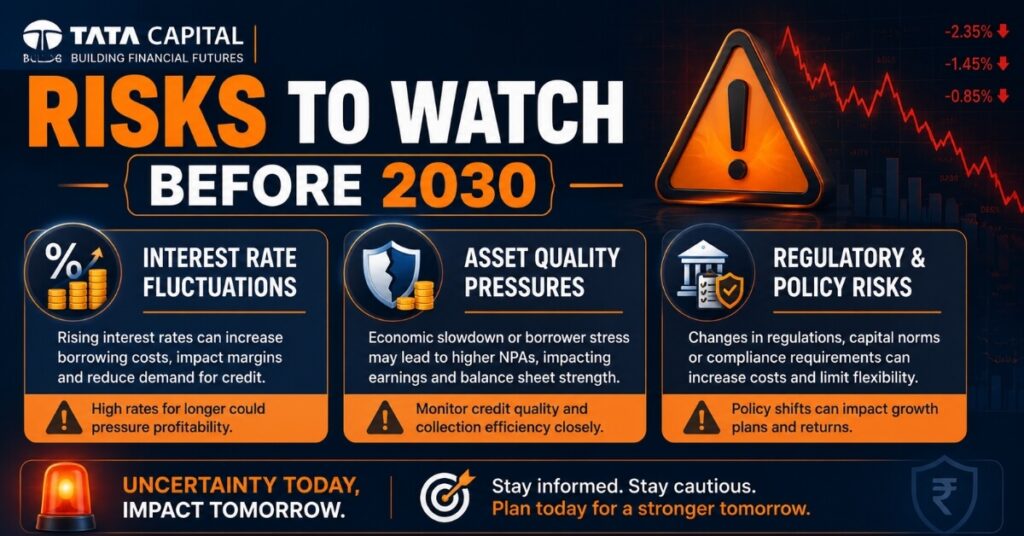
No long-term investment thesis is complete without an honest look at potential risks. Interest rate volatility is one of the biggest variables that could influence the Tata Capital share target 2030, since NBFCs are sensitive to borrowing costs and net interest margins. A sustained period of high interest rates could compress margins and slow credit growth.
Asset quality is another important factor. Any meaningful rise in non-performing assets (NPAs) could dent investor confidence and weigh on the stock’s valuation multiple. Regulatory changes from the Reserve Bank of India regarding capital adequacy norms, lending practices, or NBFC classification could also alter the competitive landscape. Additionally, broader market corrections, global economic slowdowns, or sector-wide de-rating of financial stocks could temporarily impact price movement, regardless of the company’s underlying fundamentals.

Financial Performance and Fundamentals
A closer look at Tata Capital’s financial fundamentals helps put the Tata Capital share target 2030 conversation into better perspective. The company has reported healthy year-on-year growth in its loan book, supported by strong disbursement volumes across retail, SME, and corporate segments. Net interest income and profit after tax have shown consistent improvement in recent quarters, reflecting the benefits of scale and operating leverage. The company’s capital adequacy ratio remains comfortably above regulatory requirements, giving it room to expand its balance sheet without immediate pressure to raise additional capital.
Return on assets and return on equity, two of the most closely watched profitability metrics for NBFCs, have generally trended in a healthy range, though they can fluctuate depending on provisioning requirements and credit cost cycles. Analysts building long-term models typically project these ratios forward under different scenarios, factoring in India’s credit growth outlook, competitive intensity, and potential changes in the interest rate environment over the coming years.
Bull Case and Bear Case Scenarios
Like most long-term equity stories, there are both optimistic and cautious scenarios worth considering. The bull case rests on the assumption that India’s credit penetration continues to rise steadily, that Tata Capital successfully cross-sells insurance, wealth management, and other financial products to its existing customer base, and that the company maintains disciplined underwriting even as it scales aggressively. Under this scenario, sustained earnings growth combined with a premium valuation multiple, driven by the strength of the Tata brand, could support meaningfully higher share prices by 2030.
The bear case, on the other hand, assumes intensifying competition from digital-first lenders and banks with lower cost of funds, gradual margin compression, and periodic asset quality stress during economic slowdowns. In this scenario, earnings growth could be slower than expected, and the stock’s valuation multiple might compress rather than expand, limiting upside potential. Most realistic outlooks fall somewhere between these two extremes, which is why investors should treat any single-point estimate with appropriate caution and instead think in terms of ranges and probabilities.
Tata Capital vs Peer NBFCs
When evaluating the Tata Capital share target 2030, it helps to compare the company with other established NBFCs and housing finance companies in India. While direct comparisons can be tricky due to differences in loan book composition and geographic focus, investors generally look at metrics such as return on assets, return on equity, gross NPA ratio, and loan growth rate to benchmark performance. Companies with the backing of strong parent groups, similar to Tata Capital, have historically commanded premium valuations due to lower perceived risk and easier access to capital during economic downturns.

How Long-Term Investors Can Approach This Stock
For investors specifically interested in the Tata Capital share target 2030, a systematic approach often works better than trying to time short-term price movements. This can include staggered investment through SIPs in mutual funds that hold the stock, periodic review of quarterly results, and monitoring key metrics like net interest margin, provisioning coverage ratio, and loan book growth. Rather than fixating on a single price number, long-term investors are generally better served by tracking whether the company continues to execute on its stated growth strategy year after year.
It is also worth diversifying across sectors rather than concentrating too much capital in a single NBFC stock, no matter how promising the long-term story appears. A well-balanced portfolio that includes exposure to banking, technology, consumer goods, and other sectors tends to reduce overall risk while still allowing participation in India’s broader growth story. For readers who are also tracking related opportunities in other sectors, understanding stocks like Laurus Labs share price target can provide useful context for building a well-diversified, growth-oriented portfolio alongside NBFC holdings like Tata Capital.
Another practical approach for long-term investors is to set realistic expectations from the outset. Rather than anchoring decisions to a single headline number, it helps to build a range of possible outcomes based on different growth and margin assumptions, and to revisit that range periodically as new quarterly data becomes available. This kind of scenario-based thinking tends to produce more resilient portfolios than simply chasing a specific target price, since it forces investors to continuously validate whether the underlying business is actually performing in line with expectations.
Position sizing also matters a great deal. Even investors who are highly confident in a company’s long-term prospects generally benefit from limiting any single stock to a reasonable percentage of their overall portfolio. This discipline helps protect against unforeseen events, whether company-specific, such as a regulatory setback, or macroeconomic, such as a sharp rise in interest rates or a slowdown in consumer credit demand. Combining thoughtful position sizing with periodic portfolio rebalancing allows investors to stay invested in promising long-term stories while still managing downside risk effectively.
The Role of India’s Broader Financial Sector Growth
India’s financial services sector has been undergoing rapid transformation over the past decade, driven by rising incomes, greater digital adoption, and improving access to formal credit in smaller towns and rural areas. NBFCs have played a crucial role in this expansion, often reaching customer segments that traditional banks have historically underserved. This structural shift in India’s credit landscape forms an important part of the broader investment thesis for many NBFC stocks, including Tata Capital.
Government initiatives aimed at improving financial inclusion, along with the continued rollout of digital public infrastructure for lending and credit verification, have made it easier and faster for NBFCs to assess borrower risk and disburse loans efficiently. These structural tailwinds are expected to persist over the next several years, supporting continued growth across the sector. However, execution still matters enormously, and companies that combine strong governance, prudent risk management, and efficient capital allocation are generally better positioned to capture a disproportionate share of this growth compared to peers that expand more aggressively without adequate risk controls.
The Road Ahead
Looking toward the rest of the decade, the Tata Capital share target 2030 will likely be shaped by how effectively the company scales its digital lending infrastructure, manages asset quality through different economic cycles, and capitalises on India’s expanding credit market. With a strong parentage, an experienced leadership team, and a diversified business model, Tata Capital appears well positioned to participate in India’s long-term financial services growth story, though as with any equity investment, actual outcomes will depend on execution and external market conditions.
Investors tracking authoritative market data can also refer to NSE India for official price updates, trading volumes, and corporate announcements related to the stock, which can provide additional context when evaluating any long-term price target.
Global macroeconomic conditions will also play a role in shaping this journey. Interest rate decisions by the Reserve Bank of India, global commodity price trends, currency movements, and overall investor sentiment toward emerging markets can all influence how financial stocks are valued over multi-year periods. While these factors are largely outside any single company’s control, well-managed businesses tend to navigate changing macro cycles more effectively than their peers, which is one reason why governance and management quality remain such important considerations for long-term investors evaluating NBFC stocks in India.
Frequently Asked Questions
Q1. What is the Tata Capital share target 2030?
The Tata Capital share target 2030 refers to analyst and market projections for where the stock’s price could potentially trade by the year 2030, based on assumptions around earnings growth, loan book expansion, and overall NBFC sector performance. It is important to remember that this is a projection, not a guarantee.
Q2. Is Tata Capital a good long-term investment?
Many analysts view Tata Capital favourably due to its strong parentage, diversified loan portfolio, and growth potential in India’s expanding credit market. However, like any equity investment, it carries risks, and investors should do their own research or consult a financial advisor before making decisions related to any Tata Capital share target 2030 estimate.
Q3. What factors could affect the Tata Capital share target 2030?
Key factors include interest rate movements, asset quality trends, regulatory changes, competitive pressure from banks and fintech lenders, and broader macroeconomic conditions in India.
Q4. How can investors track progress toward the Tata Capital share target 2030?
Investors can monitor quarterly earnings reports, loan book growth, net interest margins, and asset quality metrics, along with broader market commentary from brokerage research reports.
Q5. Are long-term price targets like the Tata Capital share target 2030 reliable?
Long-term price targets are estimates based on current assumptions and can change significantly as new information becomes available. They should be used as directional guidance rather than precise predictions.
Q6. What is the minimum investment needed to invest in Tata Capital shares?
There is no fixed minimum investment amount for buying Tata Capital shares on the stock exchange — investors can purchase as little as one share through their demat account, subject to the current market price and their broker’s terms.
Q7. Will Tata Capital pay dividends by 2030?
Dividend payouts depend on the company’s future profitability, capital requirements, and board decisions. While NBFCs with strong parentage like Tata Capital often maintain steady dividend policies, investors should track annual reports and board announcements for updated dividend guidance rather than assuming a fixed payout.
Conclusion
The Tata Capital share target 2030 continues to attract attention from investors who believe in the long-term growth story of India’s financial services sector. With strong brand backing, a diversified business model, and exposure to India’s expanding credit market, the company has several structural advantages working in its favour. That said, achieving any specific price target depends on multiple variables, including interest rate cycles, asset quality, and competitive dynamics. Investors interested in the Tata Capital share target 2030 should approach the stock with a long-term mindset, stay updated with quarterly performance, and maintain a diversified portfolio rather than relying solely on price target speculation.
Disclaimer
This article is for informational and educational purposes only and should not be considered financial or investment advice. Stock market investments are subject to market risks, and past performance is not indicative of future results. The Tata Capital share target 2030 figures mentioned or implied in this article are based on general market analysis and publicly available information, and actual outcomes may vary significantly. Readers are strongly advised to consult a certified financial advisor and conduct their own research before making any investment decisions.


Pingback: Is Indo MIM Ltd IPO Worth Investing? 5 Proven Amazing Facts