

Introduction
The biggest question every retail investor is asking today is — should you stop or continue SIP investments. when mutual fund companies are selling heavily in the market? While SIP inflows are hitting record highs of nearly ₹35,000 crore every month, mutual fund houses are simultaneously offloading positions in select stocks. This contradiction is making investors nervous about their portfolio. Many people are wondering whether to pause their monthly contributions immediately or stay disciplined despite the market uncertainty.
Before you decide whether .should you stop or continue SIP investments, it is extremely important to understand why mutual funds are selling stocks and what this activity actually means for your money. Retail investors who panic during market volatility almost always regret their choices later. On the other hand, those who maintain their discipline through market cycles consistently build more wealth over the long term. In this article, we will break down everything — from the real reasons behind mutual fund selling to expert advice on whether **should you stop or continue SIP investments .right now.
What Is Happening in the Market Right Now?
The Indian mutual fund market in 2026 is showing a very interesting contradiction. On one hand, retail investor participation is at an all-time high with monthly SIP inflows nearing ₹35,000 crore. On the other hand, several large mutual fund houses have been heavily offloading positions in certain stocks due to global uncertainty, crude oil price fluctuations, and domestic market volatility.
This combination is confusing investors about whether .should you stop or continue SIP investments. They see headlines about mutual funds selling stocks and immediately assume something is wrong with their equity portfolio. But the reality is very different from what headlines suggest.
Despite falling markets in early 2026, equity inflows into mutual funds remained positive. This means millions of investors chose to stay invested even when fund managers were actively selling specific stocks. Smart investors understood that mutual fund selling is a professional portfolio management activity — not a signal that helps you decide if . should you stop or continue SIP investments.

Why Are Mutual Fund Companies Selling Stocks?
Understanding why Asset Management Companies (AMCs) sell stocks is the key to staying calm. If you understand the real reasons, you will never feel the urge to disrupt your financial journey. When evaluating whether .should you stop or continue SIP investments. consider these main reasons why mutual fund companies sell stocks heavily:
1. Portfolio Rebalancing
Every mutual fund has a target asset allocation — a fixed percentage that should be in equity, debt, gold, and other assets. When markets rise sharply, equity exposure automatically increases beyond the target limit. To bring the portfolio back in balance, fund managers must sell some equity holdings. This process is called portfolio rebalancing, and it is never a reason that should dictate whether **should you stop or continue SIP investments.
Example: If a fund’s target is 70% equity and strong market performance pushes it to 85%, the fund manager must sell stocks worth 15% of the portfolio. This selling has nothing to do with your personal investment performance.
2. Profit Booking After Bull Run
When a particular stock or sector has risen significantly, fund managers book profits to lock in gains for their investors. The money collected from selling is then reinvested into better-valued opportunities. This is a standard and healthy investment practice, not a trigger to analyze whether should you stop or continue SIP investments.
3. SEBI Regulatory Compliance
In March 2026, SEBI’s Master Circular for Mutual Funds made it mandatory for fund pairs — particularly in sectoral and thematic categories — to keep portfolio overlap below 50% with other schemes from the same AMC. This regulatory change forced many fund houses to restructure their portfolios, leading to heavy selling in some overlapping stocks. Your decision regarding should you stop or continue SIP investments. should never be affected by regulatory restructuring at the fund level.
4. Sector Rotation Strategy
Fund managers constantly rotate money from overvalued sectors to undervalued ones. When one sector becomes expensive relative to its fundamentals, they exit and move capital into sectors with better growth potential. This sector rotation is normal fund management and shouldn’t impact your dilemma of whether should you stop or continue SIP investments.
5. Managing Global Risk Factors
In 2026, geopolitical tensions, crude oil price fluctuations, and global trade policy shifts have forced many fund managers to reduce exposure to certain cyclical and high-risk stocks. For example, Parag Parikh Flexi Cap Fund exited 34 stocks during a portfolio restructuring phase while Kotak Multicap Fund added 10 new stocks. Both moves were strategic decisions — not reasons for retail investors to think about whether .should you stop or continue SIP investments.

Should You Stop or Continue SIP Investments?
This is the most critical question every investor is asking right now. So, should you stop or continue SIP investments. when mutual funds are selling heavily? Based on all available data, expert opinion, and 30 years of historical evidence, the answer is absolutely clear — you should keep your investments running without any interruption. Here is the detailed reasoning:
6. Portfolio Selling vs. Fresh Inflows
When a mutual fund sells stocks from its existing portfolio, it does not mean your fresh investment is at risk. Your new installment is invested at the current Net Asset Value (NAV) and buys new units. The fund manager’s selling activity involves existing holdings — not your incoming money. These are completely separate processes, making it clear why should you stop or continue SIP investments leans heavily toward staying invested.
7. Rupee Cost Averaging Benefits
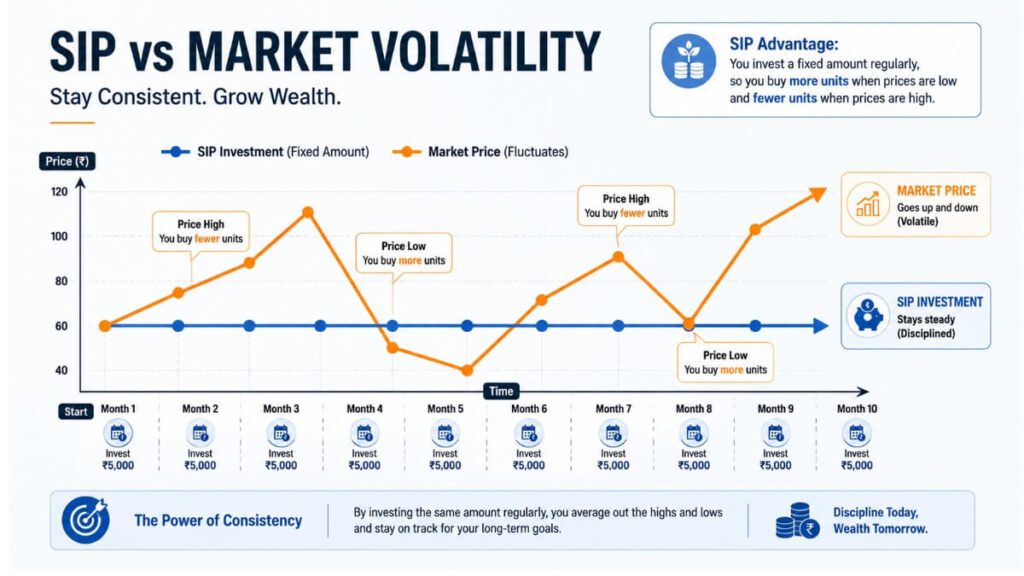
When markets fall and NAVs drop, your fixed monthly investment amount automatically buys more units at a lower price. This is called rupee cost averaging. When people ask whether should you stop or continue SIP investments during a market downturn, they often forget that pausing means missing out on accumulating units at discounted prices. Investors who stay disciplined during downturns always benefit more from the eventual market recovery.
8. Thirty-Year Historical Data
Historical data from the Indian market spanning 30 years clearly shows that investors who chose to stay consistent through market cycles consistently outperformed those who stopped and restarted later.
| Investment | Monthly | Duration | Final portfolio value | XIRR |
| Consistent | ₹10,000 | 30 Years | ~₹3.38 Crore | 12.48% |
This long-term data removes all doubts when considering whether should you stop or continue SIP investments.
9. Market Corrections are Opportunities
When markets fall, investors who don’t panic are actually in the most advantageous position. Lower market levels allow accumulation at more reasonable valuations, which directly improves long-term return potential. Every falling market is the best opportunity to collect more units cheaply, answering the big question of whether should you stop or continue SIP investments during corrections.
10. The Hidden Long-Term Cost of Pausing
Many investors do not realize that pausing your portfolio has a real financial cost that compounds over time. The months you pause are months where you do not accumulate units. When markets recover — and historically they always do — you miss the full benefit of the recovery on those missing units. Over a 10 to 15 year horizon, even a 6-month break can reduce your final corpus by several lakhs of rupees.

The Psychology Behind Investor Decisions
Research on investor behavior consistently shows that people face the dilemma of whether should you stop or continue SIP investments .at exactly the wrong time — when markets are falling and sentiment is most negative. This emotional reaction is driven by loss aversion, a psychological bias where people feel the pain of losses more strongly than the pleasure of equivalent gains.
Consider two real-world investor scenarios from recent years:
Investor A:Panicked during the market correction of 2024-25, stopped their monthly investments for 8 months, and switched funds twice while chasing past performance.
Investor B: Felt the same discomfort but understood how to handle the question of whether should you stop or continue SIP investments choosing to stay active without interruption.
By the time markets recovered in 2026, Investor B held significantly more units accumulated at lower costs during the correction phase — leading to a substantially higher portfolio value.
What Should You Do Instead of Stopping Your SIP?
If you are worried about mutual funds selling heavily, here are smarter and more productive actions you can take instead of debating whether should you stop or continue SIP investments.
Review Your Fund Selection Regularly. Check whether your current mutual fund is still aligned with your financial goal. Look at 5-year performance consistency, fund manager track record, and expense ratio.
Top-Up Your Investments Annually: Instead of stopping, consider increasing your monthly investment amount by 10% every year. This simple habit can significantly boost your final wealth corpus.
Add Multi-Asset Funds to Stabilize Your Portfolio: In 2026, multi-asset allocation funds — which invest across equity, debt, and gold — are gaining strong popularity because they provide built-in automatic rebalancing.
Stop Checking NAV Daily: One of the biggest mistakes investors make is checking their NAV every day. Daily market movements create unnecessary panic and push investors to make emotional decisions.
Rebalance Portfolio Strategically: Instead of pausing your wealth creation, review and rebalance your overall portfolio once a year. If equity has grown significantly, you can redirect new cash flows toward debt funds to restore balance.
When Is It Actually Okay to Stop Your SIP?
While the strongly recommended advice is to stay consistent, there are genuine situations where pausing makes sense. When thinking about whether should you stop or continue SIP investments , a halt is only justified under these conditions:
1. Financial Emergency: If you have lost your primary source of income or are facing a major medical emergency, it is completely okay to pause temporarily until your financial situation stabilizes.
2. Wrong Fund Selection: If after proper research you discover that your current fund does not match your actual risk appetite or financial goals, stopping and switching to a better-suited fund is a smart decision.
3. Goal Already Achieved: If your financial goal has been fully met and your target corpus is reached, it makes perfect sense to stop and move the accumulated funds to a safer capital protection instrument.
However, market volatility and news about mutual funds selling stocks are never valid reasons when deciding whether **should you stop or continue SIP investments**.
SIP Inflows at Record Highs — What Smart Investors Are Doing
Despite mutual funds selling stocks heavily in 2026, retail investor behavior tells a very encouraging story. Monthly inflows are approaching ₹35,000 crore — a historic milestone. Millions of Indian investors are not panicking about whether should you stop or continue SIP investments .they are choosing to stay invested, and many are even increasing their monthly contributions.
Smart investors understand that mutual fund selling is professional portfolio management — not a red flag or crash signal. They use falling markets as opportunities to accumulate more units cheaply, knowing that long-term wealth creation comes from consistency rather than trying to time the market.
According to data published by the Association of Mutual Funds in India (AMFI), monthly SIP inflows are approaching ₹35,000 crore — a historic milestone for the Indian mutual fund industry.
Frequently Asked Questions (FAQs)
Q1. Should you stop or continue SIP investments when mutual funds are selling stocks?
You should always continue your investments. Mutual fund selling is a routine portfolio management activity done for rebalancing, profit booking, and regulatory compliance. It has no direct negative impact on your fresh monthly contributions.
Q2. What happens to my monthly investments when mutual funds sell stocks?
Your fresh installment is invested at the current NAV to buy new units. The fund manager’s selling activity involves existing portfolio holdings, meaning your incoming money is managed independently. This clarifies the debate on whether should you stop or continue SIP investments during AMC selling phases.
Q3. Is it a good idea to pause investments during a market fall?
No. A market fall is actually the best time to invest because rupee cost averaging allows you to buy more units at lower prices. Pausing means missing out on the most productive accumulation phase of your journey.
Q4. How often should I review my mutual fund portfolio?
Financial experts recommend reviewing your portfolio once every 6 months. Daily or weekly NAV checking creates unnecessary anxiety and leads to poor emotional choices.
Q5. What is the minimum duration for long-term investments to give good returns?
The ideal duration is at least 5 to 10 years. A longer investment horizon allows your money to benefit from compounding and ride out multiple market cycles smoothly.
Q6. Can I increase my contributions instead of stopping them during volatility?
Yes, and this is actually the smartest move. Topping up your monthly investment amount by even 10% annually during volatile periods allows you to accumulate more units at a discount, dramatically improving your long-term wealth potential.
Key Takeaways
Mutual funds sell stocks for strategic reasons like rebalancing, profit booking, SEBI compliance, and sector rotation — never out of random panic.
Your monthly contributions are completely independent of mutual fund portfolio selling activity.
Panicking about whether should you stop or continue SIP investments during market volatility permanently destroys long-term wealth creation potential.
Thirty years of historical data proves that consistent investors always build more wealth than those who stop and restart.
Ignore short-term market noise completely and review your fund selection calmly every 6 months
If you are also looking to reduce your overall tax burden while managing your investments, read our complete guide on TDS on Rent FY 2026-27 to stay tax compliant this financial year.
Conclusion
Every time markets get volatile and news about mutual fund selling floods your screen, the same important question comes up — should you stop or continue SIP investments And the answer, backed by decades of data and expert consensus, never changes. You should stay consistent and let the power of compounding build your financial future over the long term.
Fund managers selling stocks are simply doing their professional job — managing risk and protecting investor wealth strategically. Your job as a retail investor is far simpler. Instead of stressing over whether should you stop or continue SIP investments . keep your plans running every month, review your portfolio twice a year, and trust the process.
Disclaimer
This article is for educational purposes only and does not constitute financial advice. Please consult a SEBI-registered financial advisor before making any investment decisions.


Pingback: Petrol Price Hike Effect on Common Man 2026: Shocking Truth