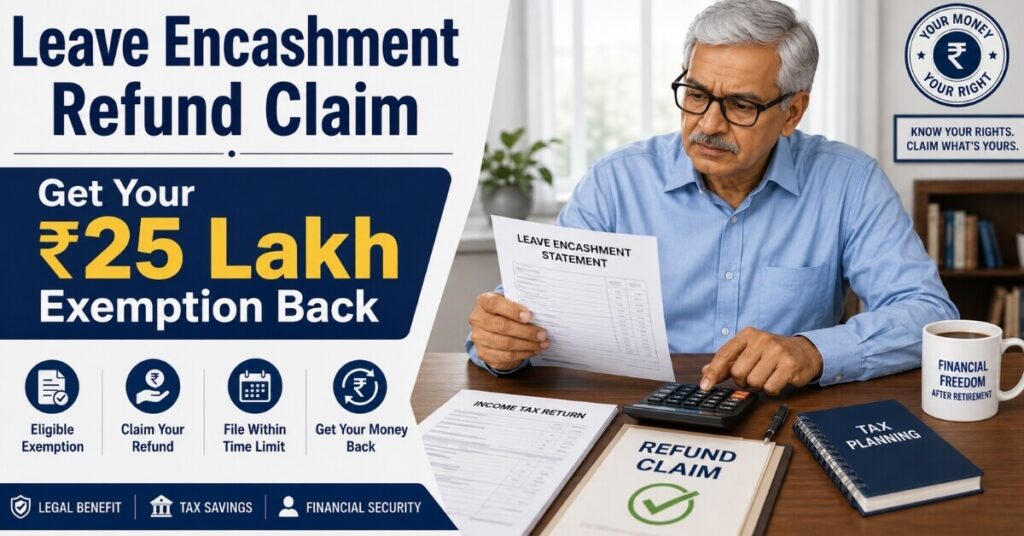
Leave Encashment Refund Claim requests have surged sharply after the Central Board of Direct Taxes increased the tax-exemption limit on leave encashment for non-government employees from ₹3 lakh to ₹25 lakh. Several recent Income Tax Appellate Tribunal rulings have confirmed that retirees who left their jobs before the new limit took effect can still benefit from it, even though their retirement date falls years before the official notification.
“This development has opened the door for thousands of private-sector employees, bank staff, and PSU retirees to revisit their old tax returns and recover money that was taxed under the outdated ₹3 lakh ceiling. If you retired before April 2023 and paid tax on your leave encashment amount above ₹3 lakh, understanding how this refund process works could help you get back a meaningful sum of money that is otherwise sitting unclaimed.”
This guide explains, in simple and practical terms, who is eligible, which legal route applies to your particular situation, how much refund you might realistically expect, and the exact steps involved in filing a Leave Encashment Refund Claim with the Income Tax Department.
What Is a Leave Encashment Refund Claim?
A Leave Encashment Refund Claim is a formal request made to the Income Tax Department asking for a refund of excess tax paid on leave encashment income, based on the revised and much higher exemption limit. Leave encashment itself is the cash amount an employee receives for unused earned leave, usually paid out at the time of retirement, resignation, or superannuation.
Until March 2023, non-government employees could claim tax exemption on leave encashment only up to ₹3 lakh under Section 10(10AA) of the Income Tax Act, a limit that had remained unchanged since 2002 despite two decades of rising salaries and inflation. Anything received above this ₹3 lakh threshold was added directly to taxable salary income and taxed at the individual’s applicable slab rate.
The CBDT later raised this exemption ceiling to ₹25 lakh through an official notification effective from April 1, 2023. Because several employees had already retired and paid tax under the older, lower limit before this change, tax authorities and appellate tribunals have since clarified that a Leave Encashment Refund Claim can be filed for genuine cases where the higher limit should reasonably apply, even retrospectively.
How Section 10(10AA) Evolved Before This Change
To understand why a Leave Encashment Refund Claim has become so relevant today, it helps to look at how the underlying rule evolved. When Section 10(10AA) was framed, the ₹3 lakh exemption limit was considered adequate for most salaried employees at the time. Over the following two decades, average salaries in India rose substantially, but this specific exemption limit was never revised to match.
As a result, by the early 2020s, many retiring employees with even modest leave balances found a large portion of their leave encashment pushed into taxable income, simply because the old ceiling had not kept pace with reality. This mismatch is the primary reason the government eventually raised the limit to ₹25 lakh, and it is also the underlying justification tribunals have used while allowing such refunds for retirements that occurred before the formal notification date
Why This Refund Opportunity Matters in 2026
Retirees who left their jobs even a few years before the revised limit was announced may still be sitting on unclaimed money without realising it. A Leave Encashment Refund Claim matters because the gap between the old ₹3 lakh exemption and the new ₹25 lakh exemption is significant — for many senior employees, this difference alone can translate into a refund running into several lakhs of rupees, depending on their leave balance and salary at the time of retirement.
Multiple tribunal benches, including ITAT Chennai and ITAT Jaipur, have ruled that the enhanced limit is a beneficial, curative amendment meant to correct an outdated ceiling, and such amendments can reasonably be extended to earlier assessment years in deserving cases. This has strengthened the case for retirees who want to pursue a Leave Encashment Refund Claim instead of simply assuming their old tax liability is final and unchangeable.
Who Can File This Refund Claim
Not every retiree automatically qualifies for this benefit. A Leave Encashment Refund Claim is generally relevant to the following categories of taxpayers:
Non-government (private sector) employees who retired, resigned, or took voluntary retirement before April 1, 2023
Employees of public sector undertakings (PSUs) and nationalised banks, who are treated as non-government employees for the purpose of this exemption
Individuals who received leave encashment above ₹3 lakh at the time of leaving their job and paid tax on the excess amount
Taxpayers whose relevant assessment year still falls within the permissible window for rectification or condonation of delay
Central and state government employees are not affected by this issue at all, since their leave encashment has always been fully exempt from tax, regardless of the amount involved. If you fall into one of the categories above and believe you overpaid tax on your retirement settlement, it is worth evaluating whether a Leave Encashment Refund Claim genuinely applies to your case before deciding to proceed further.
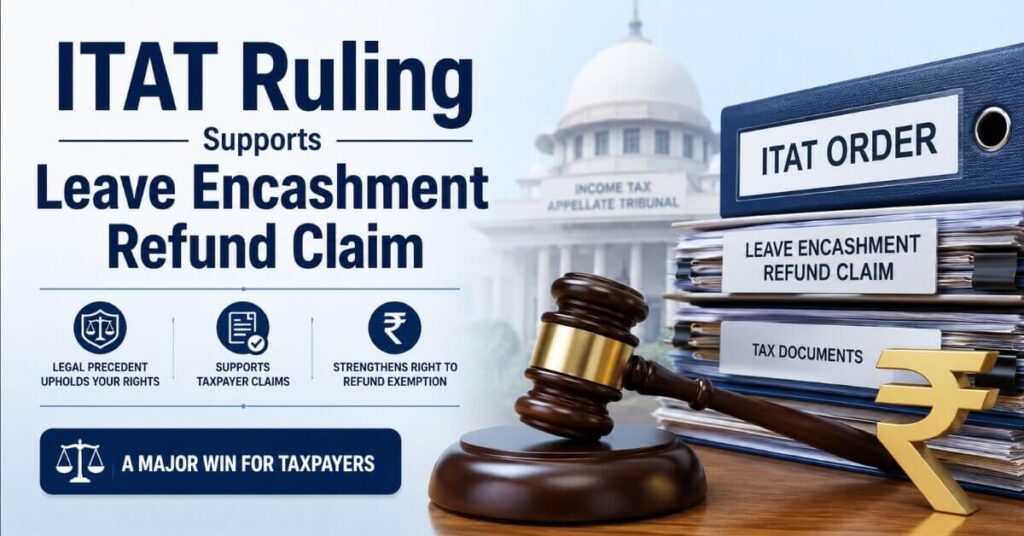
ITAT Rulings Supporting Leave Encashment Refund Claim for Pre-2023 Retirees
Recent tribunal decisions have played a central role in shaping how such refund requests are assessed by tax authorities. In one widely discussed case, the Income Tax Appellate Tribunal ruled in favour of a retired employee, increasing his leave encashment exemption to the full ₹25 lakh limit even though his retirement predated the CBDT notification by several years
“The tribunal reasoned that the enhanced limit was introduced specifically to address the erosion of the exemption’s real value due to inflation and rising salaries since the ₹3 lakh ceiling was first set in 2002. Similar reasoning has appeared in rulings from other benches as well, reinforcing the broader view that this is not merely a theoretical possibility but something that has already succeeded in real, documented assessments.”
These rulings do not guarantee approval in every single case, and final outcomes may still depend heavily on individual facts and the assessing officer’s discretion, but they provide a strong legal foundation for taxpayers to formally pursue a Leave Encashment Refund Claim rather than leaving the matter unaddressed out of uncertainty.
How Much Refund Can You Realistically Expect
The refund amount under a Leave Encashment Refund Claim depends entirely on how much of your original leave encashment exceeded the old ₹3 lakh limit and how it was taxed at the time. For example, an employee who received ₹8 lakh in leave encashment and was taxed on ₹5 lakh of it under the older rule may now be eligible to have that entire ₹5 lakh reconsidered under the new ₹25 lakh ceiling, since the full amount would fall well within the revised limit.
The resulting refund would depend on the applicable tax slab that portion was originally taxed under, along with any interest the department may compute on the delayed refund. Because every case differs based on salary structure, leave balance, and the assessment year involved, it is advisable to calculate the exact figure with a tax professional before formally submitting your Leave Encashment Refund Claim, rather than relying on rough estimates.
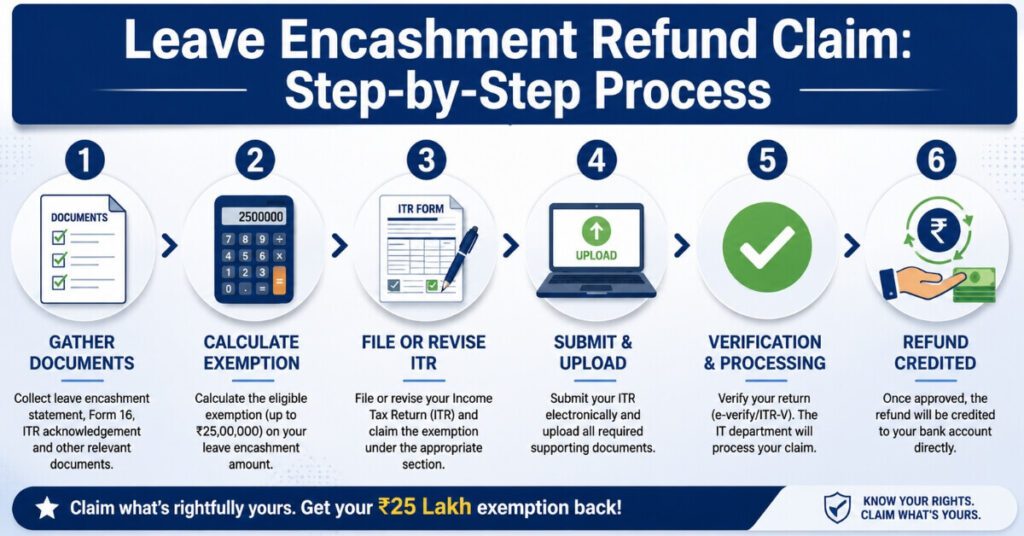
Step-by-Step Process to File a Leave Encashment Refund Claim
Filing a Leave Encashment Refund Claim involves a fairly clear and structured sequence of steps:
Review your old tax return: Check the assessment year in which you declared leave encashment income and confirm exactly how much exemption was claimed at that time.
Calculate the difference: Work out the additional exemption you would now be entitled to under the ₹25 lakh limit and estimate the resulting tax refund amount.
Choose the correct legal route: Depending on how old the assessment year is, you may use Section 154 (rectification of mistake) for relatively recent years, or Section 119(2)(b) (condonation of delay) for older, time-barred years.
File the application: Submit the rectification request online through the income tax e-filing portal, or file a condonation application with supporting documents if the assessment year falls outside the normal rectification window.
Attach supporting proof: Include your Form 16, salary and leave encashment certificate from your employer, computation of income, and the original return acknowledgment.
Track the outcome: Monitor your e-filing account regularly for updates, and be prepared to respond promptly to any queries raised by the assessing officer during processing.
Following this sequence carefully improves the chances of a successful Leave Encashment Refund Claim, especially since incomplete or unclear documentation remains one of the most common reasons such requests get delayed or rejected outright.
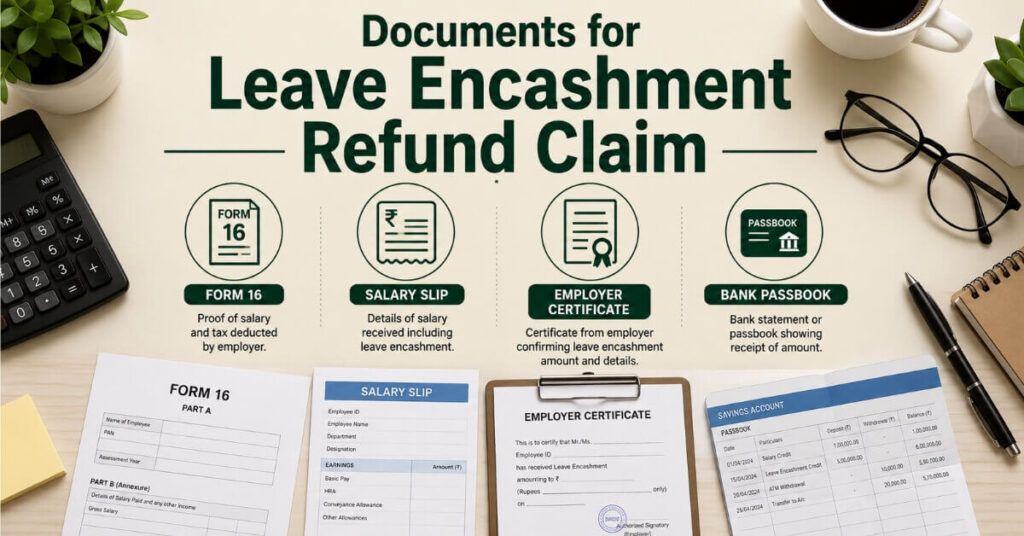
Documents Required for Leave Encashment Refund Claim
Before submitting a Leave Encashment Refund Claim, it helps to keep the following documents organised and ready:
Form 16 for the relevant assessment year
Salary slip or retirement settlement statement showing the exact leave encashment amount received
Employer certificate confirming the number of leave days encashed and the calculation basis used
Copy of the original income tax return and its acknowledgment
Bank account details for direct refund credit
Any prior communication received from the Income Tax Department related to that specific assessment year
Having these documents organised in advance can significantly speed up processing once you formally file your Leave Encashment Refund Claim, since assessing officers frequently request clear proof of the leave encashment amount and the employer’s classification as government or non-government before approving any adjustment or refund.
Time Limit for Filing a Leave Encashment Refund Claim
Time limits are one of the most important and often overlooked factors in this entire process. Under Section 154, rectification requests are typically accepted within four years from the end of the financial year in which the original order was passed. For assessment years that fall outside this window, taxpayers must instead rely on Section 119(2)(b), which allows condonation of delay for genuine hardship cases, generally within six years from the end of the relevant assessment year.
This practically means a Leave Encashment Refund Claim for very old retirements — say, from 2015 or earlier — may face a much stricter review process or could fall outside the eligible period altogether. It is strongly advisable to check your specific assessment year against these limits carefully before assuming it will be automatically accepted by the department.”
Impact of the New Tax Regime on Leave Encashment Refund Claim
Another point worth understanding is how the new tax regime interacts with this exemption. The good news is that the leave encashment exemption under Section 10(10AA) continues to be available even under the new concessional tax regime, unlike many other deductions that were removed. This means taxpayers who shifted to the new regime after retirement need not worry that switching tax regimes will disqualify them from pursuing a valid Leave Encashment Refund Claim. However, since other deductions may differ between the old and new regimes, it is still worth reviewing your overall computation with a tax advisor to ensure the refund calculation accounts for your specific regime correctly.
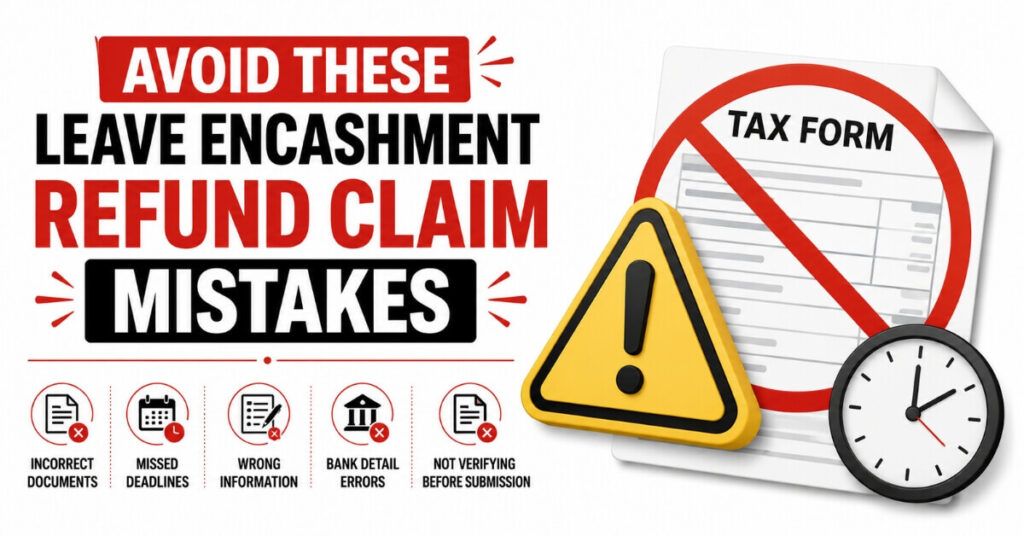
Common Mistakes to Avoid While Filing a Leave Encashment Refund Claim
Many taxpayers unfortunately lose out on a valid Leave Encashment Refund Claim simply due to avoidable errors during the filing process. Common mistakes include:
Filing the request without recalculating the exact exemption difference beforehand
Missing the condonation deadline for older, time-barred assessment years
Submitting incomplete employer certificates that do not clearly separate leave encashment from other retirement benefits like gratuity
Assuming government employee rules apply when the actual employer is a PSU or private company
Not retaining a copy of the original tax return for reference during the application process
Avoiding these mistakes can make the real difference between a smooth, successful Leave Encashment Refund Claim and one that gets stuck in departmental queries for several months without resolution.
Where to Get Official Information and Related Financial Support
For official notifications and circulars related to leave encashment exemption limits, taxpayers can refer to the Income Tax Department website as the primary and most reliable source before filing any rectification or condonation application. Retirees exploring how to put their refund amount or retirement corpus to productive use may also find it worthwhile to read our earlier guide on the Stand-Up India Loan Scheme 2026, which explains funding options available to new entrepreneurs, including retirees planning a second career alongside pursuing their Leave Encashment Refund Claim.
FAQS
Q1.Can I file a Leave Encashment Refund Claim if I retired in 2019?
Yes, if you paid tax on leave encashment above ₹3 lakh and your assessment year is still within the permissible rectification or condonation window, you can evaluate a Leave Encashment Refund Claim with your tax advisor.
Q2.Is a Leave Encashment Refund Claim applicable to government employees?
No. Central and state government employees have always enjoyed full tax exemption on leave encashment, regardless of amount, so this issue does not apply to them at all.
Q3.How long does it take to process a refund request?
Processing time varies depending on case complexity and the legal route used, whether rectification or condonation, and can range from a few weeks to several months depending on departmental workload.
Q4.What if my Leave Encashment Refund Claim gets rejected?
You may be able to file an appeal or seek clarification directly from the assessing officer, depending on the specific reason given for rejection.
Q5.Do I need a tax professional to file a Leave Encashment Refund Claim?
While not mandatory, professional guidance is strongly recommended, especially for older assessment years that require condonation of delay under Section 119(2)(b).
Q6.Is the ₹25 lakh exemption limit applicable to leave encashment received after resignation, not just retirement?
Yes, the exemption generally applies whether the payout follows retirement, resignation, or superannuation, as long as it qualifies as leave encashment under the relevant provision.
Q7.Does this benefit apply to employees of foreign companies operating in India?
Eligibility depends on the employment structure and residency status of the individual, so it is best evaluated case by case with a tax advisor.
Q8.Will I receive interest on the refunded amount?
In many cases, the department computes statutory interest on delayed refunds, though this varies based on the specific assessment year and processing timeline.
Q9.Can legal heirs pursue this on behalf of a deceased retiree?
Yes, legal heirs can generally file such applications with appropriate succession documents and authorisation.
Q10.Is there a fee for filing a rectification or condonation application?
No government fee is typically charged for filing these applications through the official e-filing portal.
Conclusion
A Leave Encashment Refund Claim offers a genuine and often overlooked opportunity for eligible retirees to recover excess tax paid before the exemption limit was raised to ₹25 lakh. With supporting ITAT rulings and clear legal routes such as Section 154 and Section 119(2)(b), taxpayers no longer need to treat their old tax outgo as final or unchangeable. Reviewing past returns carefully, gathering the right documents in advance, and filing within the applicable timelines can help convert this policy change into real, tangible financial relief for retirees across the country.
Disclaimer
This article is for general informational purposes only and does not constitute tax or legal advice. Tax laws and CBDT notifications are subject to change, and individual eligibility may vary based on specific facts and circumstances. Readers are advised to consult a qualified chartered accountant or tax professional before filing any rectification, condonation, or refund application with the Income Tax Department.