
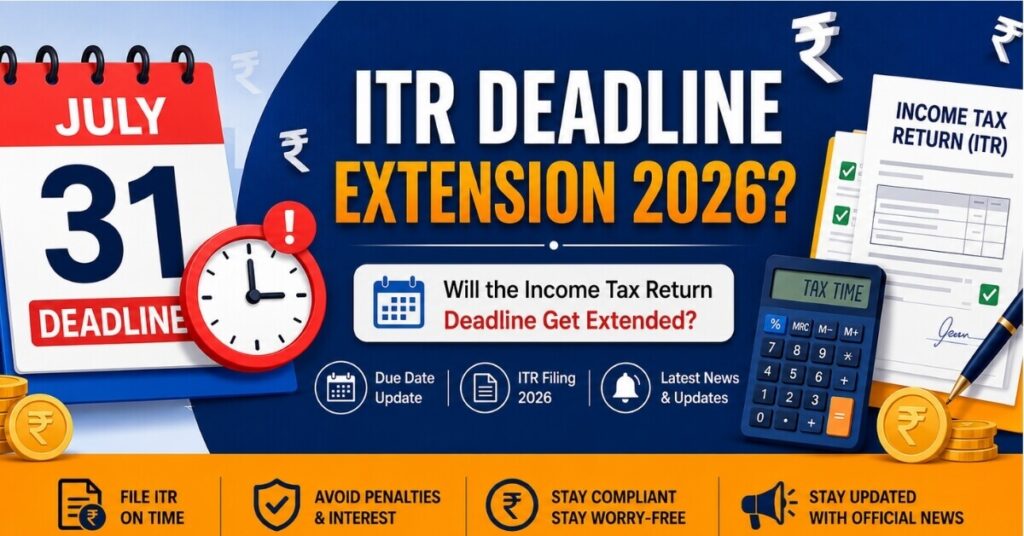
Every year, lakhs of taxpayers get confused about income tax return filing dates, and this year is no exception. Google Trends recorded a massive 1,000% spike with over 5,000+ searches in just 3 hours on this exact topic, which clearly shows how much uncertainty exists in people’s minds right now. In this article, we will cover every important aspect related to ITR Filing Deadline Extension 2026 — from current deadlines to penalty rules — so that you can avoid last-minute panic.
The filing process for Assessment Year 2026-27 has already started, and the income tax department has issued several clarifications regarding deadlines. However, so much misinformation is circulating on social media and WhatsApp forwards that taxpayers are finding it difficult to understand what’s actually true. This is exactly why ITR Filing Deadline Extension 2026 is trending so rapidly. In the sections below, we will break down all the facts, myths, and official guidelines related to ITR Filing Deadline Extension 2026 in detail.
What Is ITR Filing Deadline Extension 2026?
In simple terms, ITR Filing Deadline Extension 2026 refers to the Central Board of Direct Taxes (CBDT) pushing back the original due date for filing income tax returns. Such extensions are usually granted due to technical glitches, portal issues, or genuine demand from taxpayers. Every year, as the deadline approaches, taxpayers hope for an official notification regarding ITR Filing Deadline Extension 2026.
However, it’s important to understand that an extension is never automatic. Only a CBDT official circular or press release counts as an authentic source. Rumours often spread so fast that people postpone their filing without confirming anything, which later becomes a reason for penalty.
Current ITR Deadlines for AY 2026-27
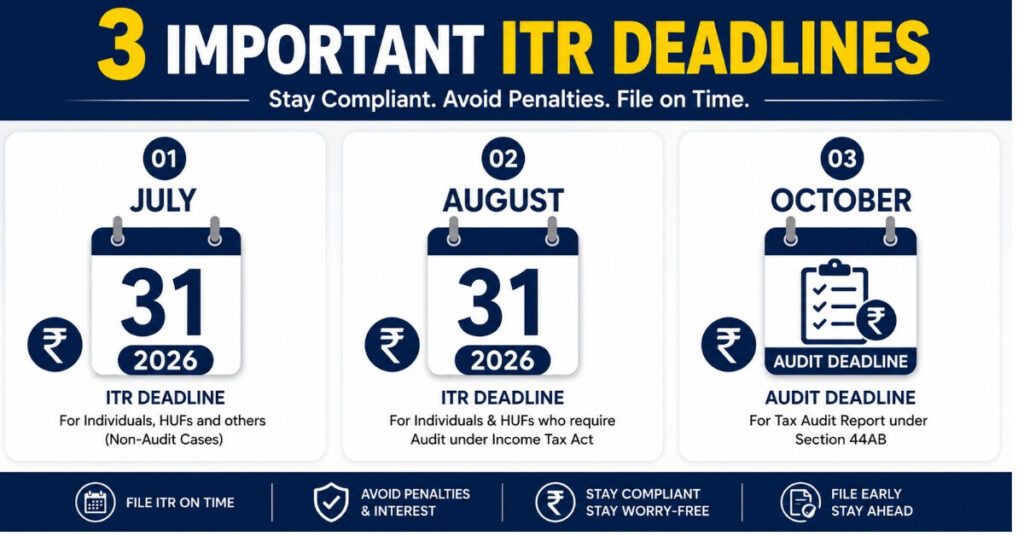
For Assessment Year 2026-27, the deadlines are structured as follows:
July 31, 2026: This is the original due date for individual taxpayers, salaried employees, and non-audit cases filing ITR-1 or ITR-2.
August 31, 2026: This deadline may apply to taxpayers filing ITR-3 or ITR-4 who are not subject to a tax audit.
Audit cases: For businesses that require a tax audit, the deadline is typically around October, linked with the audit report submission timeline.
Based on the information available so far, no official ITR Filing Deadline Extension 2026 has been announced for the standard July 31, 2026 deadline. Taxpayers are therefore advised to file their returns on time rather than relying on unofficial news.
Are the Rumours True, or Just Speculation?
As happens every year, several posts about ITR Filing Deadline Extension 2026 are going viral on social media this time too. Some news portals have also published articles under headlines like “rumours vs reality” on this exact topic. It’s extremely important that before trusting any unverified source, you check the income tax department’s official website or their verified social media handles.
Over the past few years, it has been observed that whenever technical issues occur on the e-filing portal, demands for ITR Filing Deadline Extension 2026 automatically start trending. There have even been reports of penalties being imposed on managed service providers, which shows that the government is taking portal stability quite seriously as well.
How Much Penalty Applies for Late Filing?
If you miss the deadline and no official ITR Filing Deadline Extension 2026 benefit is granted, you will need to file a belated return. The following penalties may apply:
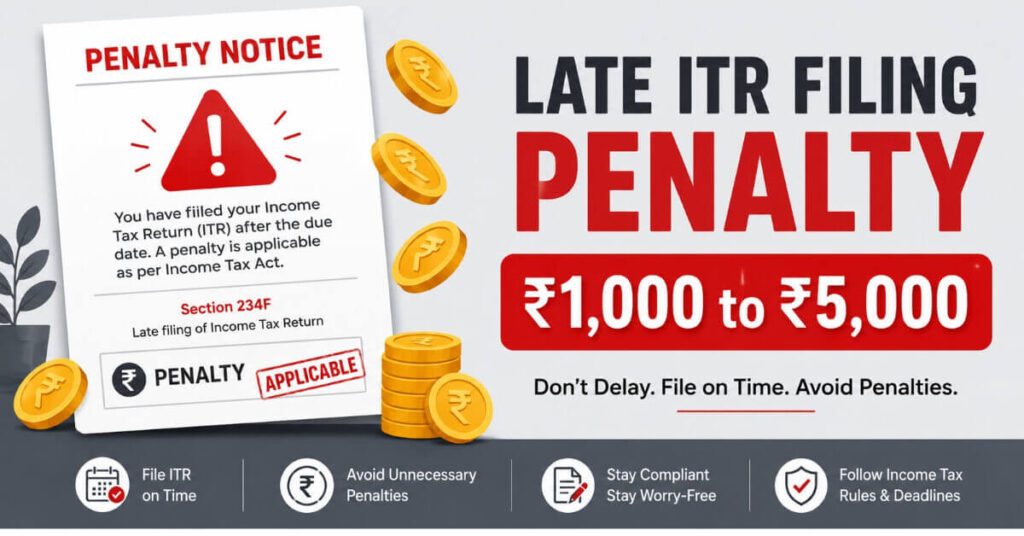
- Late filing fee: Under Section 234F, if your total income exceeds ₹5 lakh, a penalty of up to ₹5,000 may be charged. If your income is below ₹5 lakh, this fee is capped at ₹1,000.
2. Interest on tax due: Under Section 234A, 1% interest per month is charged on the outstanding tax amount until the return is filed.
3. No carry forward of losses: With a belated return, you cannot carry forward certain losses to future years, which can affect your long-term financial planning.
4. Delayed refunds: If you are eligible for a refund, late filing can also delay its processing.
So whether or not ITR Filing Deadline Extension 2026 is announced, filing on time always remains the better strategy. The easiest way to avoid penalties is to file your return early instead of waiting for extension-related news.

How to Check the Status of ITR Filing Deadline Extension 2026
If you want to confirm whether ITR Filing Deadline Extension 2026 has actually been granted, follow these steps:
Visit the official Income Tax Department website at www.incometax.gov.in, where the latest circulars and press releases are published.
Check CBDT’s official Twitter/X handle or the Press Information Bureau (PIB) website, since any genuine extension is announced there first.
Follow trusted financial news portals that verify news from authentic sources before publishing.
Confirm with your Chartered Accountant or tax consultant, as they stay directly connected with professional updates.
Following these steps will help you avoid fake news and make the right decision at the right time.
Tips to Avoid Last-Minute Rush
Waiting for ITR Filing Deadline Extension 2026 and postponing your filing can be risky. Here are some practical tips to avoid this:
Keep documents ready in advance: Collect Form 16, capital gains statements, interest certificates, and investment proofs well ahead of time.
Verify AIS and Form 26AS: Before filing your return, carefully match your Annual Information Statement and Form 26AS to avoid any mismatch.
Avoid the portal’s busy hours: Traffic on the portal is much higher during the final days before the deadline, so filing early is a smarter choice.
Seek professional help: If your income is complex or comes from multiple sources, it’s wise to take help from a CA.
Track your filing status regularly: Keep checking your acknowledgment and e-verification status on the portal regularly.
By adopting these simple habits, you can file your return stress-free without needing any extension. Good planning means you don’t have to wait around for such news at all.
Importance of Long-Term Tax Planning
Instead of depending on news about ITR Filing Deadline Extension 2026, a better approach is to keep your tax planning organized throughout the year. This includes not just the income tax return itself, but also tracking your investments, since capital gains directly affect your return as well. If you invest in the stock market, it becomes important to keep an eye on share price movements of companies — for example, you can check our detailed NTPC Green share price today analysis, which will help you understand current market trends and their tax impact.
For official and verified information, you can also directly visit the Income Tax Department website, where all authentic details about notifications, circulars, and deadlines are available. Together, tracking your investments and relying on official sources for updates will make your tax planning much smoother, whether or not an extension is announced.
ITR Filing Deadline Extension 2026: Expert Opinion
Tax experts say that demanding ITR Filing Deadline Extension 2026 isn’t wrong, especially when the portal faces technical issues. However, postponing your filing purely in that hope can be financially risky. Many financial advisors suggest that taxpayers should file their return at least 15 days before the deadline, so that no last-minute glitch stands in their way.
In addition, for people who run businesses or work as freelancers, waiting for ITR Filing Deadline Extension 2026 can be even riskier, since their filing is more complex and requires more time. Overall, it’s better to focus on completing your filing proactively rather than depending on this trend.
Step-by-Step Process for Online ITR Filing
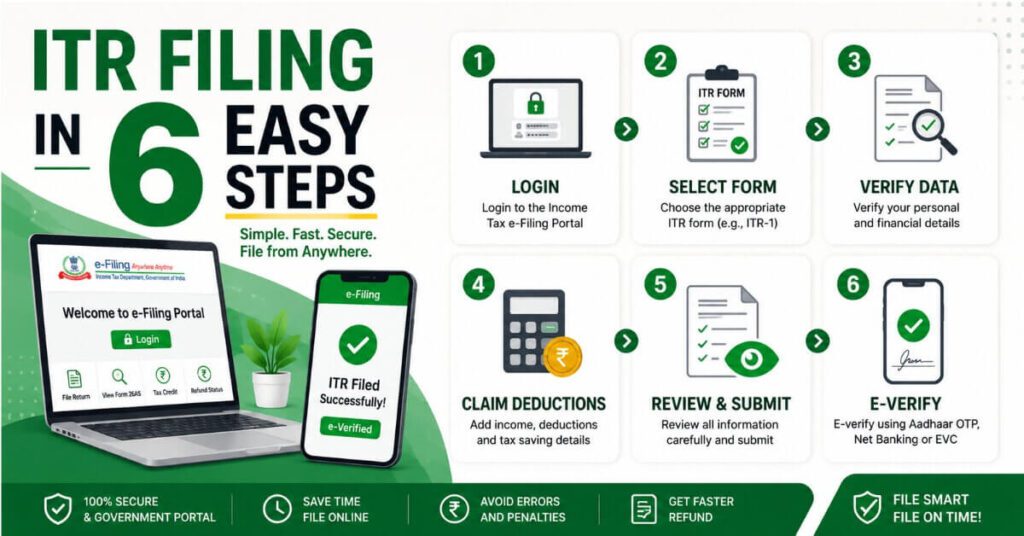
Many taxpayers wait for ITR Filing Deadline Extension 2026 simply because they find the filing process complicated. However, if you follow the right steps, this task becomes fairly simple:
- Log in: Log in to incometax.gov.in using your PAN. If you’re filing for the first time, complete your registration first.
2. Select the correct ITR form: Choose the right form — ITR-1, ITR-2, ITR-3, or ITR-4 — based on your income sources.
3. Verify pre-filled data: The portal automatically pre-fills details like your Form 16 and TDS. Check these carefully.
4. Claim deductions: Enter applicable deductions under Section 80C, 80D, and others correctly so your tax liability is calculated accurately.
5.Review tax computation: Before submitting, carefully review the final tax computation to ensure there are no mistakes.
6. Submit and e-verify the return: After submission, e-verify your return within 30 days, otherwise your filing will be considered invalid.
Following this process allows you to complete your return on time without confusion, whether or not ITR Filing Deadline Extension 2026 is granted.
Why Is E-Verification So Important?
Many taxpayers file their return but forget to e-verify it. Remember, without e-verification, your ITR filing is considered incomplete — as if you never filed at all. You can e-verify in the following ways:
Through Aadhaar OTP
Through net banking
Through bank account pre-validation
Through your Demat account
By sending a physical ITR-V form to CPC Bengaluru (this is the slowest method)
If you don’t complete e-verification within 30 days, your filing becomes invalid and you’ll need to start the process again, which further increases the risk of penalty.
Benefits of Maintaining Digital Records
Whenever news about ITR Filing Deadline Extension 2026 starts trending, taxpayers who keep all their financial documents organized in digital form remain far more relaxed. Salary slips, bank statements, investment proofs, and capital gains records maintained in one place help not only during filing but also with loan applications or visa processing.
Additionally, if you regularly track your income and expenses, calculating advance tax also becomes easier, which helps you avoid a heavy tax burden at the end of the year.
What Has the Trend Been in Previous Years?
It’s also important to understand when extensions have been granted historically. In some cases, such as during COVID-19 or when the e-filing portal underwent a major technical upgrade, CBDT has extended deadlines. However, under normal circumstances, when the portal is functioning properly, the chances of getting an extension are quite low.
So, looking at the historical pattern, unless there’s a major technical issue or unforeseen situation, the government generally sticks to the original deadline. Taxpayers should keep in mind that every year presents a different scenario, and last year’s trend doesn’t always repeat.
Different Strategies for Salaried and Self-Employed Taxpayers
For salaried employees, the filing process is generally simple since their TDS is already deducted and Form 16 is readily available. Such taxpayers are advised to start filing as soon as they receive their Form 16, so they can avoid the last-minute rush.
On the other hand, the process is a bit more complex for self-employed professionals and business owners, since they need to calculate their income, expenses, and applicable deductions themselves. Such taxpayers should also keep track of quarterly advance tax payments, so there isn’t a large tax burden at year-end. For both categories of taxpayers, the common advice is to proactively complete their filing instead of relying on a deadline extension.
Important Points for Freelancers and Gig Workers
Freelancing and the gig economy are growing rapidly these days, and filing works a bit differently for such taxpayers. If you receive payments from multiple clients, whether domestic or international, you should carefully document all your income sources. Keeping bank statements, invoices, and payment gateway records organized makes this process much easier.
The presumptive taxation scheme can also be a good option for freelancers, allowing you to calculate tax on a fixed percentage without tracking actual expenses, if you meet the eligibility criteria. Be sure to discuss this with your CA, since every case is different and getting the right advice is always beneficial.
Freelancers receiving payments from international clients should additionally keep TDS certificates and foreign remittance documents safe, as these come in handy during any future tax scrutiny. Proper record-keeping not only makes filing easier but also allows you to respond confidently if the department ever raises a query.
Common Mistakes Taxpayers Make While Waiting for an Extension
Many taxpayers make avoidable mistakes while waiting for news about ITR Filing Deadline Extension 2026. One of the most common mistakes is delaying document collection, assuming there will always be extra time. Another common issue is relying on unverified social media posts instead of checking the official portal directly.
Some taxpayers also make the mistake of not reconciling their AIS and Form 26AS in advance, which leads to last-minute errors when the actual filing window is short. Others skip calculating their advance tax liability throughout the year, resulting in a large lump-sum payment closer to the deadline. Avoiding these mistakes can save you significant stress, regardless of whether an extension is eventually announced.
It’s also worth noting that even in years when an extension was granted, it usually came with very short notice — sometimes just a day or two before the original deadline. This means that building a habit of filing early is a far more reliable strategy than hoping for a last-minute announcement. Ultimately, taxpayers who plan ahead rarely need to worry about whether such news arrives or not.
FAQs
Q1: Has ITR Filing Deadline Extension 2026 been officially announced?
No official extension has been announced yet for the standard July 31, 2026 deadline. Keep checking the income tax department’s official website for the latest updates.
Q2: What happens if the deadline is not extended?
If ITR Filing Deadline Extension 2026 is not granted and you don’t file on time, you will need to file a belated return, which may attract a late fee and interest.
Q3: How much penalty applies for missing the ITR filing deadline?
Under Section 234F, a late filing fee of ₹1,000 to ₹5,000 may apply depending on your income, along with monthly interest charged on any outstanding tax.
Q4: Where can I confirm genuine news about the extension?
Only confirm through the Income Tax Department’s official website, CBDT’s verified handles, or trusted financial news portals — never rely on WhatsApp forwards.
Q5: Is there a different deadline for audit cases?
Yes, taxpayers subject to a tax audit typically have a deadline around October, which is different from the standard deadline.
Conclusion
ITR Filing Deadline Extension 2026 is a topic that creates confusion among taxpayers every year, but having the right information and taking timely action is always the safest path. So far, no confirmed extension has been announced for the standard July 31, 2026 deadline, so the best strategy is to file your ITR as soon as possible. Instead of relying on rumours, always confirm through official sources, and keep your tax planning organized throughout the year so you don’t have to wait for any extension at the last moment.
Disclaimer
This article is for general information and educational purposes only. The details provided are based on news reports and publicly available sources, which are subject to change over time. Before making any decisions related to ITR Filing Deadline Extension 2026 or any tax matter, please confirm with your Chartered Accountant, tax consultant, or the Income Tax Department’s official website. The author or publisher of this article shall not be held responsible for any financial loss.

Pingback: Income Tax Notice High Value Transactions: 7 Powerful Rules