

Building a ₹1 crore portfolio is one of the most powerful financial goals any investor can set. Whether you are a salaried professional, a student just starting out, or an NRI looking to grow wealth in India, knowing how to build a 1 crore portfolio is the first step toward real financial freedom. The good news? You do not need a large salary or a secret formula. You need a clear plan, the right investment tools, and the discipline to stay consistent.
In this complete guide, we will break down exactly how to build a 1 crore portfolio from zero — using SIPs, mutual funds, asset allocation strategies, and the power of compounding.
Why ₹1 Crore Is the Most Important Financial Milestone
₹1 crore is not just a number. It represents financial security, freedom from debt, the ability to fund your children’s education, and a comfortable retirement. Yet most Indians never reach this milestone — not because it is impossible, but because they delay starting or make avoidable mistakes.
Understanding how to build a 1 crore portfolio early in life is the difference between financial stress and financial independence. Even with modest monthly investments, compounding can do the heavy lifting — if you give it enough time.
Step 1 — Set Your Timeline First
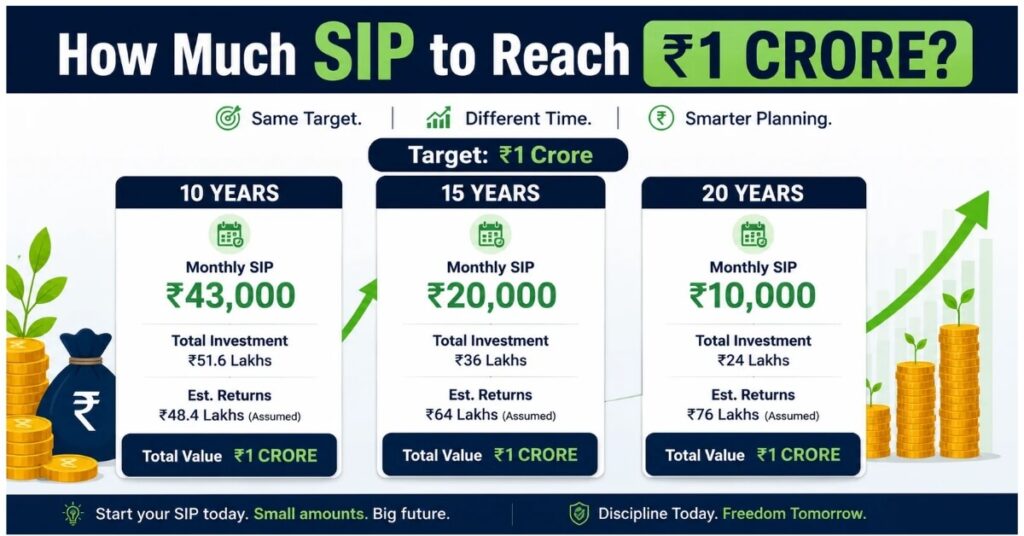
The single most important factor in how to build a 1 crore portfolio is time. The longer your investment horizon, the smaller your monthly SIP needs to be.
Here is a simple breakdown assuming 12% annual returns from equity mutual funds:
| Time Horizon | Monthly SIP Required |
| 10 Years | ₹40,000 – ₹45,000 |
| 15 Years | ₹20,000 – ₹25,000 |
| 20 Years | ₹10,000 – ₹12,000 |
| 25 Years | ₹5,500 – ₹6,500 |
The message is clear — start early, invest less. Start late, invest more. This is why the best time to learn how to build a 1 crore portfolio is today.
Step 2 — Start Small, But Start Now
One of the biggest myths about how to build a 1 crore portfolio is that you need a large starting amount. The reality is completely different. You can begin with as little as ₹500 per month through a SIP.
The key principle here is rupee cost averaging — when markets fall, your SIP buys more units at lower prices. When markets rise, your existing units gain value. Over time, this automatic averaging lowers your overall cost and boosts returns.
Even if you can only invest ₹2,000 or ₹5,000 per month today, begin anyway. Increase the amount as your income grows. A small consistent investment always beats a large investment that never starts.
Step 3 — Use the 15-15-15 Rule
If you are wondering exactly how to build a 1 crore portfolio with a simple formula, the 15-15-15 Rule is your answer.
The Rule: Invest ₹15,000 per month via SIP, for 15 years, targeting 15% annual returns = ₹1 crore corpus.
This rule works because of compounding. Your returns earn returns, and over 15 years the effect becomes dramatic. While 15% returns are not guaranteed, diversified equity mutual funds have historically delivered returns in this range over long periods in India.
The 15-15-15 rule is the simplest answer to how to build a 1 crore portfolio for beginners who want a clear starting point.

Step 4 — Use Step-Up SIP for Faster Results
Regular SIP is powerful. But a Step-Up SIP is even more powerful. This is where most investors unlock the real secret of how to build a 1 crore portfolio faster than expected.
A Step-Up SIP allows you to increase your monthly investment by a fixed percentage every year — typically 10% to 15% — in line with your salary growth.
Real Example:
Normal SIP: ₹20,000/month for 20 years at 11% returns = ₹1.73 crore
Step-Up SIP: Same ₹20,000/month with 10% annual increase = ₹3.58 crore
That is more than double — just by increasing your SIP by 10% every year. This is the most practical strategy in how to build a 1 crore portfolio for anyone whose income is expected to grow over time.
Most mutual fund platforms and fund houses allow you to set up Step-Up SIP automatically during registration.
Step 5 — Choose the Right Asset Allocation
Knowing how to build a 1 crore portfolio is not just about choosing one fund and forgetting it. You need a balanced asset allocation across different investment types to manage risk while maximizing growth.
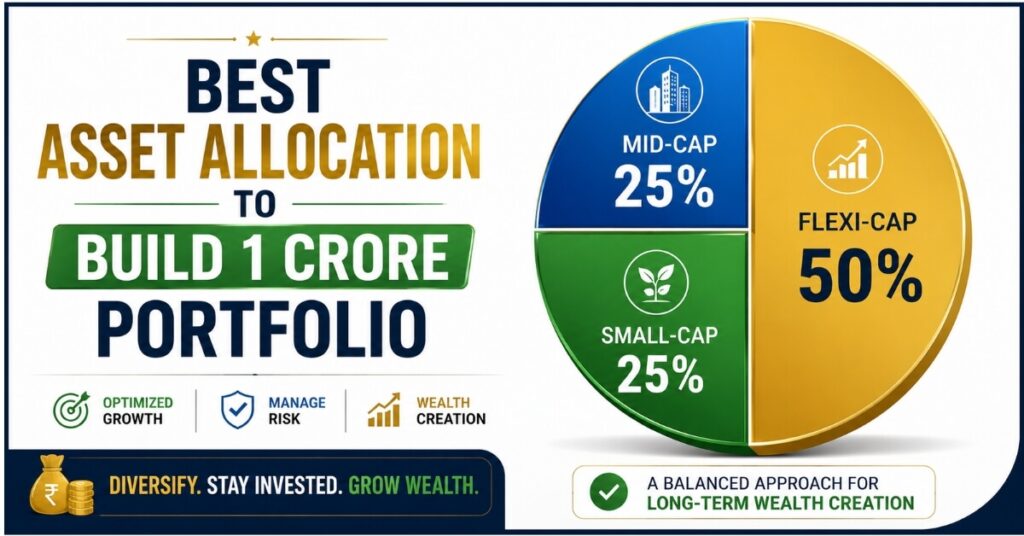
Recommended Allocation for Beginners:
Aggressive (Age below 35):
50% Flexi-Cap Mutual Funds
25% Mid-Cap Mutual Funds
25% Small-Cap Mutual Funds
Balanced (Age 35–45):
40% Large-Cap or Flexi-Cap Funds
30% Mid-Cap Funds
20% Debt Mutual Funds
10% Gold ETF
Conservative (Age 45+):
40% Debt Mutual Funds
30% Large-Cap Funds
20% Government Securities or FD
10% Gold ETF
A well-diversified allocation is a core part of how to build a 1 crore portfolio that does not collapse during market downturns.
Step 6 — Best Investment Instruments to Reach ₹1 Crore
When planning how to build a 1 crore portfolio, you have several powerful instruments available:
1. Equity Mutual Funds (Core)
Flexi-cap, mid-cap, and small-cap funds offer the highest long-term growth potential. These form the backbone of any serious wealth creation plan.
To verify fund performance and check direct vs regular plan expense ratios, visit the Association of Mutual Funds in India (AMFI) official website.
2. ELSS Funds (Tax + Growth)
Equity Linked Saving Schemes give you Section 80C tax deduction up to ₹1.5 lakh per year while delivering equity-level returns. A smart dual-purpose tool in how to build a 1 crore portfolio.
If you are a salaried employee building your portfolio, make sure you have also completed your EPFO e-nomination and free ₹7 lakh EDLI insurance — it protects your family at zero cost.
3. Index Funds
Low-cost passive funds tracking Nifty 50 or Sensex. Ideal for investors who prefer simplicity and lower expense ratios. Choose direct plans to save on distributor commissions and add 1–1.5% extra to annual returns.
4. Direct Stocks
For investors with market knowledge, direct stock investing in fundamentally strong companies can accelerate growth. However, this carries higher risk and requires active monitoring.
5. Gold ETF
5–10% allocation in Gold ETF acts as a hedge against inflation and market volatility — a safety net in your how to build a 1 crore portfolio strategy.
6. Debt Mutual Funds
For risk-averse investors or those nearing their goal, debt funds offer steady returns with lower volatility than equity.
Step 7 — Follow the 7-5-3-1 Rule
A simple but powerful framework for how to build a 1 crore portfolio with discipline:
7 — Stay invested for at least 7 years minimum
5 — Diversify across at least 5 asset types
3 — Control 3 emotions: panic, greed, and FOMO
1 — Increase your SIP amount at least once every year
This rule keeps you focused, reduces impulsive decisions, and ensures your portfolio grows steadily over time.
Step 8 — Start Early — The Age Advantage
Age plays a massive role in how to build a 1 crore portfolio with minimum effort:
| Starting Age | Starting AgeMonthly SIP Needed (12% returns) | Years to ₹1 Crore |
| 25 Years | ₹3,500 | 30 Years |
| 30 Years | ₹8,730 | 20 Years |
| 35 Years | ₹20,000 | 15 Years |
| 40 Years | ₹43,000 | 10 Years |
Starting at age 25 versus age 40 means investing 12x less per month for the same goal. This table alone answers why starting young is the most important lesson in how to build a 1 crore portfolio.

Step 9 — Avoid These Common Mistakes
Even with the best intentions, investors sabotage their own how to build a 1 crore portfolio journey with these mistakes:
1. Stopping SIP During Market Crashes
This is the costliest mistake. Market crashes are actually buying opportunities in SIP investing. Stopping means you miss buying units at lower prices.
2. Investing in Too Many Funds
Over-diversification reduces returns without reducing risk meaningfully. 3 to 5 well-chosen funds are sufficient.
3. Ignoring Inflation
₹1 crore today will have the purchasing power of roughly ₹50 lakh in 10 years at 7% inflation. Plan your corpus target accordingly — aim for ₹2–3 crore if your goal is 15–20 years away.
4. Not Reviewing the Portfolio
Review your portfolio every quarter. If a fund consistently underperforms for 2+ years, rebalance into a better-performing option.
5. Choosing Regular Plans Over Direct Plans
Direct mutual fund plans have no distributor commission, giving you 1–1.5% higher annual returns — which compounds significantly over 15–20 years.
Step 10 — Use Technology to Automate Everything
The modern investor’s biggest advantage in how to build a 1 crore portfolio is automation. Set up:
Auto-debit SIP on the 1st or 5th of every month
Annual Step-Up SIP reminder or automatic increase
Portfolio tracking via apps like Groww, Zerodha Coin, or Paytm Money
Goal-based investing dashboards to track ₹1 crore milestone progress
Automating removes emotion from investing. You never miss a SIP, and you never panic-sell during a correction.
Real-Life Example — From ₹5,000 to ₹1 Crore
Meet Rahul, 28 years old, salaried professional. He starts with a SIP of ₹5,000 per month in a flexi-cap fund. Every year he increases his SIP by 15% (Step-Up).
Year 1: ₹5,000/month
Year 5: ₹10,057/month
Year 10: ₹20,227/month
Year 15: ₹40,683/month
Total corpus at 15% average returns: Over ₹1 crore
This real-world example proves that how to build a 1 crore portfolio is not about starting big — it is about starting smart and staying consistent.
Frequently Asked Questions (FAQs)
Q1. How long does it take to build a 1 crore portfolio?
It depends on how much you invest and when you start. If you begin at age 25 with a SIP of ₹3,500 per month, you can build a 1 crore portfolio in 30 years at 12% returns. Starting at age 30 with ₹8,730 per month, you can reach the same goal in 20 years. The earlier you start, the less monthly investment you need to build a 1 crore portfolio.
Q2. What is the minimum SIP amount to reach 1 crore?
There is no fixed minimum, but even ₹500 per month can grow significantly over 25–30 years with compounding. The key to building a 1 crore portfolio is not the starting amount — it is consistency and time. Use Step-Up SIP to increase your amount every year as your income grows.
Q3. Which mutual fund is best to build a 1 crore portfolio?
Flexi-cap funds are the best starting point for beginners because they automatically balance between large-cap, mid-cap, and small-cap stocks. For faster growth, a combination of flexi-cap (50%), mid-cap (25%), and small-cap (25%) works well. Always choose direct plans over regular plans to maximize returns.
Q4. Is the 15-15-15 rule guaranteed to give 1 crore?
The 15-15-15 rule — ₹15,000 SIP per month for 15 years at 15% returns — is a mathematical estimate, not a guarantee. Actual returns from equity mutual funds vary based on market conditions and fund selection. However, historically, diversified equity mutual funds in India have delivered returns in the 12–15% range over long periods.
Q5. Can I build a 1 crore portfolio with a small salary?
Yes, absolutely. Building a 1 crore portfolio does not require a high salary. Starting with ₹2,000 to ₹5,000 per month and increasing it by 10–15% every year through Step-Up SIP is enough if you stay invested for 15–20 years. Time and discipline matter more than the starting amount.
Q6. Should I invest in stocks or mutual funds to build a 1 crore portfolio?
For most beginners, mutual funds are the safer and smarter choice. They offer professional fund management, automatic diversification, and lower risk compared to direct stock picking. Once you build financial knowledge and experience, you can add direct stocks as a small portion — around 10–15% — of your overall portfolio.
Q7. What happens if I stop my SIP in between?
Stopping your SIP, especially during market crashes, is one of the costliest mistakes in building a 1 crore portfolio. You miss the opportunity to buy more units at lower prices, and your compounding growth is interrupted. If cash flow is tight, reduce the SIP amount temporarily — but never stop completely.
Final Thoughts — Your ₹1 Crore Journey Starts Today
Learning how to build a 1 crore portfolio is the most valuable financial skill you can develop. The math is clear, the tools are accessible, and the path is proven. Whether you start with ₹500 or ₹50,000, the principles remain the same — start early, stay consistent, step up your SIP, diversify smartly, and never stop during market dips.
Every rupee you invest today is a step closer to the financial freedom that ₹1 crore represents. Stop waiting for the perfect time. The perfect time to begin how to build a 1 crore portfolio was yesterday. The second best time is right now.
Disclaimer
This article is for educational purposes only. Mutual fund investments are subject to market risks. Please consult a SEBI-registered financial advisor before making investment decisions.


Pingback: How to Use Form 16 to File ITR: 9 Easy Steps (2026)