

If you are a student in India wondering how to grow your money without taking big risks, then finding the best mutual funds for students in India is the smartest first step you can take. You do not need a job or a large income to start investing. With as little as ₹100 per month, students can begin building wealth through mutual funds using a Systematic Investment Plan (SIP).
This guide covers everything — from why students should invest, which funds are ideal, how to start, and what mistakes to avoid. By the end, you will clearly know which are the best mutual funds for students in India and how to pick the right one for your goals.
Why Should Students Invest in Mutual Funds?
Most students wait until they get a job before thinking about investing. But the truth is, starting early is the biggest financial advantage you will ever have. The power of compounding means that even a small amount invested today can grow into a large sum over 10–20 years.
Here is why the best mutual funds for students in India are worth considering right now:
Low minimum investment — Start with just ₹100–₹500 per month
No need to track markets — Fund managers do it for you
Flexible SIP — Pause or reduce anytime
Builds financial discipline — A habit that will serve you for life
Higher returns than FD — Equity mutual funds have historically delivered 12–15% annually
Whether you receive pocket money, part-time income, or a stipend, you can start investing in the best mutual funds for students in India today.
Things to Consider Before Choosing Mutual Funds as a Student
Before jumping in, keep these key factors in mind:
1. Your Investment Goal
Are you saving for higher education fees, a laptop, travel, or long-term wealth? Short-term goals need debt funds; long-term goals are better suited to equity funds.
2. Risk Tolerance
Students generally have low income and cannot afford big losses. Beginners should start with low to moderate risk funds before moving to high-risk equity funds.
3. Investment Horizon
How long can you stay invested? If you can invest for 5+ years, equity mutual funds are ideal. For 1–3 years, hybrid or debt funds work better.
4. KYC Requirements
To invest in any mutual fund in India, you need a PAN card and Aadhaar. Students above 18 can complete KYC online in minutes through any fund platform.
5. Platform to Invest
Use apps like Groww, Zerodha Coin, Paytm Money, or directly through AMC websites to invest in the best mutual funds for students in India with zero commission.
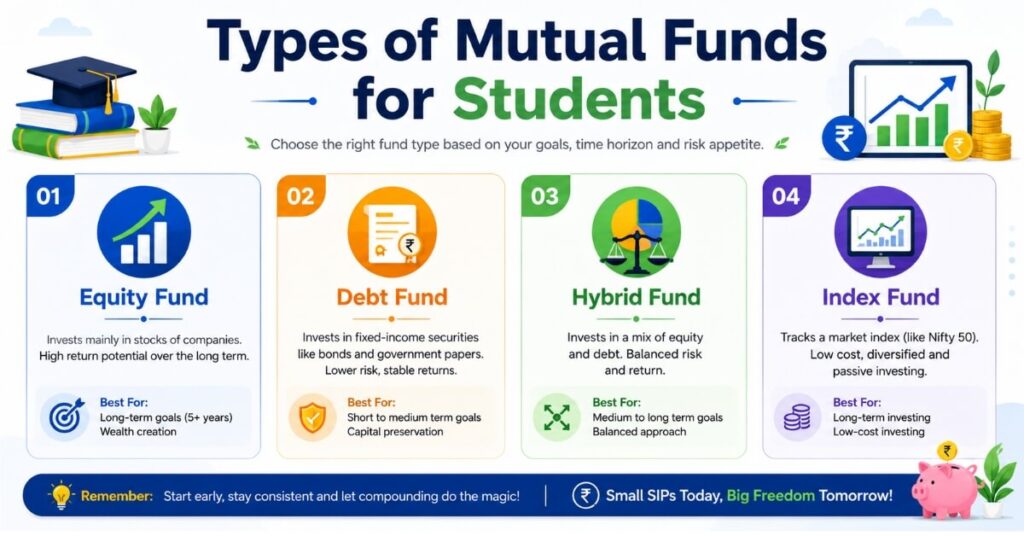
Types of Mutual Funds Suitable for Students
Understanding fund types helps you match your goals with the right investment:
Equity Mutual Funds
These invest in stocks and offer the highest returns over the long term. Ideal for students who can stay invested for 5–10 years. The best mutual funds for students in India in the equity category include large cap and flexi cap funds.
Debt Mutual Funds
These invest in bonds and government securities. Low risk and stable returns. Good for students saving for fees or short-term goals within 1–2 years.
Hybrid Mutual Funds
A balanced mix of equity and debt. Perfect for students who want moderate growth with lower risk. These are among the safest picks from the best mutual funds for students in India list.
ELSS (Equity Linked Savings Scheme)
These tax-saving funds have a 3-year lock-in period. If you have a PAN card and taxable income, ELSS is a great option for students who earn part-time income.
Index Funds
Index funds track the Nifty 50 or Sensex. Very low expense ratio and no fund manager bias. A simple and effective choice for student investors looking for the best mutual funds for students in India.
Best Mutual Funds for Students in India 2026
Here is a carefully selected list of the best mutual funds for students in India based on past performance, expense ratio, risk level, and suitability for beginners:
1. Mirae Asset Large Cap Fund
Category: Equity — Large Cap
Risk: Moderate
Minimum SIP: ₹500/month
Why it’s ideal: One of the most consistent large cap funds in India. Invests in top 100 blue-chip companies. Low volatility makes it one of the best mutual funds for students in India who are just starting out.
2. Parag Parikh Flexi Cap Fund
Category: Equity — Flexi Cap
Risk: Moderate to High
Minimum SIP: ₹1,000/month
Why it’s ideal: Diversified across Indian and international stocks. Known for transparent fund management and long-term wealth creation. A top pick among the best mutual funds for students in India for those with a 7+ year horizon.

3. Axis Bluechip Fund
Category: Equity — Large Cap
Risk: Moderate
Minimum SIP: ₹500/month
Why it’s ideal: Consistently delivers stable returns by focusing on quality large cap stocks. Suitable for students who want steady growth without high risk.
4. SBI Nifty Index Fund
Category: Index Fund
Risk: Moderate
Minimum SIP: ₹500/month
Why it’s ideal: Tracks the Nifty 50 index with a very low expense ratio of around 0.20%. No fund manager risk. Absolutely one of the best mutual funds for students in India who believe in passive investing.
5. HDFC Hybrid Equity Fund
Category: Hybrid — Aggressive
Risk: Moderate
Minimum SIP: ₹500/month
Why it’s ideal: Balances equity and debt exposure. Great for students who want growth but with a safety net. A strong recommendation in the best mutual funds for students in India for moderate risk takers.
6. Nippon India Small Cap Fund
Category: Equity — Small Cap
Risk: High
Minimum SIP: ₹100/month
Why it’s ideal: High growth potential over 10+ years. Only for students with high risk appetite and long investment horizon. Not recommended as a first fund, but a great addition once you are comfortable with the best mutual funds for students in India.
7. ICICI Prudential Short Term Fund
Category: Debt — Short Term
Risk: Low
Minimum SIP: ₹100/month
Why it’s ideal: Perfect for students saving for fees or short-term goals within 1–2 years. Stable returns around 6–7% annually with very low risk.
“If you prefer guaranteed returns over market-linked investments, check out our complete guide on Digital Fixed Deposit — Best Platforms & Returns in India 2026″
8. Quant ELSS Tax Saver Fund
Category: ELSS — Tax Saving
Risk: High
Minimum SIP: ₹500/month
Why it’s ideal: Best performing ELSS fund in recent years. If you have part-time income and want to save tax under Section 80C, this is the best pick from the best mutual funds for students in India in the tax saving category.

How to Start Investing in Mutual Funds as a Student in India
Starting is easier than most students think. Here is a simple step-by-step process:
Step 1 — Complete KYC
Keep your PAN card, Aadhaar card, and a bank account ready. Complete eKYC online on any investment platform.
Step 2 — Choose a Platform
Download Groww, Zerodha Coin, or Paytm Money. These apps make investing in the best mutual funds for students in India simple and commission-free.
Step 3 — Pick Your Fund
Based on your goal and risk tolerance, select one fund from this list. Do not invest in 5–6 funds at once as a beginner.
Step 4 — Set Up a SIP
Start a monthly SIP of ₹500 or whatever you can afford. Automate the deduction so you never miss a payment.
Step 5 — Review Every 6 Months
Check your portfolio twice a year. Do not panic if the market falls — stay invested for the long term.
SIP Calculator — How Much Can You Earn?
Here is a simple illustration of how even small SIPs grow over time when you invest in the best mutual funds for students in India:
| Monthly SIP | Years | Expected Return | Final Value |
| ₹500 | 10 years | 12% | ₹1.16 Lakhs |
| ₹1,000 | 10 years | 12% | ₹2.32 Lakhs |
| ₹500 | 20 years | 12% | ₹4.99 Lakhs |
| ₹1,000 | 20 years | 12% | ₹9.99 Lakhs |
The earlier you start with the best mutual funds for students in India, the more powerful compounding becomes for you.
Common Mistakes Students Make While Investing
Avoid these pitfalls when investing in mutual funds:
Mistake 1 — Chasing Last Year’s Top Performer
A fund that gave 40% returns last year may not repeat. Always check 3-year and 5-year returns before picking the best mutual funds for students in India.
Mistake 2 — Stopping SIP When Market Falls
Market dips are the best time to accumulate more units at lower prices. Never stop your SIP out of fear.
Mistake 3 — Investing Without a Goal
Always invest with a purpose. Random investing without a goal leads to random results.
Mistake 4 — Ignoring Expense Ratio
A fund with 2% expense ratio eats into your returns significantly over 10 years. Always prefer direct plans of the best mutual funds for students in India to save on commission.
Mistake 5 — Withdrawing Too Early
Equity mutual funds need time to grow. Withdrawing in 1–2 years often leads to losses or minimal gains.

Direct Plan vs Regular Plan — Which Should Students Choose?
Always choose the Direct Plan when investing in the best mutual funds for students in India. Here is why:
“All mutual funds in India are regulated by SEBI — Securities and Exchange Board of India, ensuring complete transparency and investor protection.”
| Factor | Direct Plan | Regular Plan |
| Expense Ratio | Lower (0.5–1%) | Higher (1.5–2.5%) |
| Returns | Higher | Lower |
| Commission | None | Paid to distributor |
| Best For | Self-investors | Those needing advice |
Over 20 years, the difference in returns between direct and regular plans can be lakhs of rupees. Always go direct.
Best Apps to Invest in Mutual Funds for Students
These platforms make investing in the best mutual funds for students in India easy and beginner-friendly:
Groww — Most popular among students. Simple UI, zero commission, instant KYC.
Zerodha Coin — Best for those who also want to invest in stocks. Direct mutual fund platform.
Paytm Money — Easy UPI-based SIP setup. Good for first-time investors.
ET Money — Tracks spending and investments in one app. Smart analytics for students.
HDFC Sky / SBI YONO — Bank-linked apps for those who prefer investing directly through their bank.
Frequently Asked Questions (FAQs)
Q1. Can a student invest in mutual funds in India?
Yes, any Indian student above 18 with a PAN card and bank account can invest in the best mutual funds for students in India. Minors can invest through their parents or guardians.
Q2. What is the minimum amount to invest in mutual funds as a student?
You can start with as little as ₹100 per month through SIP. Many of the best mutual funds for students in India have a minimum SIP of ₹500.
Q3. Is SIP better than lump sum for students?
Yes, SIP is always better for students as it requires small regular amounts and removes the risk of timing the market.
Q4. Which is the safest mutual fund for students?
Debt funds and hybrid funds are the safest. ICICI Prudential Short Term Fund and HDFC Hybrid Equity Fund are among the best mutual funds for students in India for low-risk investors.
Q5. Can I withdraw my mutual fund investment anytime?
Yes, except ELSS funds which have a 3-year lock-in. Most other funds allow withdrawal anytime, though exit loads may apply within 1 year.
Q6. Do students need to pay tax on mutual fund returns?
Short-term capital gains (held less than 1 year) are taxed at 20%. Long-term capital gains above ₹1.25 lakh are taxed at 12.5%. ELSS investments qualify for deduction under Section 80C.
Q7. How many mutual funds should a student invest in?
Start with 1–2 funds. Diversifying too early across many funds creates confusion. Once comfortable, you can explore more of the best mutual funds for students in India.
Conclusion
Investing in mutual funds as a student is one of the best financial decisions you can make. The earlier you start, the more time your money gets to grow through the power of compounding. Whether you have ₹100 or ₹5,000 to invest monthly, there is always a suitable option among the best mutual funds for students in India for your goals and risk profile.
Start small, stay consistent, and never stop learning about personal finance. Your future self will thank you for the decisions you make today.
Disclaimer
: This article is for educational purposes only and does not constitute financial advice. Mutual fund investments are subject to market risks. Please read all scheme-related documents carefully and consult a SEBI-registered financial advisor before investing.


Pingback: EPFO E-Nomination: Secure Free Rs.7 Lakh Insurance Now