
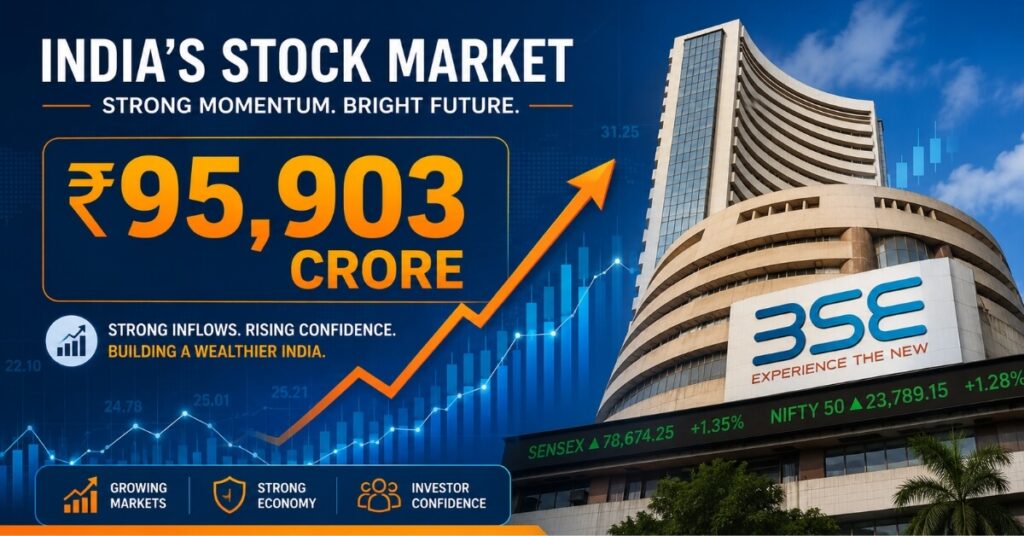
When one of the world’s largest asset managers quietly moves nearly ₹96,000 crore into Indian stocks, smart investors pay attention. That is exactly what Vanguard has done. As of June 2026, Vanguard India stocks 2026 holdings across 47 BSE-listed companies stand at a staggering ₹95,903 crore — a sharp 44% jump from just ₹66,403 crore in the December 2025 quarter. This is not a random market move. This is a calculated, data-backed signal from an institution that manages over $10 trillion globally.
For everyday investors in the US, UK, Canada, and beyond who want exposure to one of the fastest-growing economies on Earth, understanding Vanguard’s India strategy is like getting a masterclass in emerging market investing — for free. In this article, we break down exactly what Vanguard India stocks 2026 look like, which sectors they are betting on, what their top holdings reveal, and what you can personally learn from this institutional playbook.
Whether you are a seasoned investor or just starting your wealth-building journey, this guide will help you understand why India is the most exciting investment story of 2026 — and how Vanguard is leading the charge.
What Is Vanguard and Why Does It Matter for Indian Stocks?
Before we dive into Vanguard India stocks 2026 specifically, it is important to understand who Vanguard is and why its moves carry so much weight.
Founded in 1975 by John Bogle, Vanguard is headquartered in Malvern, Pennsylvania, USA. It is one of the three largest asset management companies in the world, alongside BlackRock and Fidelity, collectively managing assets worth over $10 trillion. Vanguard pioneered the concept of low-cost index investing — the idea that instead of paying high fees to active fund managers, ordinary investors could simply track a market index and outperform most professionals over time.
Vanguard India stocks 2026 portfolio operates primarily through index-based funds and ETFs. This means when a company gets added to a major global index — like the MSCI Emerging Markets Index — Vanguard automatically buys that stock in proportion to its index weight. This is exactly why Vanguard India stocks 2026 holdings have grown so dramatically — as India’s economy has expanded and Indian companies have gained higher weightage in global indices, Vanguard’s India allocation has naturally increased. For investors tracking Vanguard India stocks 2026, understanding this index-based approach is the key to understanding why Vanguard keeps buying more Indian equities every quarter.
As a Foreign Institutional Investor (FII) in India, Vanguard is ranked among the top three active FIIs in the country. Its investments span banking, information technology, healthcare, energy, consumer goods, and manufacturing — essentially a cross-section of India’s most important industries.
When Vanguard increases its India allocation by 44% in a single quarter, it is telling the global investment community something very clear: India is where the growth is in 2026.
The Big Number: ₹95,903 Crore and What It Means
Let us put the Vanguard India stocks 2026 portfolio value in perspective.
₹95,903 crore is approximately $11.5 billion USD. That is larger than the entire GDP of many small nations. Vanguard holds this amount across 47 BSE-listed companies as of the March 2026 shareholding quarter. The 44% increase from ₹66,403 crore (December 2025) to ₹95,903 crore happened in just one quarter — representing an addition of nearly ₹29,500 crore in value.
This massive jump reflects two things working together. First, Vanguard may have increased its actual shareholding in certain companies during the March 2026 quarter — two new stocks were reportedly added to the portfolio during this period. Second, the Indian stock market itself performed strongly in early 2026, pushing up the value of existing holdings.
Either way, the message is the same: Vanguard’s confidence in Vanguard India stocks 2026 is at an all-time high. For retail investors watching global smart money flows, this is a powerful signal that Indian equities deserve serious attention in any diversified portfolio.
Why Is Vanguard So Bullish on India in 2026?
Understanding the macro reasons behind Vanguard India stocks 2026 enthusiasm helps investors see the bigger picture. Several powerful forces are driving institutional money into Indian equities right now.
1. India’s GDP Growth Story
When examining Vanguard India stocks 2026, it is important to understand the macro backdrop. India is projected to be one of the fastest-growing major economies in 2026, with GDP growth estimates ranging between 6.5% and 7.2%. This strong growth outlook is one of the biggest reasons behind Vanguard India stocks 2026 surge in value. While China has slowed and Western economies face inflation and rate pressures, India continues to deliver robust economic expansion driven by domestic consumption, infrastructure investment, and a young working population — making Vanguard India stocks 2026 one of the most compelling investment stories of the year.
2. Earnings Revival
After a period of subdued corporate earnings in 2024-2025, Indian companies are showing strong profit growth in FY2026. Sectors like banking, IT, automobiles, and capital goods are reporting healthy quarterly numbers. Higher earnings directly translate into higher stock valuations — making Vanguard India stocks 2026 more attractive on a fundamental basis.
3. Valuation Reset
Indian equities went through a significant correction in late 2024 and early 2025. This pullback brought valuations to more reasonable levels. The Nifty 50’s price-to-earnings ratio came close to its 10-year average, making Indian large-cap stocks attractive compared to historical standards and compared to other emerging markets.
4. Policy and Rate Support
The Reserve Bank of India (RBI) began cutting interest rates in early 2025, and the Indian government continued its focus on infrastructure spending and manufacturing incentives through the Production Linked Incentive (PLI) scheme. Lower interest rates reduce borrowing costs for companies and make equities relatively more attractive than bonds — a direct tailwind for Vanguard India stocks 2026.
5. India’s Rising Index Weight
As Indian companies grow larger and more profitable, their weight in global indices like the MSCI Emerging Markets Index increases. As this happens, index-tracking funds like Vanguard are automatically required to buy more Indian stocks to maintain proper index representation. This creates a structural, self-reinforcing flow of foreign capital into Indian equities.
Top Vanguard India Stocks 2026: Sector-by-Sector Breakdown
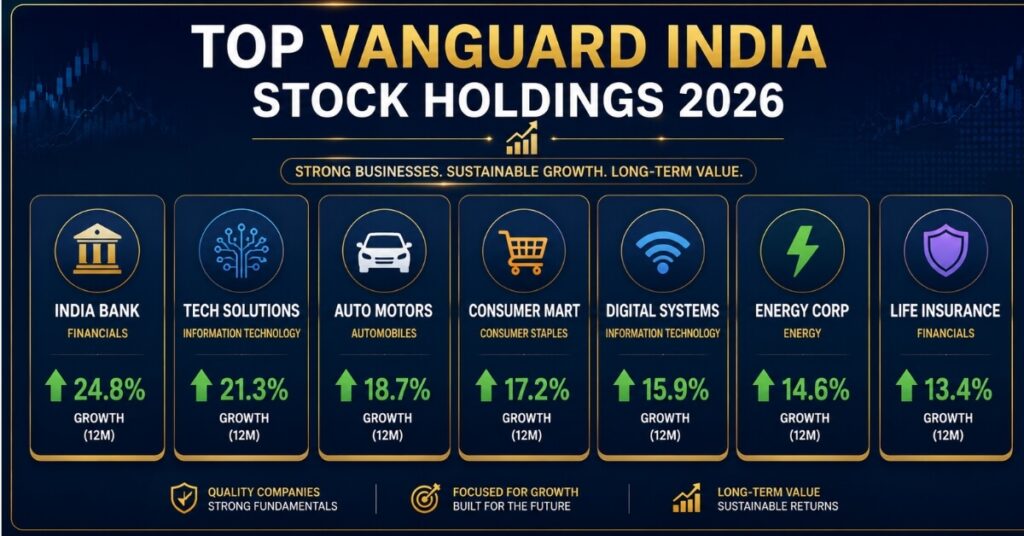
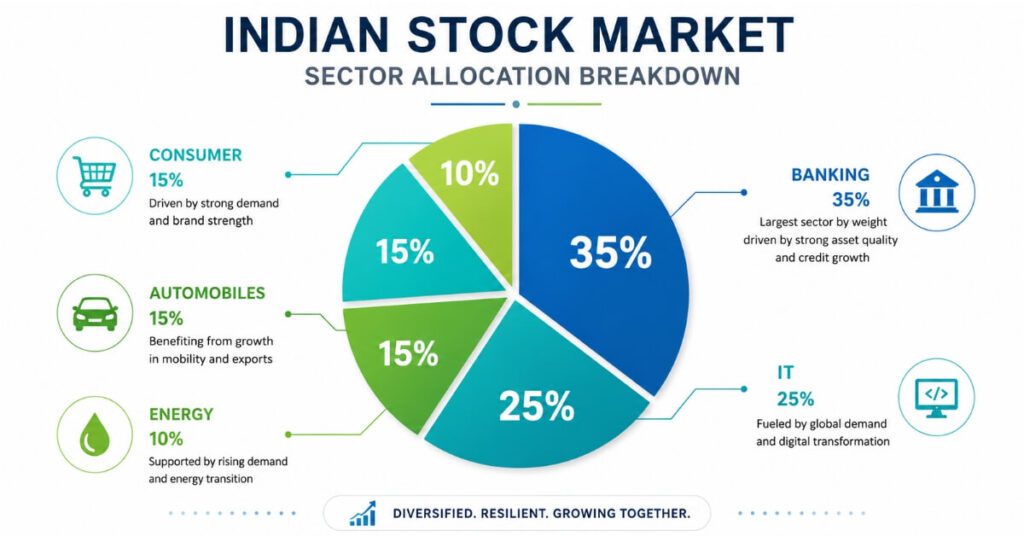
Based on publicly available shareholding data, Vanguard’s India portfolio is concentrated across several key sectors. Here is a detailed look at the types of companies that form the backbone of Vanguard India stocks 2026.
Banking and Financial Services
Banking stocks form the single largest sector in Vanguard’s India portfolio. This makes complete sense — as India’s economy grows, demand for credit, insurance, wealth management, and digital payments grows with it.
HDFC Bank is consistently the top holding in Vanguard India stocks 2026 portfolio by market capitalization. As India’s largest private sector bank with over 9,100 branches and a stellar digital banking platform, HDFC Bank represents the gold standard of Indian banking. When analysts study Vanguard India stocks 2026, HDFC Bank always appears at the top of the list — and for good reason. Its loan growth has been running at approximately 12% year-on-year as of Q3 FY2026, with consistent profit growth and strong asset quality. For Vanguard, which follows index weights, HDFC Bank’s massive market capitalization ensures it remains the single biggest holding in Vanguard India stocks 2026 portfolio — making it a stock every global investor should watch closely.
ICICI Bank is another major Vanguard holding. Once known for high non-performing assets, ICICI Bank has transformed dramatically over the past five years. Its Return on Equity (ROE) now consistently runs at 17-18%, and its diversified financial group — spanning banking, insurance, asset management, and securities — gives it multiple growth engines. The bank’s digital-first strategy has made it one of the most innovative financial institutions in Asia.
Axis Bank rounds out the top three banking holdings. As India’s third-largest private bank, Axis Bank has undergone significant transformation under its current management, improving profitability and asset quality while expanding its retail banking franchise.
Information Technology
India’s IT sector is the country’s biggest export earner and a global powerhouse. Vanguard India stocks 2026 naturally includes heavy exposure to Indian IT companies that serve Fortune 500 clients across the US, Europe, and Asia.
Infosys is one of Vanguard’s largest IT holdings. As a global leader in digital transformation, cloud computing, artificial intelligence, and enterprise modernization, Infosys has a client base spanning banking, healthcare, retail, and manufacturing. The company has consistently maintained strong margins and generates substantial free cash flow, making it a reliable long-term holding for institutional investors.
Tata Consultancy Services (TCS) is India’s most valuable IT company and one of the largest IT services firms in the world. With clients across 50+ countries and a growing artificial intelligence and cloud services book, TCS has a massive competitive moat. Its revenue consistently exceeds ₹2.5 lakh crore annually, with EBIT margins above 24%. For any global index fund tracking emerging markets, TCS is a must-have holding.
Automobiles and Manufacturing
Mahindra and Mahindra (M&M) has emerged as one of the standout performers in Vanguard India stocks 2026 portfolio. The company operates across automotive and farm equipment sectors, and its SUV lineup has captured dominant market share in India’s booming passenger vehicle market. Investors tracking Vanguard India stocks 2026 will find M&M particularly interesting — the company has made significant strides in electric vehicles, positioning itself for the next decade of transportation transformation in India and globally. The fact that M&M features prominently in Vanguard India stocks 2026 holdings is a strong validation of India’s booming automobile sector.
India’s manufacturing sector overall has benefited enormously from the China-plus-one strategy adopted by global companies looking to diversify supply chains away from China. This structural shift has brought billions of dollars in foreign direct investment into Indian manufacturing — a trend that benefits the entire sector over the long term.
New-Age Consumer and Digital Economy
One of the most interesting aspects of Vanguard India stocks 2026 is the inclusion of new-age digital economy companies that were not even publicly listed a few years ago.
Zomato — India’s leading food delivery and quick commerce platform — has become a significant Vanguard holding. Zomato’s rapid expansion into Blinkit (instant grocery delivery) has transformed it from a pure food delivery app into a broader quick commerce powerhouse. The company turned profitable, and its revenue growth has been exceptional, making it attractive for global index funds as it has grown large enough to enter major indices.
This inclusion of digital economy stocks in Vanguard India stocks 2026 reflects a broader truth: India’s economy is not just about traditional industries anymore. A massive, young, smartphone-using population is driving explosive growth in fintech, e-commerce, food delivery, and digital services.
Energy and Infrastructure
India’s energy transition and infrastructure buildout represent another major theme in Vanguard’s India portfolio. Companies in renewable energy, power generation, capital goods, and infrastructure are benefiting from massive government spending and private investment.
The Indian government has committed to installing 500 GW of renewable energy capacity by 2030 — one of the most ambitious clean energy targets in the world. This creates enormous opportunities for companies across the energy and infrastructure value chain, from solar panel manufacturers to power transmission companies.
What Two New Stocks Did Vanguard Add in Q4 2025?
One of the most closely watched aspects of Vanguard India stocks 2026 is the addition of two new stocks to the portfolio during the March 2026 quarter. While the specific names require access to proprietary shareholding databases like ACE Equity and Trendlyne, the addition of new stocks to an index-tracking portfolio like Vanguard’s typically signals one of two things.
Either these companies were recently added to a major global index like the MSCI Emerging Markets Index or the FTSE All-World Index, which automatically triggers Vanguard’s purchase. Or their market capitalization grew large enough to cross the threshold for index inclusion — meaning they graduated from mid-cap to large-cap status in the eyes of global index providers.
This is actually an important insight for stock market investors: companies that are about to be added to major global indices often see significant price appreciation as index funds like Vanguard are forced to buy large quantities of their shares. Tracking potential index additions is a legitimate investment strategy used by sophisticated investors worldwide.

7 Key Investment Lessons From Vanguard’s India Strategy
Studying Vanguard India stocks 2026 is not just about knowing which stocks they hold. It is about understanding the principles behind their investment decisions — principles that any individual investor can apply to their own portfolio.
Lesson 1: Follow the Index Weight, Not the Headlines
Vanguard does not make emotional investment decisions based on news cycles. It follows index weights methodically. This teaches investors that consistency and discipline beat reactive decision-making over the long term.
Lesson 2: Diversify Across Sectors
Vanguard’s India portfolio spans banking, IT, automobiles, consumer goods, healthcare, and energy. No single sector dominates overwhelmingly. This diversification protects the portfolio when any one sector underperforms — a lesson every retail investor should internalize.
Lesson 3: Think in Decades, Not Quarters
Vanguard’s India bet is based on India’s long-term economic trajectory — not on whether the market goes up or down next month. Investors who think in 10-year horizons debt free financial freedom tend to outperform those who react to short-term volatility.
Lesson 4: Large Caps Provide the Foundation
The backbone of Vanguard India stocks 2026 is large-cap, blue-chip companies with proven business models. These companies generate consistent cash flows, pay dividends, and survive economic downturns. Building a portfolio foundation with large-caps before adding smaller, riskier positions is a time-tested strategy.
Lesson 5: New Economy Stocks Deserve Attention
Vanguard’s inclusion of companies like Zomato shows that even conservative index funds now recognize the importance of digital economy companies. Investors who ignore the new economy risk missing a significant portion of future wealth creation.
Lesson 6: Emerging Market Diversification Is Essential
For US, UK, and Canadian investors who hold primarily domestic stocks, adding emerging market exposure through India-focused funds or ETFs can significantly improve portfolio diversification and long-term returns.
Lesson 7: Smart Money Flows Are a Signal, Not a Guarantee
While following institutional investors like Vanguard provides useful insight, it is important to remember that past performance does not guarantee future results. Always conduct your own research and consider your personal risk tolerance before making any investment decisions.
How Can International Investors Get Exposure to Vanguard India Stocks 2026?
For investors outside India who want to participate in the same Indian growth story that Vanguard is betting on, there are several accessible options.
Vanguard FTSE Emerging Markets ETF (VWO) provides broad emerging market exposure, with India being one of the largest country allocations. As India’s weight in global indices increases, VWO’s India exposure automatically grows.
iShares MSCI India ETF (INDA) is one of the most popular India-specific ETFs for international investors, providing direct exposure to Indian large-cap and mid-cap stocks.
WisdomTree India Earnings Fund (EPI) offers an alternative approach, weighting Indian stocks by earnings rather than market cap.
For investors who prefer mutual funds, several global asset managers including Vanguard itself offer emerging market funds with significant India allocations.
It is important to consult a qualified financial advisor before making any international investment decisions, as currency risk, tax implications, and regulatory considerations vary by country of residence.
Risks to Watch: What Could Derail Vanguard India Stocks 2026?
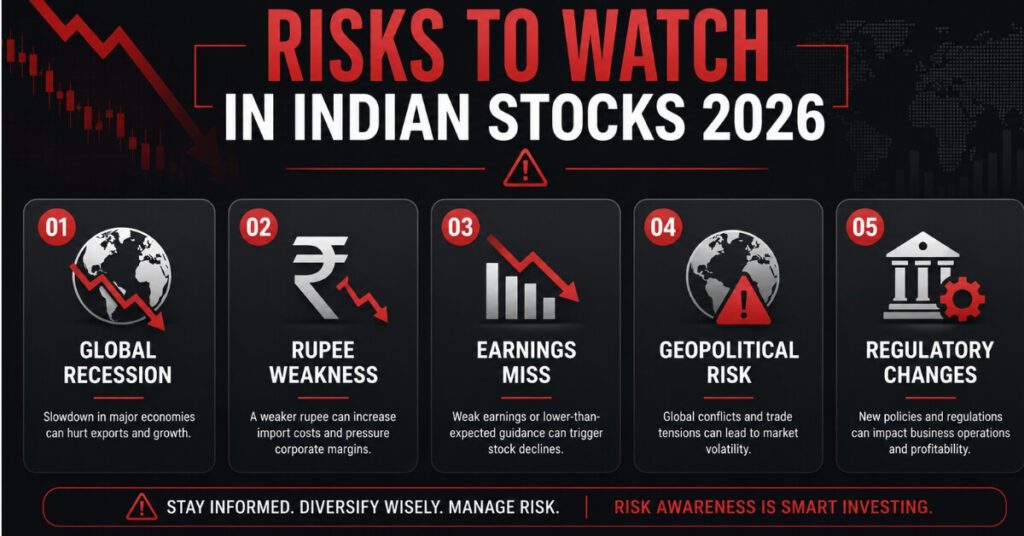
No investment story is complete without an honest assessment of risks. Even as Vanguard India stocks 2026 paint an optimistic picture, investors should be aware of potential headwinds.
Global Recession Risk: A significant slowdown in the US or European economies could reduce demand for Indian IT services exports and create risk-off sentiment in global financial markets, leading to FII outflows from India.
Rupee Depreciation: A weakening Indian rupee reduces the dollar value of Indian stock returns for international investors. While the rupee has been relatively stable in 2026, global currency pressures remain a risk.
Earnings Disappointment: If Indian corporate earnings growth disappoints in Q1 or Q2 FY2027, it could trigger a market correction that affects Vanguard’s India portfolio value.
Geopolitical Tensions: India’s complex geopolitical environment — including its relationship with China and Pakistan — creates occasional market volatility that investors should factor into their risk assessment.
Regulatory Changes: Changes in India’s FII investment regulations or tax treatment of capital gains could affect foreign institutional flows into Indian markets.
Conclusion: The Vanguard India Signal Is Too Loud to Ignore
The story of Vanguard India stocks 2026 is ultimately a story about one of the world’s most trusted asset managers placing an enormous vote of confidence in the Indian economy. A ₹95,903 crore portfolio growing at 44% in a single quarter is not noise — it is a clear, data-backed signal.
India offers what few other markets can in 2026: strong GDP growth, an earnings revival, reasonable valuations, supportive monetary policy, and a young, consumption-driven population. For global investors seeking diversification and growth, the question is no longer whether India deserves a place in their portfolio — it is how much exposure to take.
By studying Vanguard India stocks 2026, individual investors gain access to the same investment logic that governs trillions of dollars in institutional capital. The sectors Vanguard bets on — banking, IT, automobiles, digital economy, and infrastructure — are the engines of India’s future. The companies they hold — HDFC Bank, Infosys, TCS, ICICI Bank, M&M, Zomato, and Axis Bank — are household names with proven track records.
The message from Vanguard is clear. India is not an emerging market story for the distant future. It is a present-day investment opportunity that the smartest money in the world is already acting on.
Disclaimer
This article is for informational and educational purposes only. It does not constitute financial advice. Please consult a qualified financial advisor before making any investment decisions. Stock market investments are subject to market risks. Past performance is not indicative of future results.
Frequently Asked Questions (FAQs)
Q1. What are Vanguard India stocks 2026?
Vanguard India stocks 2026 refer to the Indian equity holdings of Vanguard’s global funds as disclosed in the March 2026 shareholding quarter. Vanguard holds stakes in 47 BSE-listed Indian companies with a total portfolio value of approximately ₹95,903 crore.
Q2. Why is Vanguard investing so heavily in Indian stocks in 2026?
Vanguard primarily follows index-based investing. As Indian companies have gained higher weightage in global indices like the MSCI Emerging Markets Index, Vanguard’s India allocation has automatically increased. Additionally, India’s strong GDP growth, earnings revival, and reasonable valuations make Indian equities attractive to global institutional investors.
Q3. What are Vanguard’s top Indian stock holdings in 2026?
Based on publicly available data, Vanguard’s top Indian holdings by market capitalization include HDFC Bank, Infosys, ICICI Bank, Axis Bank, Mahindra and Mahindra, Zomato, and TCS, among others across banking, IT, and consumer sectors.
Q4. How can I invest in the same Indian stocks as Vanguard?
International investors can gain exposure through ETFs like Vanguard FTSE Emerging Markets ETF (VWO), iShares MSCI India ETF (INDA), or WisdomTree India Earnings Fund (EPI). Indian residents can directly invest in BSE or NSE-listed stocks through a registered broker. Always consult a financial advisor before investing.
Q5. Did Vanguard add new Indian stocks in 2026?
Yes, according to ETMarkets analysis, Vanguard added two new stocks to its India portfolio during the March 2026 quarter. These additions likely reflect new index inclusions or companies that crossed market cap thresholds for global index eligibility.
Q6. What is the total value of Vanguard’s India portfolio in 2026?
As of the March 2026 quarter, Vanguard’s India portfolio across 47 BSE-listed companies is valued at approximately ₹95,903 crore — a 44% increase from ₹66,403 crore in the December 2025 quarter.
Q7. Is investing in Indian stocks risky for international investors?
Like all equity investments, Indian stocks carry risks including market volatility, currency risk, and geopolitical factors. However, diversification across multiple sectors and a long-term investment horizon can help manage these risks effectively.


Pingback: How to File ITR Online 2026 — 5 Easy Steps Guide