
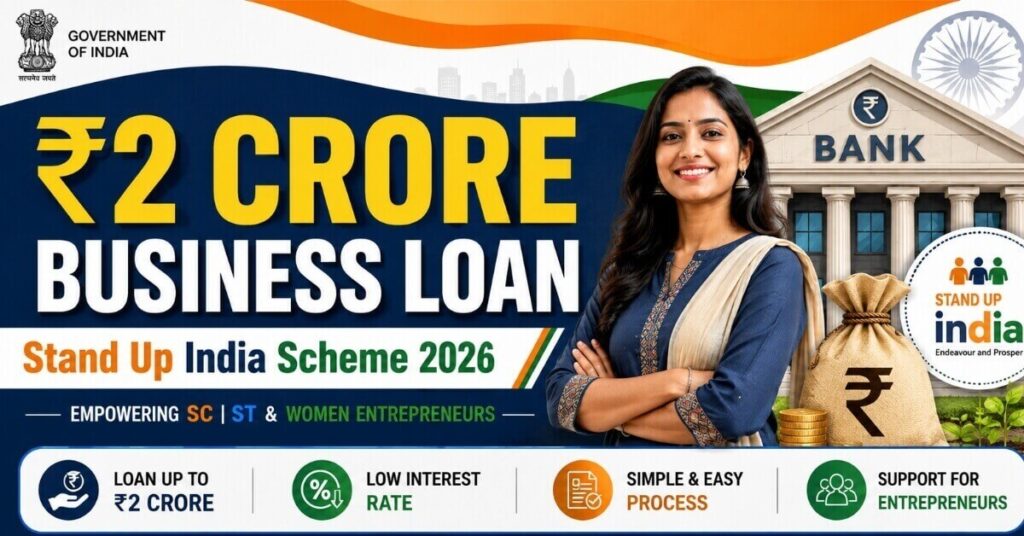
If you are a woman, SC, or ST entrepreneur planning to start your own greenfield business, 2026 is turning out to be one of the best years to apply for government-backed funding. The Stand Up India Loan Scheme 2026 has been redesigned by the Ministry of Finance to double the loan limit, simplify paperwork, and add online skill-building support for first-time business owners.
In this guide, we will break down everything you need to know about the Stand Up India Loan Scheme 2026 — from eligibility and loan amount to the step-by-step application process, so you can decide if this is the right funding option for your business idea.
What Is the Stand Up India Loan Scheme 2026?
The Stand Up India Loan Scheme 2026 is the revamped version of the original Stand-Up India initiative that was first launched by the Government of India in April 2016. The older scheme, which offered loans between ₹10 lakh and ₹1 crore, officially concluded in March 2025. Following a detailed review by NITI Aayog and other government departments, the Finance Ministry decided to redesign the program to reach more beneficiaries and offer stronger financial support.
Under the new structure, every branch of a scheduled commercial bank is expected to extend at least one loan to an SC or ST borrower and one loan to a woman borrower, helping them set up a new “greenfield” enterprise — meaning a business that is being started for the very first time by the applicant.
Why the Government Introduced the Stand Up India Loan Scheme 2026
Small business owners from underrepresented communities often struggle to get collateral-free credit from banks, even when they have a solid business idea. The original scheme helped thousands of entrepreneurs, but the loan cap of ₹1 crore was seen as too limited for medium-sized manufacturing or service ventures in today’s economy.
That is exactly why the government decided to introduce the Stand Up India Loan Scheme 2026 with a much higher funding ceiling. The goal is simple: reduce dependency on informal lenders, encourage more women and SC/ST citizens to become job creators instead of job seekers, and support India’s growing startup ecosystem at the grassroots level.
Key Features of the Stand Up India Loan Scheme 2026
The biggest highlight of the Stand Up India Loan Scheme 2026 is the increase in the maximum loan amount. Here are the features that make this update stand out from the earlier version:
Loan amount doubled from ₹1 crore to up to ₹2 crore for eligible applicants
Composite loan structure covering both term loan and working capital
Collateral-free lending backed by a dedicated credit guarantee fund
Online entrepreneurship skill-building modules included for first-time founders
Faster processing through the digital Stand-Up India portal
Continued focus on manufacturing, trading, services, and agri-allied businesses
Repayment tenure of up to 7 years with a moratorium period
These upgrades make the scheme far more attractive for entrepreneurs who need serious capital to compete in modern markets, rather than just enough money to open a small shop.
Eligibility Criteria for the Stand Up India Loan Scheme 2026
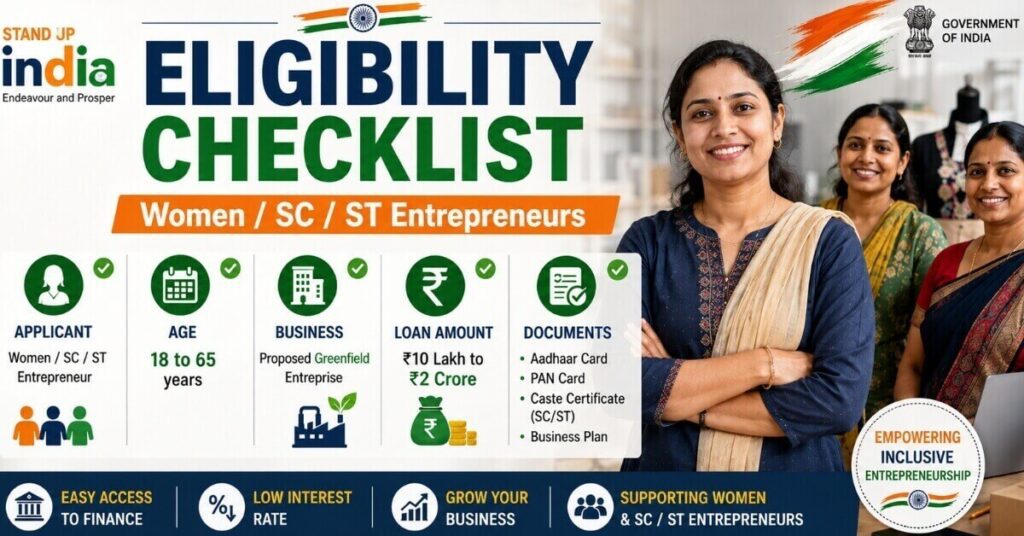
Before applying, it is important to check whether you qualify. The eligibility criteria for the Stand Up India Loan Scheme 2026 are fairly straightforward:
The applicant must be a woman above 18 years of age, or belong to the Scheduled Caste (SC) or Scheduled Tribe (ST) category
The business must be a new, first-time greenfield venture — expansion of an existing business is not covered
The enterprise can be in manufacturing, trading, services, or activities allied to agriculture
For non-individual enterprises, at least 51% of the shareholding and controlling stake should be held by a woman or SC/ST entrepreneur
The applicant should not be a defaulter with any bank or financial institution
Because the scheme specifically targets first-time entrepreneurs, having a clear business plan and a realistic project report is essential for approval. Applicants who can clearly demonstrate market demand, a rough cash-flow projection, and a workable repayment plan tend to move through the bank’s evaluation process much faster than those who submit vague or incomplete proposals.
Loan Amount, Margin Money and Interest Rate
One of the most searched questions about this program relates to how much money you can actually borrow and at what cost. Under the current structure, the composite loan can cover up to 85% of the total project cost, which includes both the term loan and working capital component.
The rate of interest is generally the lowest applicable rate offered by the bank for that borrower category, and it should not exceed the base rate (MCLR) plus 3% plus a tenor premium. Repayment is spread across 7 years, with a moratorium period of up to 18 months so new business owners get breathing room before EMIs begin. Compared to the older cap, this revised structure under the Stand Up India Loan Scheme 2026 gives applicants far more flexibility to fund larger projects without hunting for additional private financing.
It is also worth noting that borrowers are generally required to contribute a small portion of the project cost from their own savings, usually around 10 to 15 percent, unless convergence support from another government scheme is being used to cover that margin. This structure ensures the borrower has genuine skin in the game while still keeping the overall financial burden manageable for a first-time business owner.
Who Should Apply for This Scheme
The Stand Up India Loan Scheme 2026 is best suited for aspiring entrepreneurs who have a clear, well-researched business idea but lack the collateral or savings needed to start it on their own. It is particularly valuable for women who want to build an independent identity through business ownership, SC/ST graduates or diploma holders who want to move away from job-seeking into job creation, and small manufacturers who need a larger capital base than what the earlier ₹1 crore ceiling allowed.
If you already run a registered business and are simply looking to expand operations, this scheme will not apply to you, since it is strictly reserved for greenfield ventures. However, if you are starting completely fresh — whether it is a small manufacturing unit, a service-based startup, or an agri-allied enterprise — this is one of the most beneficiary-friendly funding routes currently backed by the Government of India.
Impact of the Stand Up India Loan Scheme 2026 on India’s Startup Ecosystem
Since its original launch in 2016, the Stand-Up India initiative has sanctioned loans worth more than ₹61,000 crore, with women entrepreneurs accounting for over 80% of total beneficiaries. This shows the scheme has already played a major role in shaping India’s grassroots entrepreneurship story.
With the Stand Up India Loan Scheme 2026 raising the ceiling to ₹2 crore, industry experts expect a sharper rise in medium-scale manufacturing units, tech-enabled service startups, and agri-processing businesses run by first-generation entrepreneurs. A higher loan limit also means fewer businesses will need to rely on expensive private lending or informal credit, which historically has been one of the biggest obstacles for SC, ST, and women-led enterprises trying to scale beyond a small local setup.
This shift is especially relevant given how much India’s small business landscape has changed since 2016. Digital payments, e-commerce platforms, and online marketplaces have made it possible for even small manufacturing or service units to reach customers well beyond their local district. A larger loan ceiling allows entrepreneurs to invest not just in physical infrastructure, but also in technology, packaging, and marketing — areas that were often left out of business plans when the funding cap was limited to ₹1 crore.
How to Apply for the Stand Up India Loan Scheme 2026 Online
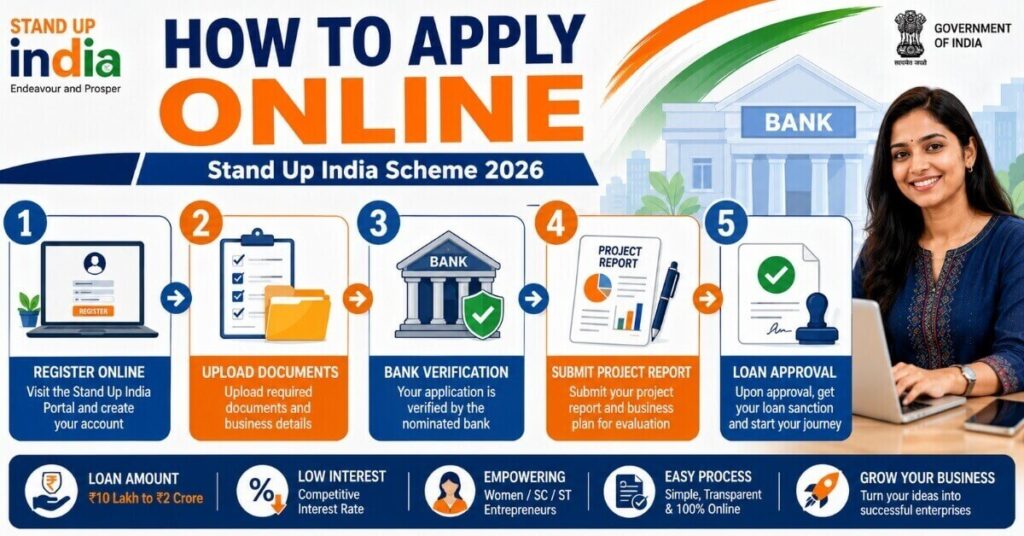
Applying for the Stand Up India Loan Scheme 2026 is designed to be simple, and most of the process can be completed digitally through the official Stand-Up India portal. Here is a general step-by-step process:
1.Visit the official Stand-Up India website and register as a new user with your basic details
2.Select whether you are applying as an SC/ST or woman entrepreneur
3.Choose your preferred sector — manufacturing, trading, services, or agri-allied
4.Fill in your business plan, project cost estimate, and personal identification details
5.Upload your caste certificate (if applicable), identity proof, and address proof
6.The system will link your application to a nearby bank branch or Lead District Manager
7.The bank will evaluate the feasibility of your project before sanctioning the loan
Once submitted, bank officials typically schedule a meeting to discuss your project report before the loan is formally approved and disbursed.
Documents Required for Application
To avoid delays, keep the following documents ready before you start your application under the Stand Up India Loan Scheme 2026:
Aadhaar card and PAN card
Caste certificate (for SC/ST applicants)
Detailed project report or business plan
Address proof and passport-size photographs
Bank account details for loan disbursement
Quotations for machinery or equipment, if applicable
Having these documents organized in advance can significantly speed up the loan sanctioning timeline.
Benefits of the Stand Up India Loan Scheme 2026
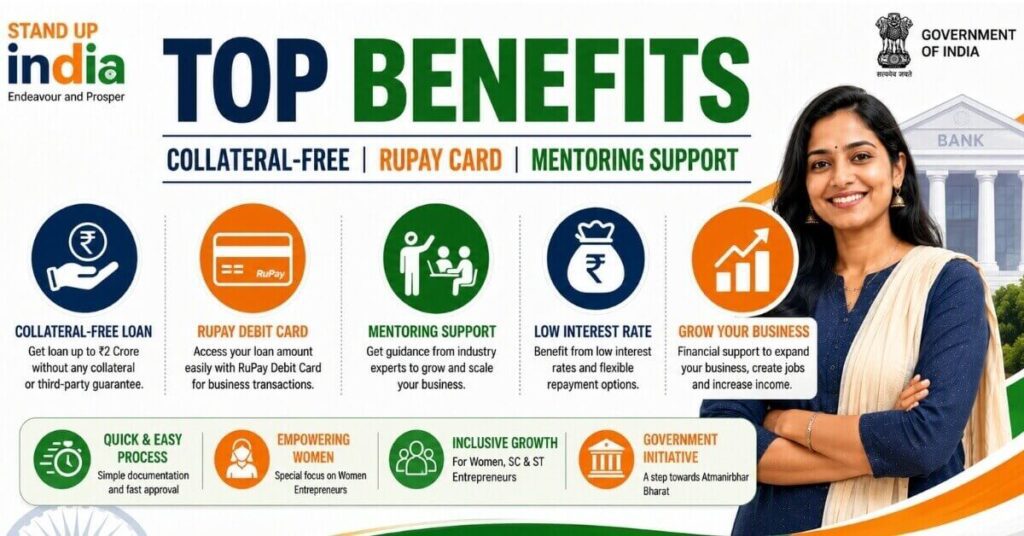
There are several reasons why entrepreneurs across India are excited about this update. The benefits of the Stand Up India Loan Scheme 2026 go beyond just the higher loan amount:
Access to institutional credit without heavy collateral requirements
Structured mentoring and handholding support through the online portal
A RuPay debit card issued for convenient day-to-day business transactions
Better financial inclusion for women and marginalized communities
Support for both new-age service businesses and traditional manufacturing units
For many first-generation entrepreneurs, this scheme is often the only realistic path to formal, low-cost business financing.
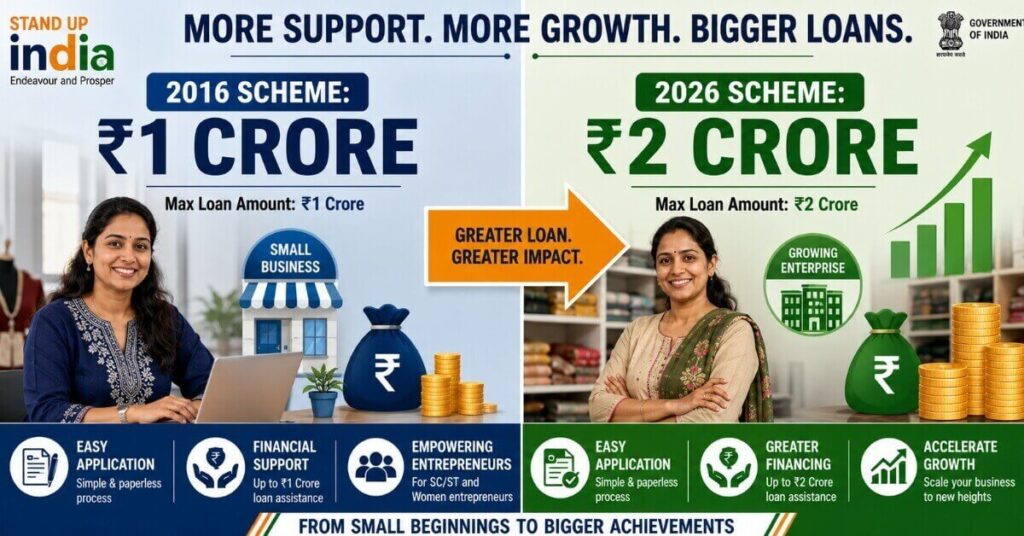
Stand Up India Loan Scheme 2026 vs Old Stand-Up India Scheme
It helps to understand exactly what has changed. The original scheme, active from 2016 to March 2025, sanctioned more than ₹61,000 crore in loans and helped a large number of women entrepreneurs, who made up over 80% of total beneficiaries. However, the ₹1 crore ceiling limited how much larger projects could actually borrow.
The Stand Up India Loan Scheme 2026 doubles that ceiling to ₹2 crore, adds structured skill-building content, and is expected to streamline the digital application process even further. In short, the revamped version keeps the same social objective but is built for entrepreneurs with bigger, more ambitious plans.
Common Mistakes to Avoid While Applying
Many applicants lose valuable time due to avoidable errors. When applying under the Stand Up India Loan Scheme 2026, avoid submitting an incomplete project report, underestimating your working capital needs, or applying for an existing business instead of a genuine greenfield venture, since the scheme strictly covers first-time enterprises only.
Some other common mistakes include:
Choosing a business idea without doing basic market research in your local area
Underestimating raw material or machinery costs, which leads to a mismatch between the sanctioned loan and actual project needs
Not keeping caste certificates or identity documents updated and readily available
Skipping the mentoring sessions offered through the portal, which can help refine a weak business plan before submission
Applying at a bank branch that is unfamiliar with the scheme’s guidelines instead of approaching the designated Lead District Manager
Taking a little extra time to prepare a realistic, well-documented application almost always results in a faster and smoother approval process.
Managing Your Business Finances After Loan Approval
Getting approved for a business loan is only the first step — how you manage the funds afterward matters just as much. Many new entrepreneurs eventually look to grow their surplus income through mutual funds or other investment instruments, and it is worth understanding the risks involved before committing your hard-earned business profits. If you are exploring where to park your extra funds, this detailed breakdown of why mutual funds can show negative returns in 2026 is a useful read before you start investing your business income.
For official and updated guidelines, applicants can always refer to the official Stand-Up India portal, which lists bank-wise application status, eligibility tools, and handholding agency contacts across India. Reviewing both official sources and independent financial guides before making decisions is generally the safest approach, whether you are applying for a business loan or planning where to invest your future profits.
FAQs About the Stand Up India Loan Scheme 2026
1. What is the maximum loan amount under the Stand Up India Loan Scheme 2026?
The revamped scheme is expected to offer loans of up to ₹2 crore, doubling the earlier ₹1 crore limit, subject to bank approval and project viability.
2. Who is eligible to apply for this scheme?
Women above 18 years of age and SC/ST entrepreneurs setting up a first-time greenfield enterprise in manufacturing, trading, services, or agri-allied activities are eligible.
3. Is collateral required for this business loan?
No, the loan is largely collateral-free and backed by a dedicated credit guarantee fund, though banks may request additional security depending on project size.
4. Can an existing business apply under this scheme?
No, only greenfield (first-time) enterprises qualify. Business expansion or diversification of an existing unit is not covered.
5. How long does loan approval usually take?
Processing time varies by bank and project complexity, but a complete application with proper documentation generally speeds up the sanction process considerably.
6. Where can I apply for the Stand Up India Loan Scheme 2026?
Applications can be submitted online through the official Stand-Up India portal or directly at any scheduled commercial bank branch.
7. Can two people from the same family apply together?
Yes, as long as both applicants individually meet the eligibility criteria and the enterprise structure satisfies the shareholding requirement for SC/ST or women applicants.
8. Does the scheme cover working capital needs after the business starts?
Yes, since it is a composite loan, it covers both the initial term loan for setting up the enterprise and ongoing working capital requirements.
Conclusion
The Stand Up India Loan Scheme 2026 represents a meaningful step toward making entrepreneurship more accessible for women, SC, and ST communities across the country. With the loan ceiling doubling to ₹2 crore, added skill-building resources, and a smoother digital application process, this is one of the most beneficiary-friendly government funding options currently available. If you have a solid business idea and meet the eligibility criteria, now is a great time to prepare your documents and apply before demand increases once the full rollout is confirmed.
Start by getting your project report, identity documents, and caste certificate (if applicable) in order, then reach out to your nearest scheduled commercial bank branch or the Lead District Manager in your area to understand the exact process for your region. Being proactive now, rather than waiting until the scheme is widely publicized, can put you ahead of the queue once full-scale implementation begins across all bank branches.
Disclaimer
This article is for general informational purposes only and is based on publicly available government announcements as of the writing date. Loan sanction, final loan limits, interest rates, and scheme rollout dates are subject to change and depend entirely on official government notifications and individual bank policies. Readers are strongly advised to verify the latest details on the official Stand-Up India portal or with their respective bank before making any financial decisions.
Pingback: Leave Encashment Refund Claim: 2026 Complete Guide