
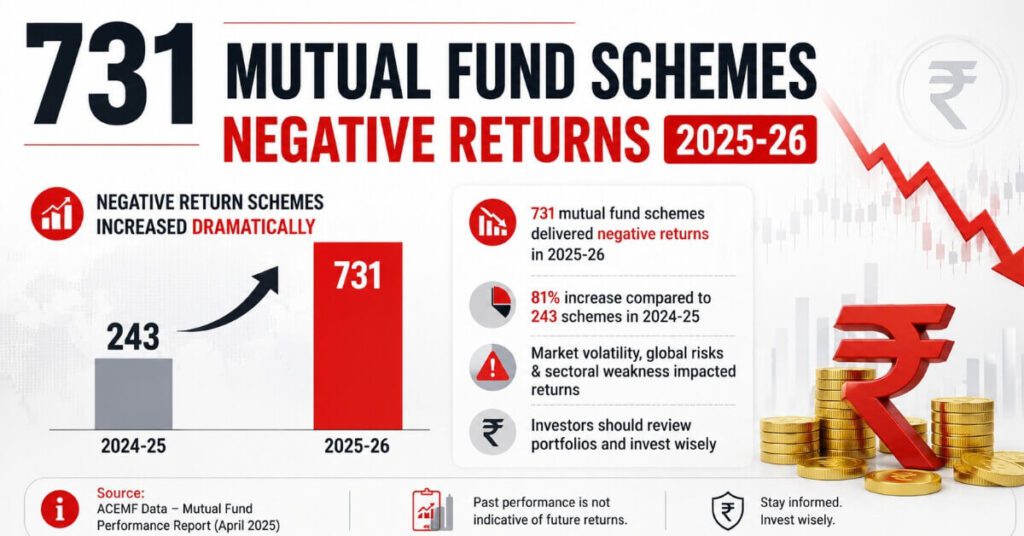
Once upon a time, most Indian investors believed mutual funds always moved in one direction — upward. That belief has been tested hard recently. A growing number of Indian investors are now searching for answers about mutual funds negative returns, and the numbers behind this trend are impossible to ignore. According to recent data, 731 mutual fund schemes delivered negative annual returns in 2025-26, a sharp jump from just 243 schemes in the previous year. If you have checked your portfolio recently and felt a small jolt of panic, you are far from alone.
Over the past few years, India has seen a remarkable rise in retail participation in mutual funds, driven largely by systematic investment plans, or SIPs, and growing financial awareness across cities and towns. Monthly SIP contributions across the industry have crossed record levels, with millions of first-time investors entering the market through simple, disciplined monthly investments. Yet this growth story has a lesser-discussed side: not every fund, and not every year, delivers positive results, and the current data proves it clearly.
This guide breaks down exactly why mutual funds negative returns are happening right now, which categories are most affected, how to check your own portfolio, and what steps you can take if your investments are currently in the red. Whether you are a first-time SIP investor or someone who has been in the market for years, understanding mutual funds negative returns is essential to making calm, informed decisions instead of panic-driven ones.
What Does It Mean When Mutual Funds Show Negative Returns
Mutual funds negative returns simply mean that the current value of your investment is lower than the amount you originally put in. This can happen over a short period, such as a few months, or it can persist for a full financial year, as seen in 2025-26. It is important to understand that this negative figure does not automatically mean your money has disappeared or that the fund itself has failed. In most cases, it reflects short-term market movement, sector-specific corrections, or broader economic shifts rather than a permanent loss.
Many new investors confuse a temporary dip with a permanent loss. However, unless you sell your units during a downturn, a negative return remains a notional loss on paper. Still, seeing mutual funds negative returns on your statement for the first time can be an unsettling experience, especially if you were expecting the commonly advertised 12 to 15 percent annual growth that many people assume is guaranteed.
731 Mutual Funds Negative Returns in 2025-26: The Real Data Behind the Headlines
The scale of mutual funds negative returns this year has surprised even seasoned market watchers. As per recent industry data, 731 mutual fund schemes across categories closed 2025-26 with negative annual returns, compared to only 243 schemes the year before. That is roughly a three-fold increase in the number of schemes struggling to stay in positive territory.
This trend of mutual funds negative returns was not limited to one type of fund. Small-cap, sectoral, and thematic funds were hit particularly hard, though even some hybrid and debt-oriented schemes reported mild negative returns due to interest rate movements. For context, small-cap and sectoral funds are inherently more volatile, so it is not entirely surprising that they led the list of underperforming schemes this year. What surprised many investors, though, was seeing categories traditionally viewed as “safer” also slip into negative territory for short stretches.
Common Reasons Behind Mutual Funds Negative Returns
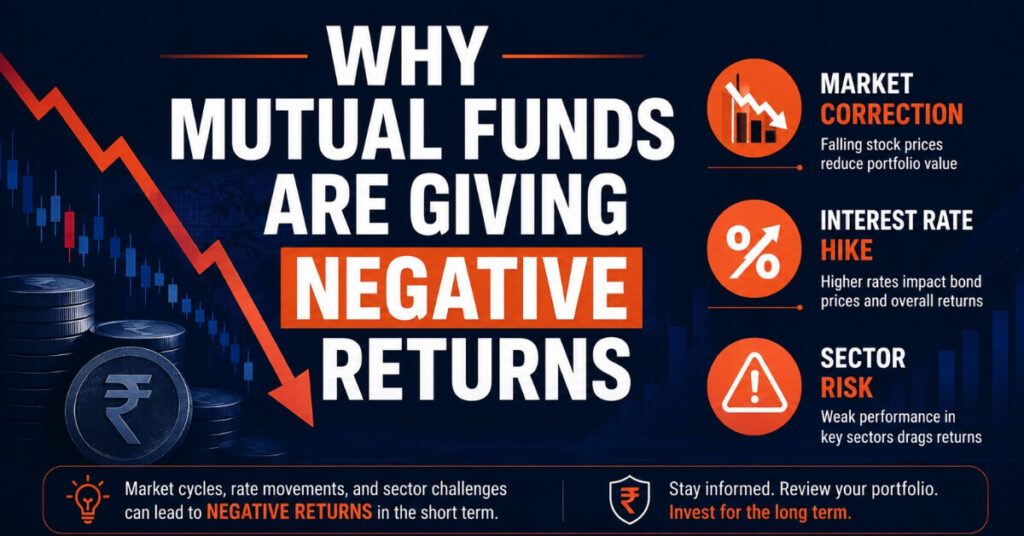
There is no single cause behind mutual funds negative returns; rather, it is usually a combination of factors working together. Below are the most common reasons experts point to:
1.Broad Market Corrections: When benchmark indices fall due to global uncertainty, interest rate changes, or geopolitical tension, equity mutual funds tied to those indices naturally follow the same downward path.
2.Sector-Specific Weakness: Sectoral and thematic funds concentrate their holdings in a single industry. If that industry underperforms — whether it is IT, pharma, or infrastructure — the fund’s returns can turn negative quickly, even while the broader market holds steady.
3.Overvaluation Corrections: Some funds that delivered exceptional returns in previous years attracted heavy inflows, pushing valuations higher than fundamentals justified. When markets correct these overvalued pockets, mutual funds negative returns often follow.
4.Interest Rate Movements: Debt mutual funds are sensitive to interest rate changes. Rising rates can reduce the market value of existing bonds held by the fund, occasionally pushing short-term returns into negative territory.
5.Global Economic Factors: Currency fluctuations, crude oil price swings, and international market volatility can all ripple into Indian mutual funds, particularly those with global or export-linked exposure.
6.SIP Timing: If you started a systematic investment plan right before a market correction, your personal extended internal rate of return, commonly called XIRR, may show negative returns even if the broader fund performance stabilizes later.
7.Unrealistic Return Expectations: Many investors assume every mutual fund will deliver 12 to 15 percent returns every single year. In reality, returns vary widely by category, and short-term mutual funds negative returns are a normal part of long-term investing cycles.
8.Liquidity Pressure and Redemption Pressure: When markets turn volatile, some investors rush to redeem their units at the same time. Fund managers may then be forced to sell holdings at unfavourable prices to meet these redemption requests, which can further pull down short-term returns for everyone still invested in the scheme.
9.Fund-Specific Management Decisions: Occasionally, a change in fund management strategy, a shift in the scheme’s portfolio composition, or exposure to a handful of poorly performing stocks can drag down returns independent of the broader market. This is one reason experts recommend comparing a fund’s performance to its category average rather than judging it in isolation.
It is worth noting that these factors rarely act alone. A combination of market correction, sector concentration, and unrealistic entry-point expectations is usually what pushes a scheme from modest underperformance into visibly negative territory on an investor’s statement.
Which Mutual Fund Categories Are Showing Negative Returns Right Now
Not every category has been affected equally by this downturn. Based on available data, here is a general pattern of how different categories have performed:
Small-Cap Funds: Among the most volatile, small-cap schemes have seen the sharpest swings, with several funds landing on the list of mutual funds negative returns due to their higher sensitivity to market corrections.
Sectoral and Thematic Funds: Because these funds concentrate on specific industries, any weakness in that sector directly translates into fund-level losses.
Mid-Cap Funds: Mid-cap schemes have shown moderate volatility, with a smaller but still notable share contributing to the overall negative returns figures this year.
Debt Funds: Typically considered low-risk, a limited number of debt schemes reported mild negative returns tied to interest rate cycles and credit events, though this remains far less common than in equity categories.
Large-Cap and Index Funds: These have generally remained more stable, though not entirely immune to short-term dips during broad market corrections.
International and Global Funds: Schemes investing in overseas markets have shown mixed results, with performance largely tied to currency movements and the underlying strength of the specific foreign markets they track, rather than domestic Indian conditions alone.
Understanding this category-wise breakdown matters because it helps investors avoid painting the entire mutual fund industry with the same brush. A negative headline number, such as 731 schemes closing the year in the red, can sound alarming, but a closer look usually reveals that the losses are concentrated in a handful of higher-risk categories rather than spread evenly across every type of fund available to Indian investors.
Historical Perspective: Have Indian Mutual Funds Seen This Before
This is not the first time a large number of schemes have closed a financial year in the red. Indian equity markets have gone through several corrective phases over the past two decades, including sharp downturns triggered by global financial crises, domestic policy changes, and unexpected geopolitical events. Each time, a wave of funds reported negative or flat annual returns, only for many of them to recover strongly over the following two to three years as markets stabilised and corporate earnings caught up with valuations.
This historical pattern does not guarantee that every fund showing losses today will recover on the same timeline, but it does offer useful context. Long-term data from the Indian mutual fund industry consistently shows that investors who stayed invested through short-term corrections, particularly through their SIPs, generally fared better than those who exited during the downturn and re-entered later at higher prices. This is one of the key reasons financial advisors emphasise patience and a long-term horizon over reactive decision-making.

How to Check If Your Mutual Funds Have Negative Returns
If you are wondering whether your own investments are part of this trend, checking is simple. Log in to your mutual fund platform, AMC website, or app, and look at your XIRR or absolute returns figure for each scheme. A negative percentage next to a fund indicates it is currently showing mutual funds negative returns on your invested capital. It also helps to compare your fund’s performance against its benchmark index and category average rather than looking at the number in isolation, since a fund that is underperforming its category may need closer attention.
A few practical steps can make this review more useful. First, check the one-year, three-year, and five-year return figures side by side rather than focusing only on the most recent period, since short-term dips can look very different in a longer context. Second, note whether the fund has underperformed its benchmark consistently over multiple periods, or whether this is an isolated, short-term event affecting the entire category. Third, keep a simple record of your own investment dates and amounts, since your personal XIRR can differ meaningfully from the fund’s published returns depending on exactly when you invested.
What Should You Do If Your Mutual Fund Portfolio Shows Negative Returns
Seeing mutual funds negative returns on your statement can trigger the urge to exit immediately, but that reaction often does more harm than good. Financial experts generally recommend the following approach:
First, avoid panic selling. Exiting a fund during a downturn locks in a loss that might have reversed if you had stayed invested longer. Second, review the reason behind the underperformance. If mutual funds negative returns are due to a broad, temporary market correction, staying invested is usually the sensible path. However, if a fund has consistently underperformed its category and benchmark for two to three years running, it may be time to reconsider.
Third, continue your SIPs if your goals remain long-term. Historically, continuing SIP contributions during a downturn allows you to buy more units at lower prices, which can improve your average purchase cost once the market recovers. Finally, revisit your asset allocation. If a large portion of your portfolio is concentrated in high-risk categories that are driving your mutual funds negative returns, it may be worth rebalancing toward a more diversified mix.

How to Avoid Mutual Funds Negative Returns in the Future
While no investor can completely avoid market volatility, there are steps that can reduce the impact of this trend on your overall portfolio:
Diversify across categories: Spreading investments across large-cap, mid-cap, debt, and hybrid funds reduces the chance that a single sector downturn drags down your entire portfolio.
Set realistic expectations: Understanding that negative returns are a normal, occasional part of mutual fund investing — rather than a sign of failure — helps you stay committed to your financial plan.
Avoid chasing past performance: Funds that delivered exceptional returns last year are not guaranteed to repeat that performance, and chasing them can increase your exposure to future corrections.
Review your portfolio periodically: A yearly review, rather than daily checking, helps you make decisions based on trends rather than short-term noise.
Match fund category to your risk appetite: If you cannot tolerate large swings, high-risk small-cap or sectoral funds may not be suitable, regardless of their long-term growth potential.
Just as many taxpayers face unexpected setbacks like an ITR filing penalty due to missed deadlines or overlooked rules, mutual fund investors often face mutual funds negative returns due to overlooked risk factors or unrealistic expectations. In both cases, a little planning ahead goes a long way toward avoiding an unpleasant surprise later.
For readers who want to explore official guidance on mutual fund risk categories and disclosure norms, the Securities and Exchange Board of India (SEBI) website offers detailed regulatory information on mutual fund classifications and investor protection measures.
Frequently Asked Questions About Mutual Funds Negative Returns
Q1. Why are so many mutual funds showing negative returns in 2025-26?
The sharp rise in mutual funds negative returns this year is largely linked to broad market corrections, sector-specific weakness in categories like small-cap and thematic funds, and interest rate movements affecting debt schemes.
Q2. Should I stop my SIP if my mutual fund is showing negative returns?
Not necessarily. Many financial advisors suggest continuing your SIP through periods of mutual funds negative returns, since it allows you to accumulate more units at lower prices, which can benefit your portfolio once markets recover.
Q3. Can debt mutual funds also give negative returns?
Yes. While less common than in equity funds, debt mutual funds negative returns can occur due to rising interest rates or credit events affecting the underlying bonds held by the scheme.
Q4. How long can mutual funds negative returns last?
There is no fixed timeline. Some corrections last a few months, while others, particularly sector-specific downturns, can persist for a year or more before recovering.
Q5. Is it normal to see mutual funds negative returns after investing for just a year?
Yes, short-term negative returns are common, especially in equity-oriented funds. Long-term investment horizons of five years or more generally help smooth out short-term volatility.
Q6. Which mutual fund categories are safest from negative returns?
Historically, large-cap and index funds have shown more stability, though no category is completely immune. Debt funds are generally lower risk but not entirely risk-free, since interest rate changes can still cause temporary dips.
Q7. Do mutual funds negative returns affect my tax filing?
No, a notional negative return on paper does not create any tax liability. Capital gains tax only applies when you actually redeem or sell your units at a loss or profit, not while the investment remains unsold.
Conclusion
The sharp increase in mutual funds negative returns in 2025-26, from 243 schemes to 731, is a reminder that mutual fund investing carries genuine market risk, regardless of how confidently returns are advertised. Rather than reacting with panic, understanding the reasons behind mutual funds negative returns — market corrections, sector concentration, interest rate shifts, and unrealistic expectations — can help you make calmer, more informed decisions. A well-diversified portfolio, realistic return expectations, and periodic reviews remain the most reliable tools for navigating both the ups and downs of mutual fund investing.
For most long-term investors, the current phase of underperformance is unlikely to be the final word on their portfolio’s success. Markets have historically moved in cycles, and disciplined investors who avoid emotional decisions during downturns tend to be better positioned when conditions eventually improve. Staying informed, reviewing your portfolio with a clear head, and seeking professional guidance where needed will always serve you better than reacting to a single year’s headline numbers.
Disclaimer
This article is for informational and educational purposes only and does not constitute financial, investment, or tax advice. Mutual fund investments are subject to market risks; please read all scheme-related documents carefully and consult a certified financial advisor before making any investment decisions.


Pingback: Stand Up India Loan Scheme 2026: Best ₹2 Crore Loan Guide