

Choosing where to put your hard-earned money for the future is one of the biggest financial decisions you’ll ever make. If you’ve found yourself wondering is pension better than savings you’re asking a question that millions of people across the world grapple with every year. The honest truth is that neither option is automatically “better” in every situation — is pension better than savings depends heavily on your age, income stability, financial goals, and how much flexibility you need. Understanding the whole picture is the only way to make a confident, informed decision about your money.
In this guide, we’ll break down exactly what a pension is, what a savings account offers, and answer the core question — is pension better than savings — by comparing both options across the factors that matter most: growth potential, flexibility, tax treatment, risk, employer contributions, inflation protection, and long-term financial security.
What Is a Pension?
A pension is a long-term financial arrangement designed specifically to fund your retirement years. You, your employer, or both, contribute money regularly during your working life, and this money is invested so it can grow over time. When you eventually retire, the accumulated fund can be converted into a lump sum, a steady monthly income, or a combination of both.
Pensions generally fall into two categories:
Defined Benefit Pensions – Your employer guarantees a fixed payout based on your salary history and years of service, regardless of how the underlying investments perform in the market.
Defined Contribution Pensions – Your final payout depends entirely on how much was contributed over the years and how well those investments performed.
Because pension funds are typically locked away until you reach a certain retirement age, they’re built around long-term discipline rather than short-term access. This locked-in nature is one of the biggest reasons the question is pension better than savings comes up so often among people planning their financial future.

What Is a Savings Account?
A savings account is money you set aside that remains easily accessible whenever you need it. Savings accounts, fixed deposits, and similar low-risk instruments typically offer modest interest rates, but their biggest advantage is liquidity. You can withdraw your money at almost any time without waiting periods or heavy penalties.
Savings are ideal for emergency funds, short-term financial goals, and situations where flexibility matters more than maximizing long-term returns. For many people just starting their financial journey, building savings feels safer and more manageable, which is exactly why comparing is pension better than savings becomes such an important early step.
Is Pension Better Than Savings? Key Factors to Consider
To properly answer is pension better than savings it helps to compare both options side by side across the factors that actually shape your financial outcomes over time.
1. Growth Potential
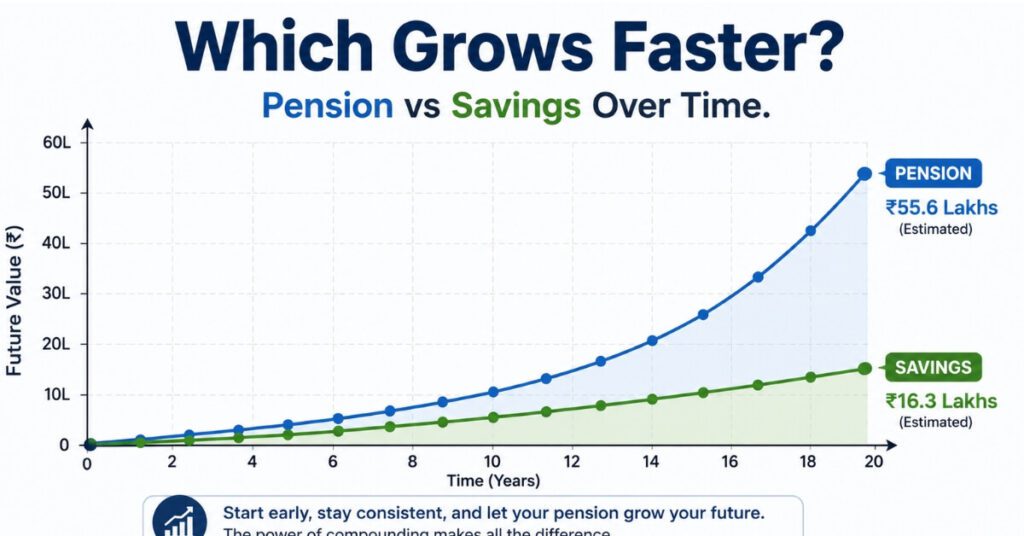
Pensions generally offer stronger long-term growth because the funds are invested across diversified assets like equities, bonds, and mutual funds over many years. This allows the power of compounding to work strongly in your favor. Savings accounts, on the other hand, typically offer lower interest rates that may not even keep pace with inflation over long periods. When it comes to raw growth potential, the answer to is pension better than savings usually leans toward pensions.
2. Accessibility and Flexibility
This is where savings clearly have the upper hand. Money sitting in a savings account can be withdrawn instantly for emergencies, unexpected expenses, or new opportunities. Pension funds are typically locked until a specific retirement age, and early withdrawal often triggers penalties or unfavorable tax consequences. If flexible access to your money is your top priority, savings remain the more practical everyday choice, which shifts the balance of is pension better than savings firmly in favor of savings for short-term needs.
3. Tax Benefits
Many pension schemes offer valuable tax advantages, such as deductions on contributions or tax-deferred growth during the accumulation phase. Savings accounts typically don’t offer the same level of tax relief, and interest earned is often taxable in the year it’s received. From a pure tax-efficiency standpoint, pensions frequently come out ahead of standard savings accounts.
4. Risk and Security
Savings accounts are generally considered very low-risk, especially when held with insured or reputable financial institutions — your principal amount stays protected. Pension funds, particularly defined contribution plans, are subject to market fluctuations, meaning their value can rise or fall depending on broader economic conditions. However, defined benefit pensions offer guaranteed payouts regardless of market performance, adding a layer of security that pure savings simply can’t replicate.
5. Employer Contributions
One major advantage pensions have over personal savings is the possibility of employer matching or additional contributions. If your employer adds money to your pension fund on top of your own contributions, that’s essentially free money boosting your retirement corpus — something a personal savings account can never offer on its own. This single factor alone often tips the scale when people seriously weigh is pension better than savings for their long-term wealth building.

6. Long-Term Retirement Income
Pensions are structured specifically to provide a steady, predictable income stream after retirement, one that can last for decades without you having to manage withdrawals manually. Savings, while accessible, require careful self-discipline to ensure the money lasts throughout your entire retirement. Without a clear withdrawal strategy, savings can run out far faster than most people expect.
7. Inflation Protection
Pensions, especially those invested in growth-oriented assets, tend to outpace inflation more effectively over long time horizons. Savings account interest rates, however, often lag behind inflation, which quietly erodes the real value of your money year after year. This is another important angle to weigh when deciding is pension better than savings for a retirement that could last twenty to thirty years.
8. Liquidity Comparison
Liquidity is essentially the mirror image of growth potential in this comparison. Savings offer near-total liquidity, meaning your money is always within reach. Pensions sacrifice that liquidity in exchange for stronger long-term growth and tax advantages. There’s no universally right answer here — it comes down to how much of your money you can realistically afford to lock away versus how much you need to keep accessible at all times.
A Real-Life Scenario to Understand the Difference
Imagine two individuals in their early thirties, each setting aside the same amount of money every month. One puts everything into a savings account, while the other splits contributions between a pension and a smaller emergency savings fund. Over twenty-five to thirty years, the person contributing to a pension is likely to see significantly higher growth thanks to compounding and potential employer contributions, even though their money was less accessible along the way.
Meanwhile, the person relying solely on savings has more flexibility in the short term but may fall short of their retirement goals due to lower returns. This scenario captures the essence of the debate around is pension better than savings — it’s a trade-off between accessibility today and financial strength tomorrow. Real numbers, when tracked over decades, tend to make the answer to is pension better than savings much clearer than theory alone.
Common Myths About Pensions and Savings
There are several misconceptions that often cloud this decision. One common myth is that savings accounts are always “safer” in every meaningful sense — while your principal is protected, the real value of that money can quietly shrink due to inflation over time. Another myth is that pensions are only for people with traditional, salaried jobs.
In reality, many self-employed individuals and freelancers also have access to voluntary pension or retirement schemes designed specifically for their situation. A third misconception is that you must choose one or the other permanently, when in reality your allocation between the two can and should evolve as your life circumstances change. Clearing up these misunderstandings is essential before deciding is pension better than savings for your own financial plan.
How Age Affects the Pension vs Savings Decision
Your age plays a bigger role in this decision than most people realize. In your twenties and early thirties, you have the luxury of time, which means even a modest pension contribution can grow substantially through compounding by the time you retire. At this stage, prioritizing a pension often makes more sense because the long runway smooths out short-term market volatility.
As you move into your forties and fifties, the calculation shifts. You may need to balance ongoing pension contributions with building a larger, more accessible savings cushion to cover near-term goals like healthcare costs, children’s education, or an earlier-than-planned retirement. This is why the answer to is pension better than savings isn’t fixed — it evolves as your life stage and financial responsibilities change over time.
Pros and Cons Summary
Pension Pros:
Higher long-term growth potential
Employer contributions boost your fund
Tax advantages on contributions
Guaranteed income in retirement for defined benefit plans
Strong protection against long-term inflation
Pension Cons:
Limited access until retirement age
Market risk in defined contribution plans
Less flexibility for emergencies
Savings Pros:
Full flexibility and instant access
Low risk to your principal
Simple to open and manage
No penalties for withdrawal
Savings Cons:
Lower returns, especially against inflation
No employer contribution benefit
Limited tax advantages
Requires strong self-discipline to maintain long-term
Weighing these pros and cons side by side makes it easier to see why is pension better than savings doesn’t have a single, one-size-fits-all answer.
Who Should Prioritize a Pension?
If you’re relatively early in your career, have access to employer contributions, and are focused on building long-term retirement security, prioritizing a pension makes strong financial sense. The combination of compounding growth, tax benefits, and employer matching typically outweighs the drawback of reduced liquidity, especially when retirement is still decades away. For this group, the answer to is pension better than savings leans clearly toward pensions.
Who Should Prioritize Savings?
If you don’t yet have an emergency fund in place, are managing short-term financial goals, or have irregular income that requires flexibility, building your savings first is the smarter move. Financial experts generally recommend having three to six months of essential expenses in accessible savings before committing larger amounts to long-term retirement vehicles. Here, is pension better than savings clearly favors savings until that safety net is firmly in place.
The Smartest Approach: Use Both
Rather than treating this as a strict either-or decision, the most financially sound strategy usually involves both pensions and savings working together. Build an emergency savings cushion first, then direct additional funds toward a pension or retirement account to take advantage of compounding growth and potential employer contributions.
So when people ask is pension better than savings , the more accurate and practical answer is that both play complementary roles in a well-rounded financial plan. Choosing between them entirely misses the bigger picture of is pension better than savings as a long-term strategy question rather than a single, one-time decision. Over time, most financially stable individuals end up allocating meaningfully to both, adjusting the balance as their income, responsibilities, and goals shift.

Expert Tips for Balancing Pension and Savings
Financial planners often recommend automating contributions to both accounts so consistency isn’t left to willpower alone. Start by fully funding a basic emergency reserve, then gradually increase pension contributions as your income grows, especially if employer matching is available. Reviewing your allocation annually — adjusting for life changes like a new job, marriage, or children — helps ensure your balance between accessibility and growth stays aligned with your actual needs. Answering is pension better than savings for yourself isn’t a one-time exercise; it’s something worth revisiting every year.
If you’re also exploring credit options during this financial planning journey, you may find it useful to check out our guide on loan without CIBIL check options, which covers alternative borrowing paths for those building their financial foundation from the ground up.
For additional guidance on structuring your long-term investments, resources like Investopedia offer detailed explanations of pension types, savings strategies, and retirement planning fundamentals that can complement the insights shared in this guide.
Frequently Asked Questions
Q1.Is pension better than savings for retirement planning?
For long-term retirement goals, pensions generally offer better growth and tax advantages, but savings remain essential for short-term flexibility and handling emergencies along the way.
Q2.Is pension better than savings if my employer offers matching contributions?
Yes, in most cases. Employer matching significantly increases the value of a pension compared to a standard savings account, since it effectively adds free money to your retirement fund every month.
Q3.Is pension better than savings when it comes to risk?
It depends on the pension type. Defined benefit pensions offer guaranteed payouts, while defined contribution pensions carry market risk similar to other investments, whereas savings accounts carry minimal risk to your principal.
Q4.Can I have both a pension and a savings account at the same time?
Absolutely. Most financial advisors recommend maintaining both — savings for liquidity and emergencies, and a pension for long-term retirement growth and security.
Q5.Is pension better than savings for someone who is self-employed?
Self-employed individuals often benefit from voluntary pension contributions since they don’t have access to employer matching, but maintaining accessible savings remains equally important for managing irregular income.
Q6.How much should I keep in savings versus a pension?
A common guideline is to build three to six months of expenses in savings first, then contribute consistently to a pension or retirement fund for long-term growth and stability.
Q7.Is pension better than savings in your fifties or closer to retirement?
Closer to retirement, many people shift more weight toward accessible savings to cover near-term needs, while still maintaining pension contributions if employer matching is available.
Conclusion
So, is pension better than savings The honest answer is that it truly depends on your financial stage, goals, and how much flexibility you need right now versus later. Pensions offer superior long-term growth, valuable tax benefits, and the potential for employer contributions, making them ideal for building lasting retirement security. Savings, meanwhile, offer unmatched flexibility and safety for short-term needs, emergencies, and life’s unexpected moments.
Rather than choosing one over the other, the smartest financial strategy combines both — using savings for immediate security and pensions for long-term wealth building. The next time you find yourself asking is pension better than savings remember that the real answer usually isn’t pension or savings — it’s pension and savings, working together to give you the best of both worlds as you plan for a financially secure future.
Disclaimer
This article is for informational and educational purposes only and should not be considered financial or investment advice. Please consult a certified financial advisor before making decisions about pensions, savings, or retirement planning based on your personal financial situation.

Pingback: Corporate Health Insurance: 94% Employees Stressed