

The topic of Section 54F Exemption 2026 has taken center stage this week following a landmark ruling from the Telangana High Court. The judgment, delivered on July 8, 2026, has brought fresh clarity to how this exemption applies in situations where builders delay handing over residential property to taxpayers who have already invested their capital gains.
For lakhs of individual taxpayers and Hindu Undivided Families across India, understanding these rules can help avoid unnecessary tax liability on long-term capital gains. This is especially relevant for anyone who has sold a non-residential capital asset such as land, gold, or shares and reinvested the proceeds into a residential property, only to face delays beyond their control.
In this article, we break down everything related to Section 54F Exemption 2026, including the recent court ruling, eligibility conditions, claim limits, the step-by-step process to claim the benefit, documentation requirements, and how it compares with the more commonly known Section 54. We will also explore how this provision fits into a broader financial and tax planning strategy for households managing capital gains, along with special considerations for NRIs and joint property owners.
What Is Section 54F and Why It Matters
Section 54F of the Income Tax Act allows individuals and Hindu Undivided Families to claim exemption on long-term capital gains arising from the sale of any capital asset other than a residential house, provided the net sale proceeds are reinvested in a residential property. The framework behind this provision remains rooted in these original rules, but recent judicial interpretations have expanded how it is applied in real-world situations involving construction delays and builder disputes.
Assets eligible under this section include land, gold, shares, mutual funds, and other long-term capital assets. This tax relief continues to help individuals save substantial tax by encouraging reinvestment into residential housing, which aligns with the government’s broader objective of promoting home ownership across the country.
This provision has grown increasingly relevant in recent years as more taxpayers diversify their investment portfolios across equities, gold, and land holdings, all of which qualify as capital assets under this section. Given the volatility often seen in stock markets and gold prices, many taxpayers book long-term gains and look to reinvest in a more stable asset class such as residential real estate, making awareness of Section 54F Exemption 2026 essential for effective tax planning.

Telangana High Court Ruling on Section 54F Exemption 2026
The recent case that brought renewed attention to Section 54F Exemption 2026 involved a Hyderabad resident, Sudhakar Reddy Mettu, who was one of 46 landowners that entered into a Development Agreement-cum-General Power of Attorney with a builder in May 2016. Under the agreement, Mettu was entitled to a 250-square-yard residential villa, which was supposed to be handed over within 36 months, by May 2019.
However, disputes between the builder’s partners delayed the project, and the villa was only completed in November 2023, nearly four and a half years after the agreed deadline. The Income Tax Department reopened the assessment after identifying the capital gains arising from the development agreement and denied the exemption, arguing that the villa had not been completed, registered, or handed over within the three-year statutory period prescribed under the law.
The Assessing Officer rejected the claim on the grounds that the occupancy certificate had not been obtained and the property had not been registered in the taxpayer’s name within the required timeframe. The Dispute Resolution Panel upheld this decision, and the Hyderabad bench of the Income Tax Appellate Tribunal also ruled against the taxpayer, observing that construction remained incomplete well beyond the statutory timeline.
On appeal, the Telangana High Court set aside the earlier orders and ruled in favor of the taxpayer. The court held that the essential requirement under Section 54F Exemption 2026 is the investment of capital gains in a residential house, and that a taxpayer should not be denied the benefit simply because construction, possession, or registration was delayed for reasons beyond their control. This judgment strengthens the reliability of such claims for thousands of taxpayers currently facing similar builder delays across India.
The bench specifically noted that Mettu had already parted with and invested his capital gains under the development agreement, and the subsequent delay arose due to disputes involving the developer, not the taxpayer. Such circumstances, the court said, could not defeat the underlying object of the provision. The court also relied on earlier judicial precedents, including CIT v. C. Gopalaswamy and CIT v. Sambandam Udaykumar, which established that taxpayers should not lose this benefit because of delays attributable to builders after the required investment has already been made.
This case highlights how Section 54F Exemption 2026 should be interpreted in a manner that advances its underlying objective of promoting residential investment, rather than penalizing taxpayers for circumstances outside their control. It is a beneficial provision, and courts across India have increasingly leaned toward interpretations that protect genuine taxpayers from procedural technicalities caused by third parties.
Who Is Eligible for Section 54F Exemption 2026
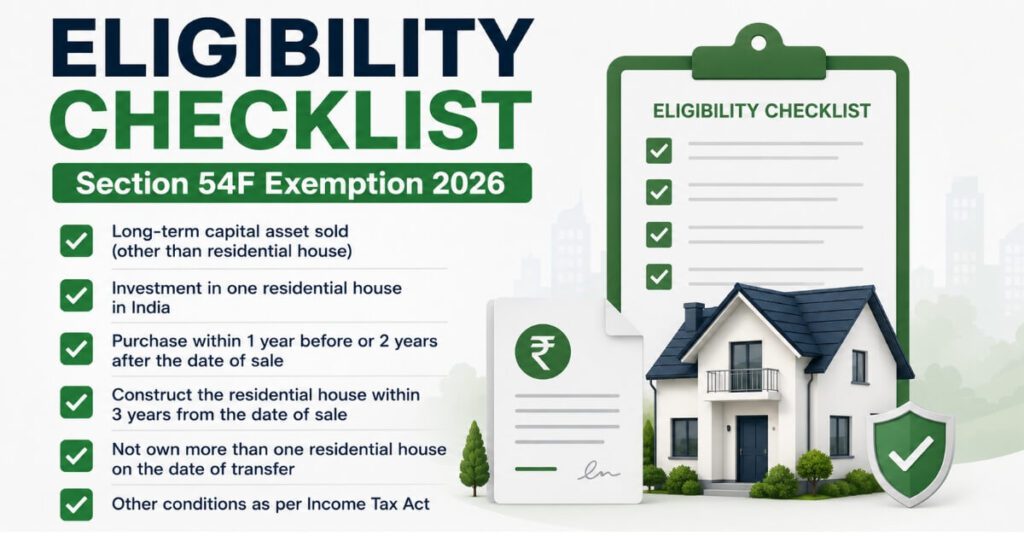
Eligibility for Section 54F Exemption 2026 is limited to individual taxpayers and Hindu Undivided Families. Companies, partnership firms, LLPs, and other business entities are not eligible to claim this benefit, as the provision was specifically designed to encourage individual home ownership rather than commercial real estate acquisition.
To qualify, taxpayers must meet the following conditions:
The capital asset sold must be a long-term capital asset other than a residential house property, such as land, gold, shares, or mutual fund units.
The entire net sale consideration must be reinvested in purchasing or constructing a residential house within the prescribed timelines.
The taxpayer must not own more than one residential house, other than the new one being purchased, on the date of transfer of the original asset.
The new residential property must be purchased within one year before or two years after the sale, or constructed within three years after the date of sale.
The new property must be located in India, as investments in overseas residential property do not qualify for this exemption.
Meeting all these conditions is essential for a successful Section 54F Exemption 2026 claim, and any deviation could invite scrutiny from the Assessing Officer during the review process. Taxpayers with multiple properties should carefully evaluate their ownership status before the date of transfer to avoid disqualification.
Key Conditions to Claim Section 54F Exemption 2026
Beyond basic eligibility, there are additional conditions that taxpayers should be aware of when claiming this benefit:
If the entire net sale consideration is not reinvested, the exemption is allowed proportionately based on the amount actually invested, rather than being denied in full.
The new residential property must not be sold within three years of purchase or construction, or the exemption claimed earlier will be reversed and added back to taxable income in the year of sale.
If the taxpayer is unable to complete the purchase or construction before filing the income tax return, the unutilized amount must be deposited in a Capital Gains Account Scheme (CGAS) with a nationalized bank before the due date of filing.
As clarified by the recent Telangana High Court ruling, delays caused by the builder after the taxpayer has made the required investment will not automatically disqualify a Section 54F Exemption 2026 claim.
Proper documentation, including the sale deed, purchase or construction agreements, and bank transaction records, must be maintained to substantiate the claim during assessment.
Failure to meet these timelines or documentation requirements can jeopardize your claim, so maintaining proper records of investment and correspondence with builders is strongly advised, particularly in cases involving under-construction properties.
Section 54F Exemption 2026 Limit and Cap
One of the most important updates relevant to Section 54F Exemption 2026 is the maximum cap introduced on the exemption amount. As per current provisions, the maximum cap is ₹10 crore. If the cost of the new residential house exceeds this amount, the excess will not be considered for the purpose of computing the exemption.
This cap ensures that the benefit is targeted toward genuine middle-class and upper-middle-class taxpayers reinvesting in housing, rather than being used disproportionately for extremely high-value transactions. Taxpayers planning large property purchases should factor in this ceiling while calculating their expected tax savings, as any amount invested beyond ₹10 crore will not generate additional exemption benefit.
Documents Required to Claim Section 54F Exemption 2026
Proper documentation plays a critical role in successfully claiming this exemption during assessment. Taxpayers should maintain the following records:
Sale deed or agreement of the original capital asset sold
Purchase agreement or construction contract for the new residential property
Bank statements showing the transfer of sale proceeds toward the new property
Capital Gains Account Scheme deposit receipt, if applicable
Completion certificate or occupancy certificate for the new residential property
Correspondence with the builder in case of construction delays
Having these documents organized in advance can significantly reduce complications if the Assessing Officer raises queries regarding your Section 54F Exemption 2026 claim during scrutiny assessment.
How to Claim Section 54F Exemption 2026 Step by Step
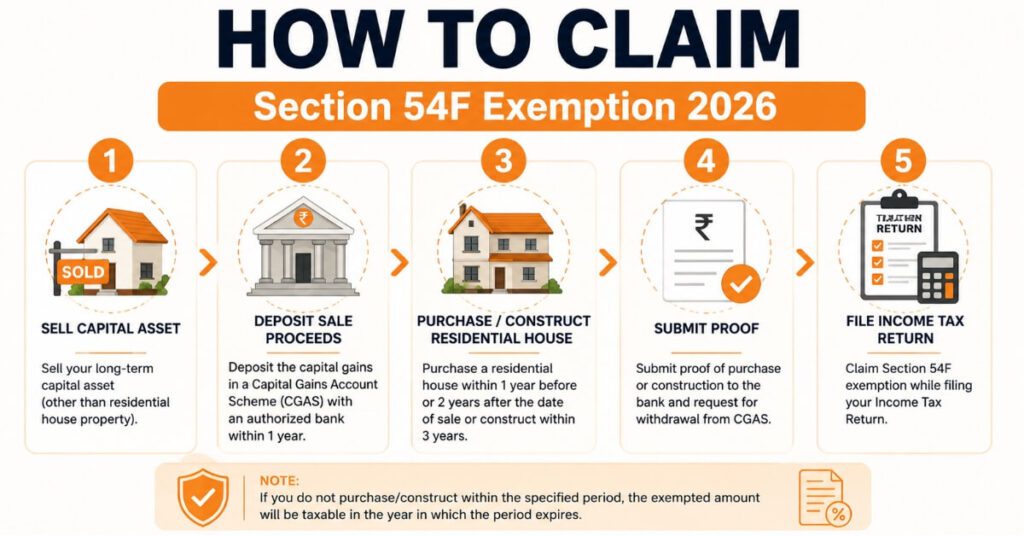
Claiming this benefit requires proper documentation and timely action. Here is how you can proceed correctly:
Step 1: Calculate the long-term capital gains arising from the sale of your non-residential capital asset.
Step 2: Identify a residential property for purchase or construction within the prescribed timelines discussed above.
Step 3: If the purchase or construction is not complete before your income tax return filing deadline, deposit the unutilized capital gains in a Capital Gains Account Scheme.
Step 4: Maintain all documentation, including sale deeds, purchase agreements, construction invoices, and bank statements, as evidence of reinvestment.
Step 5: While filing your income tax return, disclose the capital gains and claim Section 54F Exemption 2026 using the relevant schedule in the ITR form.
Step 6: In case of any delay caused by a builder, retain all correspondence and agreements, as recent judicial rulings support taxpayers in such situations.
Section 54F Exemption 2026 vs Section 54
Many taxpayers confuse this provision with Section 54, but the two apply to different situations. Section 54 provides exemption when a taxpayer sells a residential house property and reinvests the gains in another residential house. Unlike Section 54, Section 54F Exemption 2026 applies specifically when the asset sold is not a residential house, such as land, shares, gold, or mutual funds.
Another key difference is that under Section 54, only the capital gains portion needs to be reinvested, whereas under this exemption, the entire net sale consideration must be reinvested for full benefit. This makes the Section 54F route somewhat stricter in terms of the investment requirement, but it also opens up eligibility to a much wider range of asset sales beyond residential property. Understanding this distinction is important for accurate tax planning, especially for individuals selling diverse types of assets across different financial years.
Section 54F Exemption 2026 for NRIs and Joint Owners
Non-resident Indians who sell long-term capital assets in India, such as shares or land, can also claim Section 54F Exemption 2026, provided they meet the same eligibility conditions applicable to resident taxpayers. The new residential property must still be purchased or constructed in India, and the timelines remain identical.
For jointly owned assets, each co-owner can claim this exemption individually based on their proportionate share of the capital gains, provided each co-owner independently satisfies the eligibility conditions, including the requirement of not owning more than one additional residential house. This makes joint property planning an important consideration when structuring transactions to maximize benefits under this provision.

Common Mistakes to Avoid While Claiming Section 54F Exemption 2026
One common mistake while claiming this exemption is assuming that partial reinvestment automatically qualifies for full benefit. In reality, exemption is granted only in proportion to the amount actually reinvested, and taxpayers often overestimate their eligible exemption amount as a result.
Another pitfall is owning more than one residential house at the time of the original asset transfer, which can disqualify the entire claim regardless of how much was reinvested. Taxpayers should also avoid missing the Capital Gains Account Scheme deposit deadline, as this is a frequently overlooked requirement that can result in denial of Section 54F Exemption 2026 during assessment, even when the taxpayer genuinely intended to reinvest the funds.
Impact on Financial Planning
Planning around this exemption should be part of a broader financial strategy rather than a standalone tax-saving decision. Taxpayers reinvesting large capital gains into residential property should also evaluate other stable investment instruments to diversify their portfolio. For instance, NRIs and resident Indians with foreign income sources may want to review the FCNR Deposit Interest Rate 2026 to understand how fixed income options can complement real estate investments made under this provision.
For the most accurate and updated information on capital gains exemptions, taxpayers can refer to the Income Tax Department website, which provides official guidelines and notifications related to Section 54F Exemption 2026 and other provisions of the Income Tax Act.
Understanding this exemption alongside your overall investment portfolio helps ensure that tax savings translate into genuine long-term financial security, rather than being treated as an isolated compliance exercise. A well-rounded approach to capital gains, combining real estate reinvestment with other financial instruments, can help taxpayers build sustainable long-term wealth.
Frequently Asked Questions
Q1: What is Section 54F Exemption 2026?
Section 54F Exemption 2026 refers to the tax benefit available to individuals and Hindu Undivided Families who reinvest the net sale proceeds of a long-term capital asset, other than a residential house, into a new residential property.
Q2: Is this exemption available in the new tax regime?
No, it is available only under the old tax regime, as capital gains exemptions under Section 54F are not applicable within the new concessional tax regime framework.
Q3: Can it be claimed for 2 years?
Yes, taxpayers can purchase a residential property within one year before or two years after the sale of the original asset, or construct one within three years.
Q4: What is the limit of this exemption?
The limit is capped at ₹10 crore for the cost of the new residential property considered for exemption calculation.
Q5: Does a builder’s delay affect my claim?
Based on the recent Telangana High Court ruling, a builder’s delay in handing over possession will not automatically disqualify a taxpayer from claiming Section 54F Exemption 2026, provided the required investment was made on time.
Conclusion
In conclusion, Section 54F Exemption 2026 offers meaningful tax relief for individuals and HUFs reinvesting capital gains into residential property. The recent Telangana High Court ruling adds an important layer of protection for taxpayers facing builder-related delays, ensuring that genuine investors are not penalized for circumstances beyond their control. Staying informed about eligibility conditions, claim limits, documentation requirements, and proper timelines can help taxpayers make the most of this valuable exemption while remaining fully compliant with income tax regulations.
Disclaimer
This article is for informational and educational purposes only and should not be considered professional tax or legal advice. Tax laws and interpretations are subject to change, and individual circumstances may vary. Readers are advised to consult a qualified chartered accountant or tax professional before making any financial or tax-related decisions.

Pingback: SCSS vs Bank FD 2026: 7 Shocking Truths Revealed