
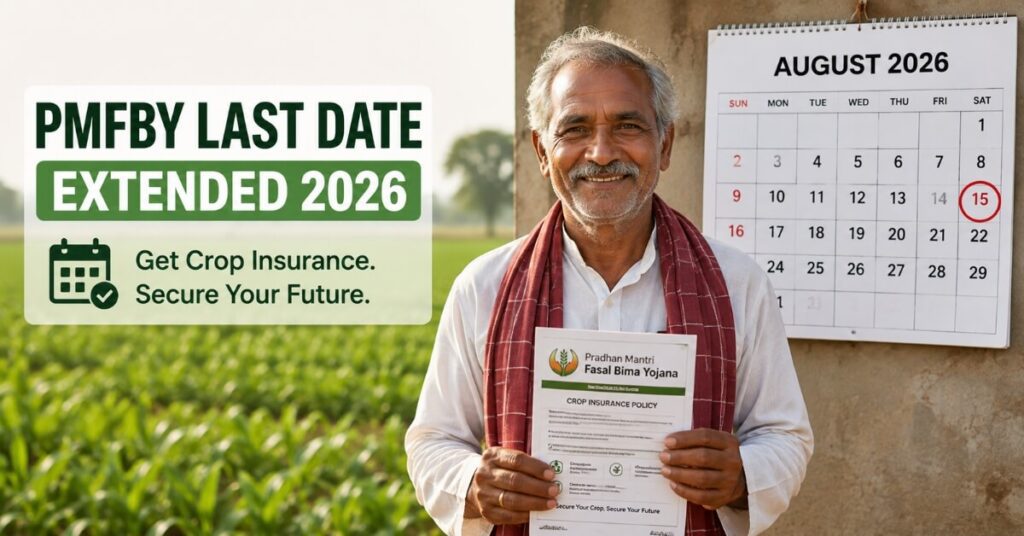
The Pradhan Mantri Fasal Bima Yojana continues to be one of the most talked about government schemes for farmers across India, and this week the news around PMFBY Last Date Extended 2026 has taken center stage. Following widespread objections from farmers in several states, the government has pushed the enrolment window further, and understanding this update has become essential for anyone who grows kharif crops this season.
For lakhs of farming families, crop insurance is not just paperwork, it is financial protection against unpredictable weather, pest attacks, and natural calamities. That is exactly why the PMFBY Last Date Extended 2026 announcement matters so much right now. If you missed the original July 31 deadline, or if you were still gathering documents, this extension gives you another chance to secure coverage for the current season.
In this article, we will break down everything connected to PMFBY Last Date Extended 2026, including the new deadline, state-wise variations, required documents, the enrolment process, and the reasons behind the extension. We will also look at how this scheme fits into the broader landscape of financial planning for households that depend on agriculture.
What Is PMFBY and Why It Matters
Pradhan Mantri Fasal Bima Yojana, launched in 2016, is a government sponsored crop insurance scheme designed to provide financial support to farmers in case of crop failure due to natural calamities, pests, or diseases. The scheme integrates multiple stakeholders, including state governments, insurance companies, and banks, on a single digital platform to make claims and premium payments smoother.
The scheme covers kharif crops, rabi crops, and annual commercial or horticultural crops. Premium rates are kept low for farmers, with the government subsidizing the rest, which makes it one of the more affordable insurance options available in the agricultural sector. Given how frequently unseasonal rains and pest outbreaks disrupt yields, the relevance of PMFBY has only grown over the years.
Why the Deadline Was Extended
The PMFBY Last Date Extended 2026 decision did not come out of nowhere. In the days leading up to the original July 31 cutoff, farmer groups across multiple states raised concerns about limited time to complete documentation, slow processing at common service centers, and confusion around premium calculation for certain crops. These objections reached state agriculture departments and eventually influenced the central decision.
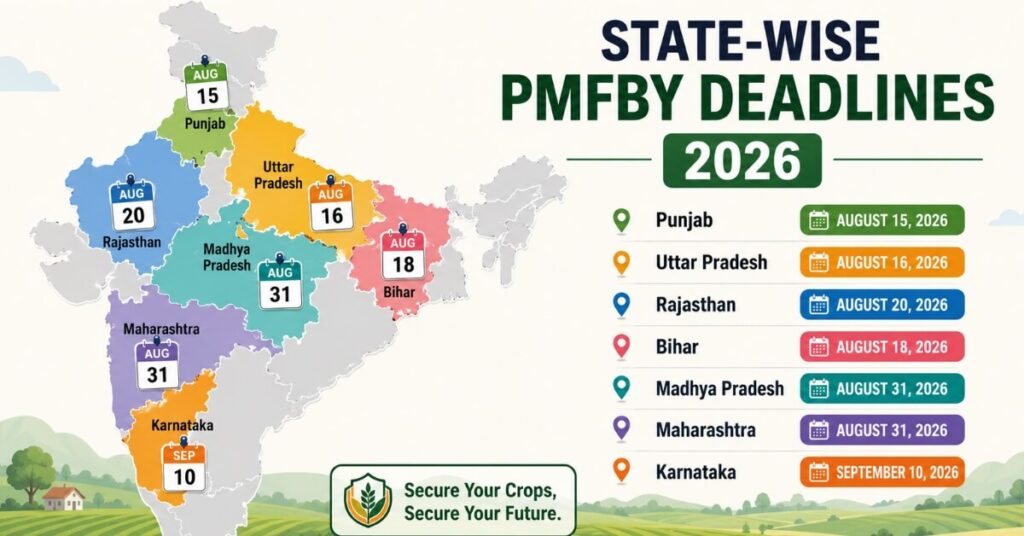
According to recent reports, the PMFBY Last Date Extended 2026 now stands at August 15 for most notified kharif crops across the majority of states, giving farmers additional time to complete their applications. Some states have their own variations on top of this national date. Uttar Pradesh, for instance, has extended its window slightly further to August 16, while Andhra Pradesh set July 31 as the deadline for most kharif crops but extended paddy cultivation specifically to August 15. This layered structure means farmers should always check their specific state notification rather than assuming a single national date applies uniformly.
New Deadline Details Under PMFBY Last Date Extended 2026
Under the PMFBY Last Date Extended 2026 framework, the national enrolment window for kharif season crops has been pushed to August 15 in most regions. This is a meaningful shift from the earlier July 31 cutoff and gives farmers roughly two additional weeks to gather documents, verify land records, and complete the premium payment process through banks, common service centers, or the official portal.
It is important to note that the PMFBY Last Date Extended 2026 timeline can differ by state and by crop. For instance, paddy growers in Andhra Pradesh have a separate cutoff of August 15, matching the national date, while Uttar Pradesh farmers get a slightly later window until August 16. Farmers in Tamil Nadu, Odisha, Maharashtra, West Bengal, and Karnataka should verify their respective state agriculture department notifications, since online search interest for state-specific confirmation has been rising sharply, indicating that many farmers are actively looking for clarity on their local dates.
Who Should Pay Attention to This Extension
Any farmer who cultivates notified kharif crops and has not yet enrolled under the scheme should treat the PMFBY Last Date Extended 2026 update as a priority reminder. This includes farmers who missed the original deadline due to travel, documentation delays, or lack of awareness. Loanee farmers, who typically get automatic enrolment through their bank, should still confirm their status manually, since opt-out procedures and confirmations also fall within the same extended window.
Non-loanee farmers, meaning those who are not availing a crop loan, have to actively apply through the official portal, a bank branch, or a common service center. For this group especially, the PMFBY Last Date Extended 2026 window offers a valuable second opportunity that should not be ignored, since missing it means waiting for the next crop cycle to get coverage.
Documents Required for Enrolment
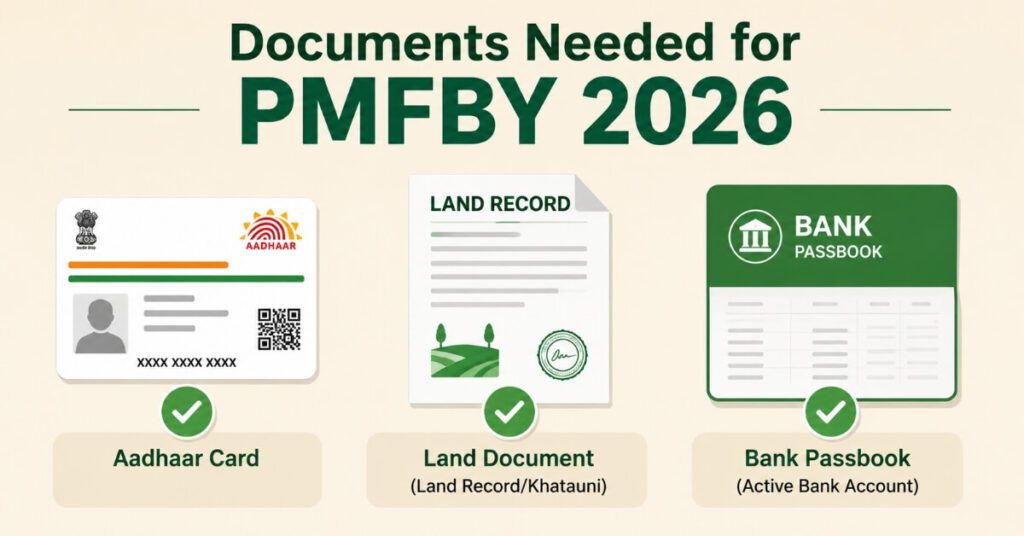
To take advantage of the PMFBY Last Date Extended 2026 opportunity, farmers need to keep a few documents ready. These typically include the Aadhaar card, land ownership or tenancy documents, bank account details for premium deduction and claim disbursement, and details of the crop being sown along with the sown area. Tenant and sharecropper farmers may need an additional declaration form, which varies slightly by state.
Since documentation delays were one of the reasons behind the PMFBY Last Date Extended 2026 decision in the first place, farmers are encouraged to visit their nearest common service center early rather than waiting until the final days of the new deadline. Rushed applications close to any cutoff often lead to errors in land records or crop details, which can complicate claims later.
How to Apply Online
Farmers can apply for coverage under the PMFBY Last Date Extended 2026 window through the official Pradhan Mantri Fasal Bima Yojana portal. The process generally involves creating a farmer login, entering land and crop details, uploading the required documents, and completing the premium payment online. Alternatively, applications can be submitted offline through a nearby bank branch or common service center, which remains a preferred route for farmers in rural areas with limited internet access.
It is worth noting that both loanee and non-loanee farmers can use the same portal, though the steps differ slightly depending on whether the farmer already has an existing crop loan account linked to the scheme. Given the renewed attention around this deadline change, portal traffic is expected to rise in the coming days, so applying a few days before the final cutoff is a sensible approach.
State-Wise Variations to Keep in Mind
While the central government sets a broad framework, individual states adjust certain aspects of the scheme, including specific cutoff dates, notified crops, and premium subsidy structures. This is precisely why the PMFBY Last Date Extended 2026 conversation cannot be treated as one uniform date across the country. The national deadline stands at August 15 for most states, Uttar Pradesh has pushed its window to August 16, and Andhra Pradesh separated its deadline for paddy from other kharif crops. Other states may issue their own circulars in the coming days as they respond to farmer feedback, similar to how the central extension responded to on-ground concerns.
Farmers are advised to check official state agriculture department websites or visit their local common service center for the most accurate, location-specific version of the PMFBY Last Date Extended 2026 timeline, since relying on generic national news alone may not capture state-level nuances.
Impact on Household Financial Planning
Crop insurance decisions do not exist in isolation from a household’s broader financial picture. Just as investors evaluate opportunities such as new listings for potential returns, farming families often need to weigh premium costs against the protection they receive under schemes tied to the PMFBY Last Date Extended 2026 window.
For readers who are also exploring other financial decisions this season, our earlier coverage on Is Indo MIM Ltd IPO Worth Investing offers useful context on evaluating financial opportunities carefully before committing funds, a mindset that applies equally well when deciding how much crop area to insure and which add-on covers to select under the extended timeline.
Understanding the trade-off between premium outflow now and potential claim benefit later is a core part of rural financial literacy, and the renewed enrolment window gives households one more chance to make that calculation without rushing.
Common Mistakes Farmers Should Avoid
One frequent issue during any enrolment window, including the current PMFBY Last Date Extended 2026 period, is mismatched land records between the insurance application and revenue department records. Even small spelling errors in names or survey numbers can delay claim settlement later. Another common mistake is underreporting or overreporting the sown area, which can affect the eventual payout calculation.
Farmers should also avoid waiting until the very last day of the PMFBY Last Date Extended 2026 deadline to submit applications, since server load and branch queues tend to increase sharply in the final 48 hours. Submitting early, even by a few days, reduces the risk of technical glitches preventing successful enrolment.
Claim Process and What Happens After Enrolment
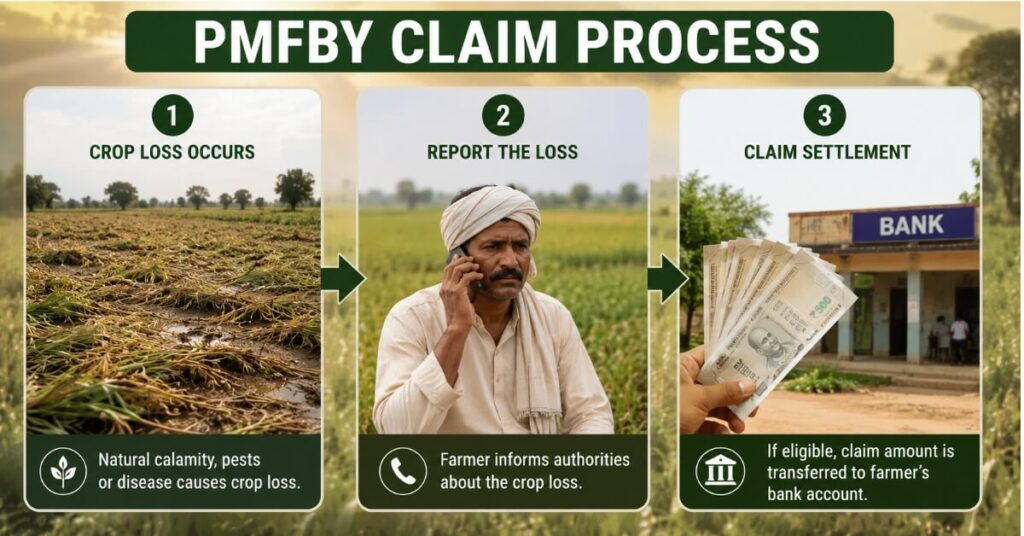
Once enrolled within the PMFBY Last Date Extended 2026 window, farmers do not need to take further action unless a loss event occurs. In case of crop damage due to natural calamities, farmers are expected to report the loss within the notified timeframe, typically within 72 hours for localized risks such as hailstorm or flooding. For widespread calamities, the assessment is often done at a larger area level using yield data.
Claim amounts are calculated based on the difference between the threshold yield and the actual yield, and disbursed directly to the farmer’s linked bank account. This is why keeping bank details accurate during the PMFBY Last Date Extended 2026 enrolment process is just as important as the crop and land details.
Understanding the Premium Structure
One of the biggest advantages of this crop insurance scheme is its affordable premium structure. Farmers typically pay only a small percentage of the total sum insured, while the government bears the remaining cost through a combination of central and state subsidies. For kharif crops, farmers usually contribute around two percent of the sum insured, while for rabi crops the contribution is closer to one and a half percent. Commercial and horticultural crops carry a slightly higher farmer share, generally around five percent.
This structure is designed to keep the scheme accessible even for smallholder farmers who may otherwise find comprehensive crop insurance unaffordable. The subsidy portion is calculated based on the actuarial premium rate determined by empanelled insurance companies, which factors in historical yield data, weather patterns, and regional risk profiles. Farmers who take time to understand this breakdown are often better placed to evaluate whether the coverage amount they are choosing matches the actual value of their crop investment.
How This Scheme Compares to Private Crop Insurance
While private insurance companies do offer standalone crop and weather-based policies, most of these products tend to be more expensive and are often limited to specific crops or regions. The government backed scheme, on the other hand, offers wider crop coverage, a subsidized premium structure, and a standardized claim process across states. This makes it a preferred choice for the majority of farming households, particularly those with smaller landholdings who need predictable, low-cost protection rather than customized but costlier private products.
That said, farmers with high value horticultural crops or those in regions with very specific microclimate risks sometimes explore supplementary private cover alongside their government policy. Comparing both options based on premium cost, claim settlement history, and crop-specific coverage terms is a reasonable approach before making a final decision, especially during a season when enrolment timelines are already shifting.
Role of Technology in Claim Settlement
Over the past few years, the use of satellite imagery, drone-based crop cutting experiments, and mobile applications has significantly improved the speed and accuracy of claim assessments. Instead of relying purely on manual field surveys, many states now use remote sensing data to estimate yield loss across larger areas, which reduces disputes and speeds up payouts. Farmers can also track their application and claim status directly through the official mobile app or web portal, reducing the need for repeated visits to bank branches or insurance offices.
This technological shift has been particularly helpful during periods of high enrolment volume, since digital verification reduces the administrative burden on local offices. As more farmers rush to complete their applications before the new deadline, this infrastructure is expected to play an important role in keeping the process smooth and transparent.
Tips for a Smooth Application Experience
Farmers who want to avoid last-minute stress should consider a few practical steps. First, keep digital or physical copies of land records, Aadhaar, and bank passbook readily available rather than searching for them at the last moment. Second, double check that the bank account linked for premium deduction is active and correctly seeded with Aadhaar, since mismatched details are one of the most common reasons for application rejection. Third, if applying through a common service center, ask for a printed or digital acknowledgment receipt as proof of submission.
Farmers who are unsure about the exact notified crops or sum insured applicable to their area should visit their local agriculture office or the nearest bank branch that handles crop loans, since staff there are usually well informed about the latest circulars and regional adjustments.

Government Sources and Official Verification
For the most reliable and updated information, farmers should always refer to the official Pradhan Mantri Fasal Bima Yojana portal at pmfby.gov.in rather than relying solely on social media posts or unverified forwards, since misinformation around scheme deadlines tends to circulate quickly during any extension period.
Frequently Asked Questions
Q1.What is the new PMFBY Last Date Extended 2026 for kharif crops?
For most notified kharif crops, the national enrolment window has been pushed to August 15, 2026, though state-specific dates may vary. Uttar Pradesh, for example, has an extended window until August 16, 2026.
Q2.Is the PMFBY Last Date Extended 2026 the same across all states?
No, the PMFBY Last Date Extended 2026 varies by state and sometimes by crop, so farmers should confirm their local notification.
Q3.Why was the deadline extended this year?
Farmer objections regarding documentation delays and limited processing time led to the PMFBY Last Date Extended 2026 decision.
Q4.Can non-loanee farmers still apply after the original July 31 date?
Yes, the PMFBY Last Date Extended 2026 window applies to both loanee and non-loanee farmers who have not yet enrolled.
Q5.What documents are required for enrolment?
Aadhaar card, land records, bank account details, and crop sowing details are generally required for enrolment.
Conclusion
The PMFBY Last Date Extended 2026 update gives farmers a valuable second chance to secure crop insurance coverage for the current kharif season. Whether you missed the original July 31 deadline due to documentation delays or simply need more time to evaluate your options, this extension is worth acting on promptly rather than waiting until the final days. Keeping documents ready, verifying state-specific dates, and applying through official channels will help ensure a smooth enrolment process under the revised timeline.
Disclaimer
This article is for informational purposes only and does not constitute financial or agricultural advisory services. Readers are advised to verify all scheme details, deadlines, and eligibility criteria through official government sources before making any decisions related to crop insurance enrolment.


Pingback: ITR Late Filing Penalty 2026: 5 Costly Mistakes to Avoid