

Post Office Time Deposit Scheme continues to be one of the most trusted investment options for Indians who prioritize safety over high returns. With market-linked instruments like mutual funds and stocks showing frequent fluctuations, many investors are turning back to government-backed savings instruments for peace of mind. This complete guide covers everything you need to know about interest rates, tenure options, tax benefits, and eligibility so that you can decide whether this scheme fits into your financial plan.
What Is Post Office Time Deposit Scheme
Post Office Time Deposit Scheme is a fixed-income savings instrument offered by India Post that works similarly to a bank fixed deposit, but with the added assurance of a sovereign guarantee. Since it is backed directly by the central government, investors do not need to worry about default risk, which makes it especially attractive for conservative savers, retirees, and anyone looking to park emergency funds without exposure to market volatility.
Unlike stock market investments where returns depend on company performance and broader economic conditions, this postal savings option offers a fixed, pre-determined interest rate for the entire tenure chosen at the time of account opening. This predictability is precisely what draws lakhs of depositors to this scheme every year, particularly those nearing retirement or building a contingency fund.
How Post Office Time Deposit Scheme Works
The mechanics behind Post Office Time Deposit Scheme are straightforward. An individual deposits a lump sum amount at their nearest post office for a chosen tenure, and in return receives a fixed interest rate that is compounded quarterly but paid out annually. The minimum deposit required to open an account under this scheme is Rs. 1,000, with no upper limit on the maximum amount that can be invested, making it accessible to both small savers and high-net-worth individuals.
Deposits can be made in multiples of Rs. 100 beyond the minimum threshold, giving investors flexibility in choosing an amount that suits their savings goals. Once the account is opened, the interest rate applicable at the time of investment remains locked for the entire tenure, regardless of any subsequent changes announced by the government for new depositors.
Interest Rates Under Post Office Time Deposit Scheme
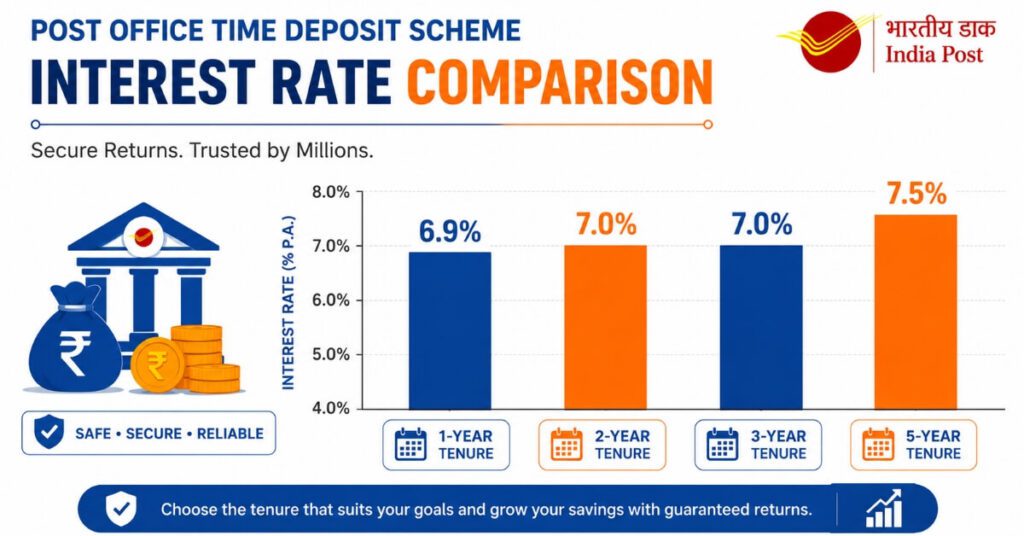
One of the first things investors check before choosing Post Office Time Deposit Scheme is the applicable interest rate, since this directly determines the final maturity amount. As per the latest rates, a one-year deposit earns 6.9 percent per annum, a two-year deposit earns 7.0 percent per annum, a three-year deposit also earns 7.0 percent per annum, and the five-year deposit offers the highest rate at 7.5 percent per annum.
These rates are reviewed and revised periodically by the government, typically on a quarterly basis, in line with prevailing economic conditions and benchmark yields. However, once you have opened your account under Post Office Time Deposit Scheme, the rate applicable at the time of your deposit continues to apply for the full tenure, even if rates for new depositors change later. This gives existing investors a degree of certainty that is often missing in market-linked products.
Tenure Options Available
This scheme offers four tenure choices to suit different financial goals: one year, two years, three years, and five years. Investors with short-term goals, such as building a buffer for upcoming expenses, often prefer the one-year or two-year options, while those focused on long-term wealth preservation and tax planning typically opt for the five-year tenure.
Choosing the right tenure under this scheme depends largely on your liquidity needs and financial objectives. Since premature withdrawal comes with certain restrictions and penalties, it is advisable to select a tenure that aligns with when you actually expect to need the funds, rather than simply choosing the option with the highest advertised rate.

Tax Benefits Under Section 80C
A key reason many investors choose the five-year variant of this scheme over other tenures is the tax benefit available under Section 80C of the Income Tax Act. Deposits made into the five-year time deposit account qualify for a deduction of up to Rs. 1.5 lakh in a financial year, making it a popular choice among salaried individuals looking to reduce their taxable income while also earning a fixed return.
It is important to note that only the five-year tenure carries this tax benefit; the one-year, two-year, and three-year deposits under this scheme do not qualify for Section 80C deductions. Additionally, the interest earned on any tenure under this scheme is fully taxable as per the investor’s income tax slab, so the tax advantage applies only to the principal invested in the five-year option, not to the interest income generated.
Minimum Deposit and Account Opening Process
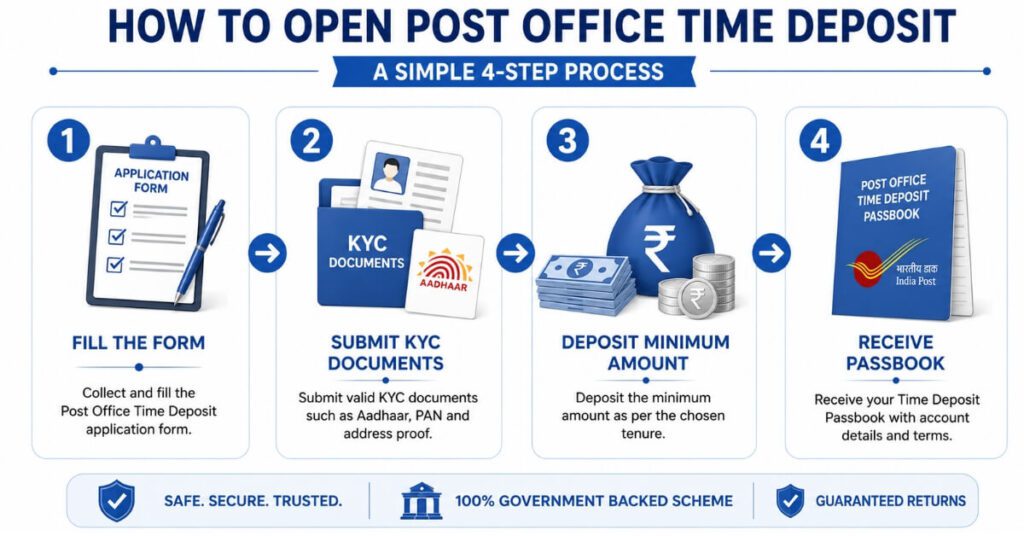
Opening an account under this scheme is a simple process that can be completed at any post office branch across India. Investors need to fill out the prescribed application form, submit KYC documents such as Aadhaar and PAN card, and deposit the minimum amount of Rs. 1,000 either in cash or through a cheque. Many post offices now also allow account opening and management through the India Post Payments Bank mobile application, making the process more convenient for tech-savvy investors.
Since there is no maximum limit on investment under this scheme, individuals can open multiple accounts across different tenures to create a laddering strategy, ensuring that funds mature at different intervals rather than all at once. This approach helps balance liquidity needs with the goal of earning consistent fixed returns over time.
Premature Withdrawal Rules
While this scheme is designed to be held until maturity, the scheme does allow for premature withdrawal under certain conditions. No withdrawal is permitted within the first six months of opening the account. If withdrawal is made between six months and one year, the depositor receives interest at the post office savings account rate, which is significantly lower than the time deposit rate.
For withdrawals made after one year but before the completion of the chosen tenure, the depositor receives interest at a rate that is two percentage points lower than the rate applicable for the actual period the money remained invested under this scheme. This penalty structure is designed to encourage investors to stay invested for the full tenure, so it is worth planning your investment horizon carefully before committing funds.
Who Should Consider Post Office Time Deposit Scheme
This scheme is particularly well-suited for risk-averse investors, senior citizens looking for predictable income, and individuals who want to diversify their fixed-income portfolio beyond bank fixed deposits. Since the interest rates offered are often competitive with or slightly better than many bank FDs, especially for longer tenures, it is worth comparing rates before deciding where to park your funds.
Investors who have already maxed out their Public Provident Fund contributions or are looking for additional Section 80C avenues also frequently turn to the five-year variant of this scheme as a supplementary tax-saving instrument. Similarly, parents saving for a child’s short-term education expenses often use the one-year or two-year options to keep funds safe while still earning a reasonable return.
Post Office Time Deposit Scheme vs Fixed Deposit
A common question among investors is how this scheme compares to a traditional bank fixed deposit. Both instruments offer fixed, predetermined returns and are considered low-risk options. However, the key differentiator is the guarantee structure: while bank fixed deposits are insured only up to Rs. 5 lakh per depositor under the DICGC scheme, deposits under Post Office Time Deposit Scheme carry a full sovereign guarantee regardless of the amount invested, since India Post operates as an extension of the central government.
Interest rates between the two options can vary depending on the bank and prevailing market conditions, so it is advisable to compare current rates before deciding. That said, for investors prioritizing absolute safety over marginal rate differences, this scheme often emerges as the preferred choice, particularly for larger sums that would otherwise exceed bank deposit insurance limits.

Nomination and Joint Account Facility
This scheme allows investors to nominate a beneficiary at the time of account opening, ensuring smooth transfer of funds in case of the account holder’s demise. This nomination facility is a crucial feature for long-term financial planning and estate management, particularly for senior citizens who want to ensure their savings pass on to family members without complications.
The scheme also permits joint account holders, allowing two or more individuals to open an account together. Joint holders can choose between joint operation, where all signatories must authorize transactions, or either-or-survivor mode, which allows either holder to operate the account independently. This flexibility makes this scheme suitable for couples and family members planning their finances together.
Comparing Returns Across Tenure Options
When evaluating which tenure to choose under this scheme, it helps to look at actual maturity value differences. A deposit of Rs. 1 lakh in the one-year option at 6.9 percent would grow to approximately Rs. 1,06,900 at maturity, while the same amount in the five-year option at 7.5 percent, compounded quarterly, would grow to a considerably higher sum due to the power of compounding over a longer period.
This compounding effect is one of the most underappreciated benefits of choosing longer tenures under this scheme, especially for investors who do not need immediate liquidity and can afford to lock in their funds for the full five-year period to also claim the associated tax benefit.
How Interest Is Calculated and Paid
Under this scheme, interest is compounded quarterly but credited to the depositor’s account annually. This means that while the calculation happens every quarter internally, the actual interest amount is paid out once a year, either directly to the depositor’s savings account linked with the post office or reinvested based on the depositor’s preference at account opening.
Investors should factor in this annual payout structure when planning their cash flow needs, since the interest is not available for withdrawal on a monthly or quarterly basis, unlike some other fixed-income instruments that offer more frequent payout options.
Digital Access and Modern Convenience
While this scheme has traditionally been associated with physical visits to post office branches, the process has become considerably more convenient in recent years. Account holders can now link their time deposit accounts with the India Post Payments Bank app for balance checks, and many post offices have adopted core banking solutions that allow transactions to be processed across branches rather than being restricted to the branch of account opening.
This modernization has made this scheme more accessible to younger, tech-savvy investors who previously associated postal savings schemes with outdated, paperwork-heavy processes. As digital infrastructure continues to improve across India Post branches, the overall experience of managing this investment is expected to become even more seamless.
Comparing With Other Government Savings Schemes
Beyond fixed deposits, investors often compare Post Office Time Deposit Scheme with other government-backed instruments such as the National Savings Certificate and the Public Provident Fund. While the National Savings Certificate offers a similar fixed-return structure with a mandatory five-year lock-in, the Public Provident Fund provides a longer fifteen-year horizon with tax-free interest, unlike the taxable interest earned under this scheme.
For investors seeking a diversified fixed-income portfolio, allocating funds across multiple government-backed instruments, including this one, the National Savings Certificate, and the Public Provident Fund, can help balance liquidity needs, tax planning, and long-term wealth accumulation goals more effectively than relying on a single instrument alone.
Broader Investment Context
While evaluating safe instruments like Post Office Time Deposit Scheme, many investors also like to track broader market trends to understand the overall investment landscape. If you also follow equity markets alongside fixed-income options, you may want to check our detailed coverage of the recent Wipro Dividend 2026 announcement, which explains record dates, payment timelines, and eligibility criteria for shareholders looking to earn income from dividend-paying stocks in addition to fixed-return instruments like postal savings schemes.
For the most accurate and updated interest rates applicable to Post Office Time Deposit Scheme, investors should always refer to the official India Post website, which publishes current rates, account opening procedures, and scheme-related notifications directly from the department, ensuring that the information used for financial planning is accurate and up to date.
Common Mistakes Investors Make
Many first-time depositors make the mistake of choosing the tenure purely based on the highest advertised rate without considering their actual liquidity needs. Locking funds into a five-year commitment when you may need the money within two years often leads to premature withdrawal penalties that eat into your overall returns. Another common oversight is forgetting to factor in the tax liability on interest income, which can significantly reduce the effective post-tax return, especially for individuals in higher income tax brackets.
Some investors also assume that the interest rate will automatically increase if government rates rise after they have already opened their account. In reality, the rate locked in at the time of deposit remains fixed for the entire chosen tenure, regardless of subsequent rate changes announced for new depositors. Being aware of these common pitfalls can help you make a more informed decision and avoid unpleasant surprises at maturity.
Building a Balanced Fixed-Income Portfolio
Financial planners often recommend not putting all your fixed-income allocation into a single instrument, even one as safe as this scheme. Diversifying across different tenures, and even across different types of government-backed instruments, can help balance liquidity, tax efficiency, and returns more effectively. For example, an investor might choose a mix of one-year and five-year deposits, using the shorter tenure for near-term goals and the longer tenure for tax planning and long-term wealth preservation.
This laddering approach also helps smooth out the impact of interest rate fluctuations over time, since funds mature at different intervals and can be reinvested at whatever the prevailing rate happens to be at that point, rather than locking the entire corpus into a single rate for a long duration.
Frequently Asked Questions About Post Office Time Deposit Scheme
Q1.What is the minimum deposit required for Post Office Time Deposit Scheme?
The minimum deposit required to open an account under Post Office Time Deposit Scheme is Rs. 1,000, with additional deposits allowed in multiples of Rs. 100.
Q2.Which tenure under Post Office Time Deposit Scheme offers tax benefits?
Only the five-year tenure under Post Office Time Deposit Scheme qualifies for a deduction under Section 80C of the Income Tax Act, up to a limit of Rs. 1.5 lakh per financial year.
Q3.Is Post Office Time Deposit Scheme better than a bank fixed deposit?
Post Office Time Deposit Scheme offers a full sovereign guarantee regardless of the deposit amount, while bank fixed deposits are insured only up to Rs. 5 lakh, making the postal option safer for larger investments.
Q4.Can I withdraw money early from Post Office Time Deposit Scheme?
Yes, premature withdrawal is allowed after six months, though it comes with reduced interest rates compared to the original tenure rate under Post Office Time Deposit Scheme.
Q5.Is the interest earned under Post Office Time Deposit Scheme taxable?
Yes, interest earned under Post Office Time Deposit Scheme is fully taxable as per the investor’s applicable income tax slab, regardless of which tenure is chosen.
Conclusion
Post Office Time Deposit Scheme remains a dependable choice for investors who value capital safety and predictable returns over the potential for higher but uncertain gains. With interest rates ranging from 6.9 percent to 7.5 percent depending on tenure, a sovereign guarantee backing every deposit, and additional tax benefits available on the five-year option, this scheme continues to serve a wide range of financial goals, from short-term savings to long-term tax planning.
Before investing, take the time to compare tenure options, understand the premature withdrawal rules, and evaluate how this fits alongside your other investments to build a well-rounded financial portfolio.
Disclaimer
This article on Post Office Time Deposit Scheme is for informational purposes only and should not be considered financial or investment advice. Interest rates and scheme rules are subject to change by the government from time to time. Please consult a certified financial advisor or visit your nearest post office branch to confirm the latest terms before making any investment decisions.


Pingback: EPF Photo Upload: 5 Important Steps You Must Know