
Cash transaction limit income tax rules are something most people ignore until they actually receive a notice from the Income Tax Department. Even in today’s digital-first India, a large number of people still rely on cash for daily needs and business dealings. However, the Income Tax Act, 1961 has placed strict boundaries on how much cash can be involved in a transaction. If you cross the cash transaction limit income tax rules, you could end up facing a heavy penalty along with an unwanted notice from the tax department.
In this article, we will explain in detail what the cash transaction limit income tax framework actually means, which 8 major cash rules you need to follow, and what consequences you may face if you exceed these limits. We will also look at why the government introduced these rules and how you can easily stay compliant without disrupting your daily financial life, whether you’re a salaried professional, a homemaker managing household finances, or a small business owner.
What Is Cash Transaction Limit Income Tax?
Cash transaction limit income tax is a regulatory framework built under the Income Tax Act to control black money and tax evasion. The government wants high-value transactions to remain traceable, which is why the cash transaction limit income tax rules set different thresholds for different scenarios — such as bank deposits, property purchases, business expenses, and loans.
If any individual or business fails to comply with these cash transaction limit income tax rules, provisions like Section 271DA can impose a penalty of up to 100% of the transaction amount. That’s why every taxpayer, whether salaried or a business owner, should have a clear understanding of cash transaction limit income tax.
Why Did the Government Introduce These Rules?
Cash transactions are inherently difficult to trace, and that’s exactly why black money, tax evasion, and benami transactions thrive wherever cash is used freely. Since demonetisation, the government has taken multiple steps to promote a digital economy, and introducing strict cash limits has been one of the most important measures. These limits were introduced to ensure:
A proper trail exists for high-value transactions
Tax evasion and black money circulation is reduced
Businesses report their genuine income accurately
The digital payment ecosystem gets a boost
This is exactly why the Income Tax Department keeps updating these rules every year and issues fresh notifications. With data analytics and AI-based tools, the department can now identify mismatched or suspicious cash transactions far more easily than before, which makes compliance more important than ever. Taxpayers who assume cash transactions go unnoticed often underestimate how much cross-verification now happens automatically through bank reporting, GST filings, and AIS data.
8 Major Cash Transaction Rules You Need to Know
The 8 rules listed below cover the most important aspects of cash transaction limit income tax that directly apply to ordinary individuals and businesses.
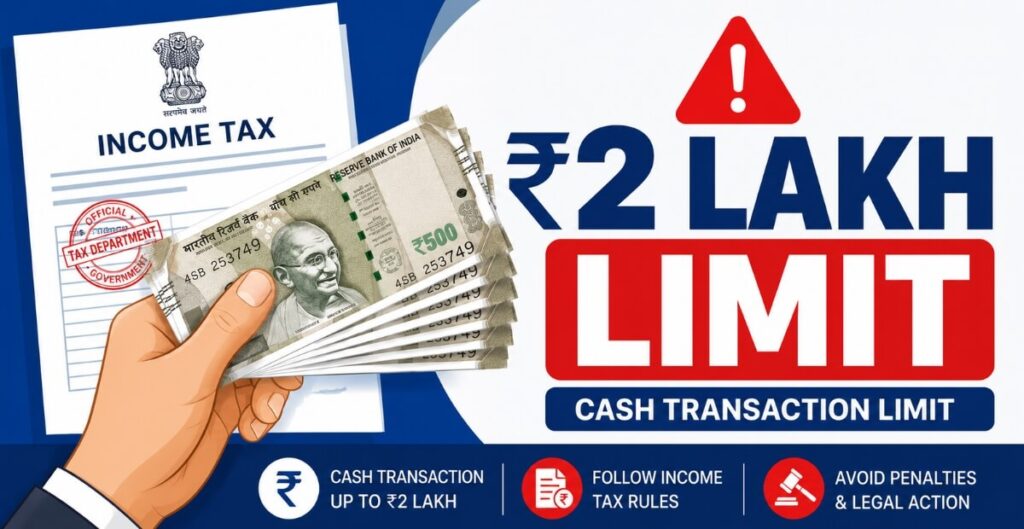
1. Section 269ST — Rs. 2 Lakh Cash Receipt Limit
Under Section 269ST, no person can receive Rs. 2 lakh or more in cash in a single day, in a single transaction, or in transactions relating to one single event or occasion. This is considered the strictest rule under cash transaction limit income tax because violating it can attract a 100% penalty on the receiver — meaning the entire cash amount received becomes the penalty.
Example: if someone receives a cash gift of Rs. 2.5 lakh at a wedding function from a single source, this transaction also falls under this rule. This is a rule that applies to weddings, functions, and family gatherings too, which is why people often violate it unknowingly, assuming this restriction only applies to business transactions. It’s worth noting that this rule applies regardless of the relationship between the giver and receiver, so even close family transactions are not automatically exempt.
2. Section 269SS — Cash Loan or Deposit Limit
Under cash transaction limit income tax, Section 269SS states that no loan or deposit of Rs. 20,000 or more can be taken or given in cash. This rule is especially important for people who lend or borrow cash from friends, relatives, or business partners. If you take a loan in cash beyond this limit, a penalty can be levied on the entire amount.
Many people take cash loans from family members during emergencies without realising that this transaction can also fall under tax scrutiny. That’s why it’s always better to use a bank transfer or cheque for larger amounts — this also protects you from any future tax disputes. Even a genuine, well-intentioned loan can invite unnecessary questions from the tax department if it’s routed entirely through cash.
3. Section 40A(3) — Business Expense Cash Payment Limit
If you run a business or profession, this rule under cash transaction limit income tax directly affects your tax deduction. Making a cash payment of more than Rs. 10,000 in a single day to one person makes that expense ineligible for deduction in your income tax return. For transport operators, this limit is raised to Rs. 35,000.
This rule is extremely important for small business owners and freelancers, because if you pay your suppliers or vendors in cash and cross this limit, the entire expense will not be deducted from your business income — meaning you’ll end up paying tax on an amount you have already spent. This makes it especially worthwhile to route recurring vendor payments through bank transfers or digital wallets from the start, rather than switching modes midway through the financial year.

4. Cash Deposit Limit in Savings Account
Bank cash deposits also fall within the scope of cash transaction limit income tax. If your total cash deposits in a savings account cross Rs. 10 lakh in a financial year, the bank is required to report this information to the Income Tax Department. For current account holders, this threshold goes up to Rs. 50 lakh.
In addition, if you deposit Rs. 50,000 or more in a single cash transaction, the bank will ask for your PAN details. If you don’t have a PAN, you’ll need to fill out Form 60. This documentation exists so that both the bank and the IT department have a clear record of the transaction, and it also protects you in case any discrepancy needs to be explained later.
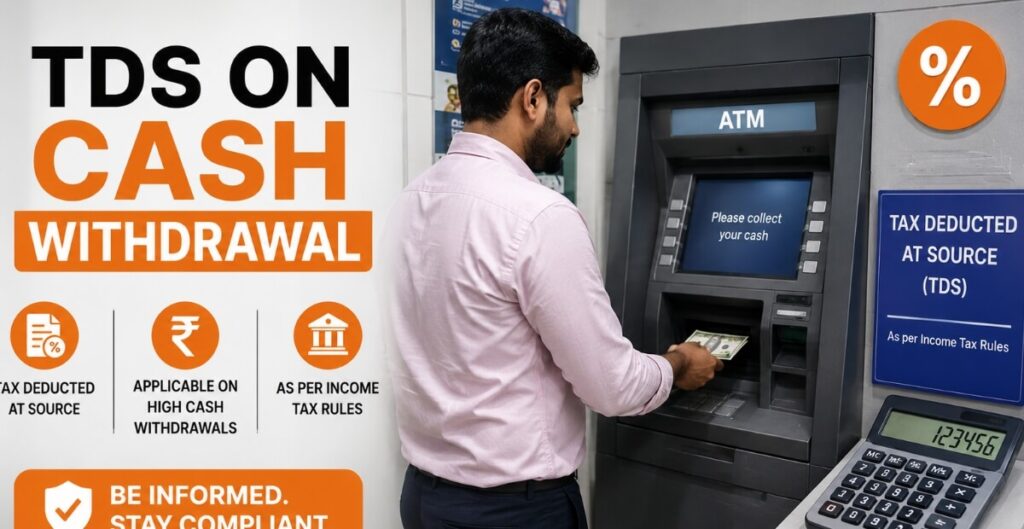
5. TDS on Cash Withdrawal — Section 194N
Under cash transaction limit income tax, if you withdraw more than Rs. 20 lakh in cash from a bank in a financial year and haven’t filed your ITR for the past 3 years, 2% TDS will be deducted. If the withdrawal exceeds Rs. 1 crore, TDS applies even in normal cases.
This rule is particularly important for business owners who regularly withdraw large amounts of cash for daily operations. If your ITR filing is up to date, you benefit from a lower TDS rate, which is why filing your ITR on time isn’t just about compliance — it also helps keep your cash flow efficient. Businesses that deal heavily in cash, such as retail shops or small traders, should track their annual withdrawal totals carefully to avoid unexpected TDS deductions.
6. Cash Payment for Property Purchase
Property transactions are also tightly regulated under cash transaction limit income tax rules. Any advance or payment above Rs. 20,000 made in cash for a property purchase is disallowed — this also means the property’s cost won’t be recognised for tax purposes.
Cash transactions used to be very common in the real estate sector, but now both Section 269SS and 269T apply to it — meaning both the payment while buying and the refund or repayment while selling must happen through digital modes.
This keeps the property’s value transparent and ensures accurate capital gains calculations in the future. Buyers should also insist on proper documentation for every rupee paid, since undervalued or partly-cash deals can create complications during resale.
7. Cash Donation Limit Under Section 80G
If you want to claim a tax deduction on a donation, the cash transaction limit income tax rule applies here too. Any cash donation above Rs. 2,000 is not eligible for deduction under Section 80G. If you want to donate more than this, you must use a cheque, bank transfer, or any digital mode.
This rule is especially relevant for people who make donations at the end of the financial year for tax-saving purposes. If you donate more than Rs. 2,000 in cash, not only will you lose the deduction, but the NGO or trust may also face discrepancies in their records.
8. Cash Payment of Credit Card Bills
Credit card bill payments are also monitored under cash transaction limit income tax. Paying a credit card bill of Rs. 1 lakh or more in cash can get reported in the Annual Information Statement (AIS), which can trigger scrutiny from the IT department.
Many people still pay their credit card bills in cash, assuming it’s a simple and untraceable method, but banks and credit card companies regularly share this information with the IT department. That’s why it’s always safer to pay credit card bills through net banking, UPI, or auto-debit.
What Happens If You Cross the Cash Transaction Limit Income Tax?
If you ignore these cash transaction limit income tax rules, you could face the following consequences:
Heavy Penalty: Up to 100% penalty on the violated amount under Section 271DA
Income Tax Notice: Information reaches the IT department through AIS and high-value transaction reporting
Disallowed Deduction: Business expenses paid in cash cannot be claimed as deductions
Scrutiny Assessment: Repeated large cash transactions can get your case selected for scrutiny
That’s why understanding and following cash transaction limit income tax rules isn’t just about compliance — it’s also essential for your overall financial planning. Even a small mistake can lead to prolonged tax notices and unnecessary paperwork, which is why keeping every transaction documented and traceable is the best practice.
If you’re looking to start your investment journey the right way and grow your money in a tax-efficient manner, do check out our article on investment portfolio for beginners — it covers diversification and smart asset allocation in detail.
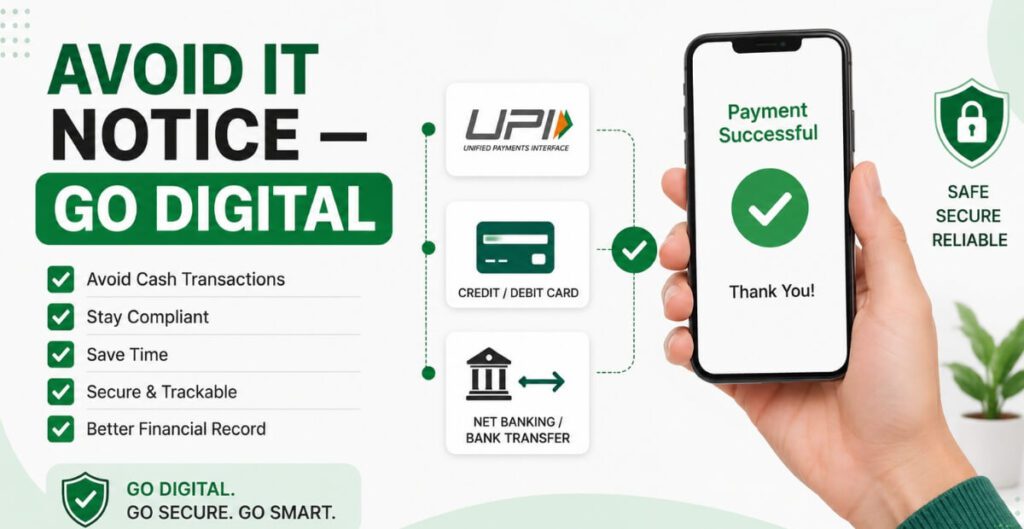
How to Avoid Violating Cash Transaction Limit Income Tax Rules
Here are some simple practices to avoid violating cash transaction limit income tax rules:
1 .Always use bank transfer, UPI, cheque, or card for large payments
2 .Maintain digital records of all business expenses
3 .Avoid cash for property, loan, or donation transactions
4 .File your ITR on time to avoid TDS on cash withdrawal
5 .Regularly check your Annual Information Statement (AIS) to catch any mismatches
6 .Always keep receipts or proof for any cash transaction, no matter how small
7 .Get your cash transactions reviewed by your accountant or CA at least once a year
Following these practices significantly reduces the possibility of running into any issue related to cash transaction limit income tax. This is especially important for small business owners and freelancers, who should maintain proper digital records of their income and expenses — not only does this make tax filing easier, it also makes financial processes like loan approvals much smoother.
A well-maintained digital trail also builds credibility with banks, lenders, and even potential business partners, which can prove valuable well beyond tax season.
For official guidelines and updated notifications, you can visit the Income Tax Department’s official website to check the latest circulars.
Maintaining a disciplined approach helps you follow cash transaction limit income tax rules with ease while also improving your overall financial health. Keeping digital records benefits you during loan applications, visa processing, or any financial verification, since bank statements and digital transactions serve as instant proof.
FAQs
Q1. What is the maximum cash I can hold under cash transaction limit income tax rules?
There’s no direct limit on holding cash, but if you receive Rs. 2 lakh or more in cash in a single transaction, Section 269ST applies, and it’s best to avoid amounts above this to prevent penalties.
Q2. Do these rules apply to salaried employees too?
Yes, these rules apply to all individuals, businesses, and professionals, whether salaried or self-employed. Whether you have a job or run your own business, knowing these cash limits is essential for every taxpayer.
Q3. What should I do if I accidentally cross the limit?
Contact your CA or tax consultant immediately and explore options for voluntary disclosure or correction. The sooner you address the issue, the lower the burden of penalty and interest. Delaying corrective action usually only increases the amount of scrutiny and paperwork involved.
Q4. Since when are these rules applicable?
Section 269ST has been applicable since the Finance Act 2017, and clarifications keep coming regularly. With every budget, the government reviews these thresholds and provisions, so it’s important to stay updated through official notifications rather than relying on outdated information.
Q5. Is there a limit on digital payments as well?
There’s no strict limit on digital payments (UPI, bank transfer, cheque) like there is on cash transactions — this is exactly why the government encourages digital payments. Lakhs of rupees can be paid easily and safely through UPI without any risk of penalty, and every transaction automatically leaves a verifiable digital trail.
Q6. Is it necessary to keep a record of cash transactions?
Yes, if you make any large cash transaction, always get a receipt, bill, or acknowledgment. These records come in handy while responding to any future query or notice.
Conclusion
Understanding cash transaction limit income tax rules has become essential for every taxpayer today. Whether you run a small business or simply use cash for daily needs, keeping these 8 rules in mind can save you from heavy penalties and unnecessary IT notices. Adopting digital payment modes isn’t just safer — it also boosts your financial credibility.
As India’s economy continues to move in a digital direction, these cash transaction limit income tax rules are only going to become more relevant. In the coming years, the government may tighten these thresholds even further, which is why building digital-first financial habits now is a smart and future-proof approach.
A little awareness and discipline will not only keep you tax compliant, but will also strengthen your overall financial planning — whether it’s building an emergency fund, taking a loan, or making a long-term investment.
As you plan your financial goals efficiently, always remember that compliance and growth can go hand in hand — all it takes is a slightly proactive approach. Building good financial habits today, especially around how you handle cash, will pay off in the form of fewer complications, faster loan approvals, and greater peace of mind during tax season.
Disclaimer
This article is for general information and educational purposes only. It does not constitute professional tax or financial advice. Before making any financial or tax-related decision, please consult a qualified CA or tax advisor. Income tax rules are updated from time to time, so please check the Income Tax Department’s official website for the latest updates before acting on any of the thresholds mentioned above.

Pingback: Share Market Crash 2026: Reasons, Impact & Safety Tips