
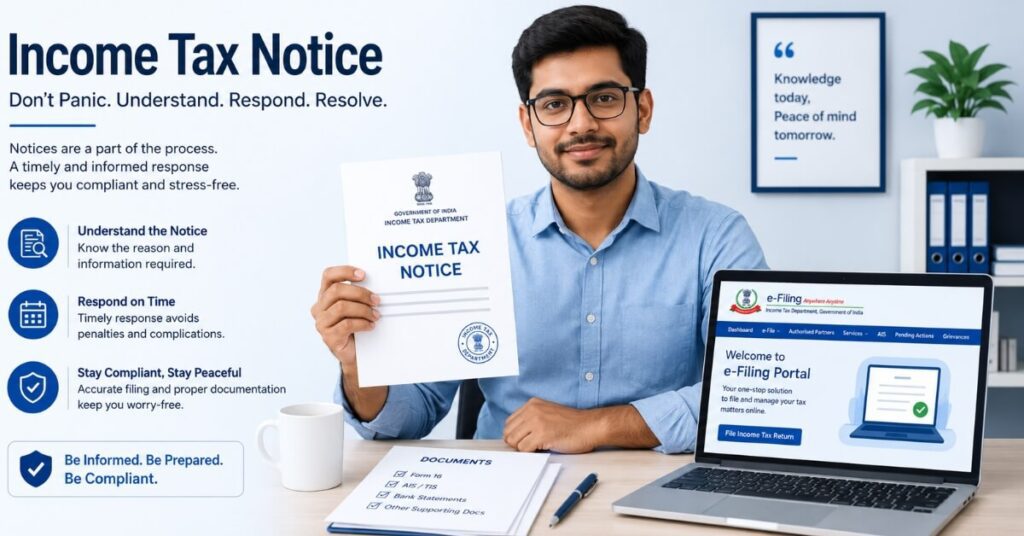
If you have received a tax notice from the Income Tax Department, do not panic. Millions of Indian taxpayers receive such notices every year — and most of them are easy to resolve if you act promptly and correctly. Whether it is your first time or you have dealt with one before, this complete guide on how to respond to income tax notice will walk you through every step online in 2026, what each notice type means, and what documents you need to keep ready.
The Income Tax Department has moved to a fully digital, faceless system since April 2026 under the Income Tax Act 2025. This means you no longer need to visit any tax office physically. Everything — from verifying the notice to submitting your reply — is done online through the e-Filing portal at incometax.gov.in.
What Is an Income Tax Notice?
An income tax notice is an official communication issued by the Income Tax Department to a taxpayer. Knowing how to respond to income tax notice starts with understanding why it is sent — usually for a discrepancy, missing documents, or ITR scrutiny. Receiving such a notice does not automatically mean you have done something wrong. In many cases, it is a routine communication asking for clarification or missing details.
Every genuine income tax notice contains a DIN — Document Identification Number — a unique 20-digit computer-generated number. Any communication without a valid DIN is not legally valid and can be safely ignored.
Why Do People Receive an Income Tax Notice and How to Respond to Income Tax Notice
Understanding why you received it is the first step when learning how to respond to income tax notice correctly. The most common reasons include:
Mismatch in Income Details: If the income you declared in your ITR does not match the data in Form 26AS, AIS (Annual Information Statement), or TIS (Taxpayer Information Summary), you will receive a tax notice asking for clarification.
Non-Filing of ITR: If you made high-value transactions — such as depositing over ₹10 lakh in a savings account, spending over ₹1 lakh on a credit card, or buying property — but did not file a return, expect a notice from the department.
High-Value Transactions: Banks, mutual funds, property registrars, and other institutions report significant financial transactions to the Income Tax Department. If these are not reflected in your ITR, it triggers a tax scrutiny notice.
Incorrect Deductions Claimed: Claiming deductions under Section 80C, 80D, HRA, or home loan without proper proof can lead to a scrutiny notice from the department.
TDS Mismatch: If the TDS deducted by your employer or bank does not match what you have reported in your return, the department sends a correction notice.
Defective Return: A return filed with incomplete or inconsistent information is flagged as defective, and an income tax notice under Section 139(9) is issued.
Types of Income Tax Notice You May Receive
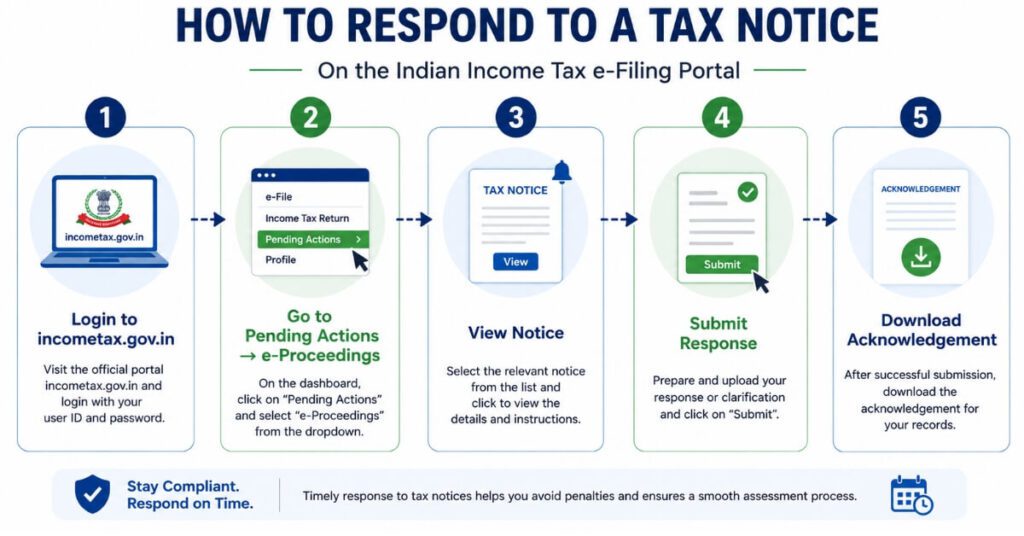
Knowing which section applies helps you prepare the correct response. Here are the most common types:
Section 143(1) — Intimation Notice
This is the most common type. It is sent after your ITR is processed. It simply informs you whether the department has accepted your return, found a mismatch, or identified a tax demand. Knowing how to respond to income tax notice under this section is simple — usually just confirm or pay a small adjustment.
Section 139(9) — Defective Return Notice
If your filed return has errors — missing schedules, wrong form selected, or incomplete information — you must know how to respond to income tax notice under 139(9) — you have 15 days to rectify the defect.
Section 142(1) — Inquiry Before Assessment
Knowing how to respond to income tax notice under Section 142(1) is important — the Assessing Officer needs documents before completing assessment. You may also receive it if you have not filed a return despite having taxable income.
Section 143(2) — Scrutiny Notice
This is a more serious type of notice. It means your return has been selected for detailed scrutiny. The department will examine your income, deductions, and expenses in depth. You must know exactly how to respond to income tax notice under scrutiny — full supporting documents are mandatory.
Section 148 — Reassessment Notice
If the department believes income has escaped assessment, you need to know how to respond to income tax notice under Section 148 to reopen and reassess old returns. This can go back up to 10 years in certain cases.
Section 156 — Tax Demand Notice
After assessment, if additional tax is due, understanding how to respond to income tax notice under Section 156 means paying within 30 days.
Section 245 — Adjustment of Refund
If you have a pending tax demand, learning how to respond to income tax notice under Section 245 helps you protect your refund.
Step 1: How to Respond to Income Tax Notice — Verify Authenticity First
Before doing anything else, verify the notice is genuine. Fraudsters often send fake notices to scare taxpayers into paying money. Here is how to authenticate:
1 .Go to the Income Tax e-Filing portal: incometax.gov.in
2 .On the homepage, under “Quick Links,” click “Authenticate Notice/Order Issued by ITD”
3 .You can verify using two methods:
Method A: Enter PAN, document type, assessment year, issue date, and your registered mobile number
Method B: Enter the DIN (Document Identification Number) and your mobile number
4.Enter the OTP received on your mobile
5 .If genuine, the portal displays a success message with notice details
If the portal shows “No record found,” the notice is fake. Do not respond to it or make any payment.
Step 2: How to Respond to Income Tax Notice — Read It Carefully
Once authenticated, read the notice thoroughly. Note the following:
The section under which it has been issued
The assessment year it relates to
The last date to respond
The specific information or documents requested
Whether there is a tax demand or just a query
Do not ignore the deadline. Response windows are typically 15 to 30 days. Missing the deadline can lead to penalties, a best-case assessment without your input, and worst-case prosecution.
Step 3: How to Respond to Income Tax Notice — Gather Required Documents
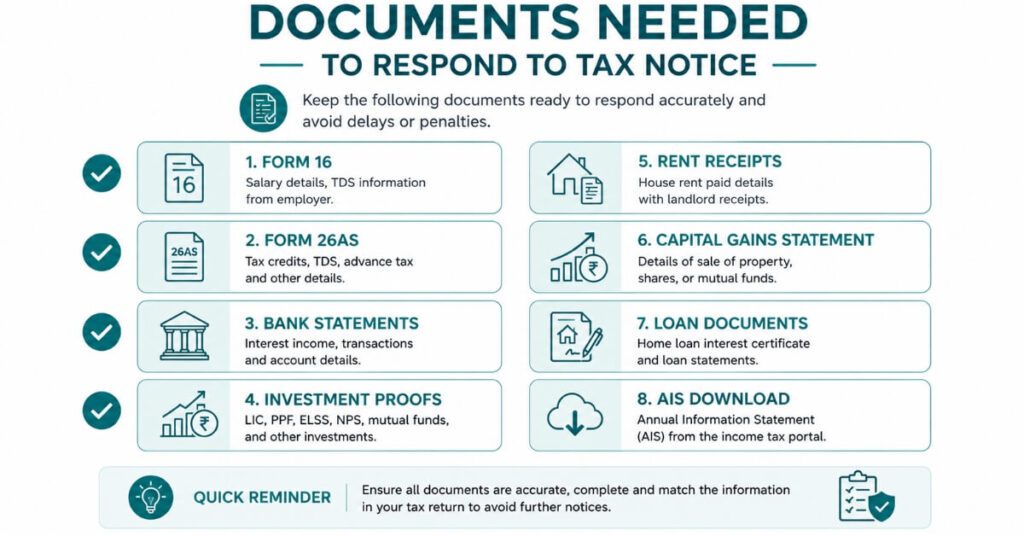
Based on the type of notice you received, collect all relevant documents before you sit down to respond. Commonly required documents include:
Form 16 (from employer) and Form 16A (from banks/others)
Bank statements for the relevant financial year
Investment proofs — ELSS, PPF, LIC premium receipts, etc.
Rent receipts and landlord PAN (for HRA claims)
Property documents (if high-value property transaction involved)
Loan sanction letters and repayment schedules
Capital gains statements from broker or mutual fund house
Form 26AS and AIS downloaded from the portal
Having these documents ready is essential when deciding how to respond to income tax notice accurately and confidently.
Step 4: Log In to the e-Filing Portal
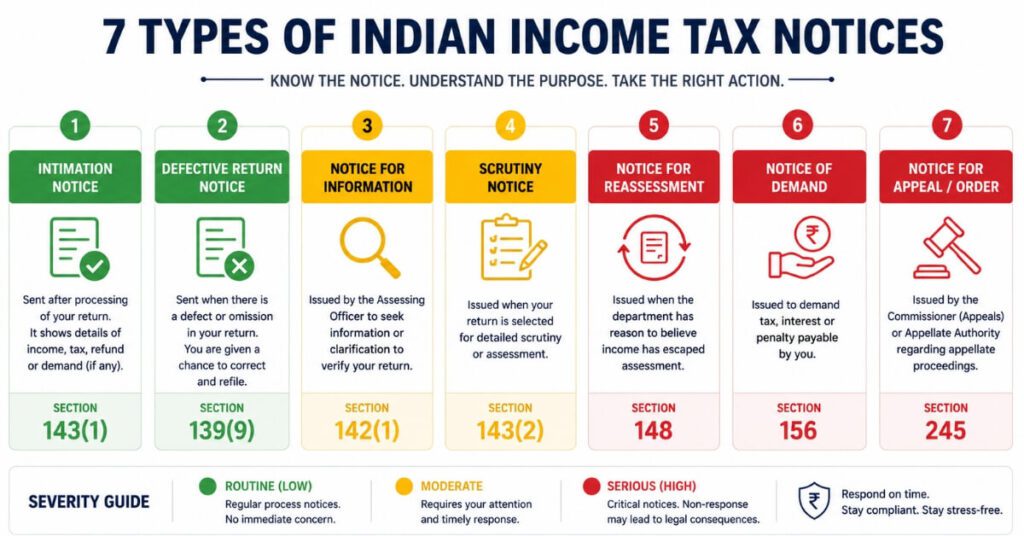
Here is how to respond to income tax notice online through the e-Filing portal — follow these steps:
1 .Visit incometax.gov.in and log in using your PAN and password
2 .On your Dashboard, go to Pending Actions → e-Proceedings
3 .You will see all pending notices listed here
4 .Click on “View Notice” next to the relevant notice listed
5 .Download and read the notice PDF
6 .Click “Submit Response”
Step 5: Submit Your Response Online
This is the most critical stage of how to respond to income tax notice. Based on the notice type:
For Section 143(1) — Tax Demand: Select one of these options:
Demand is correct (pay the tax)
Demand is partially correct
Disagree with demand (provide explanation with documents)
Demand is not correct but agree for adjustment
For Section 139(9) — Defective Return: Correct the defect online or upload a revised JSON file of your ITR.
For Section 142(1) or 143(2) — Scrutiny: Upload all supporting documents as requested. Provide a clear written explanation for each query raised in the notice.
For Section 148 — Reassessment: File a return for the relevant assessment year if not already filed, or provide explanation with documents showing income was correctly reported.
After submitting your response, save the Transaction ID and download the acknowledgement. You will also receive a confirmation email on your registered email ID.
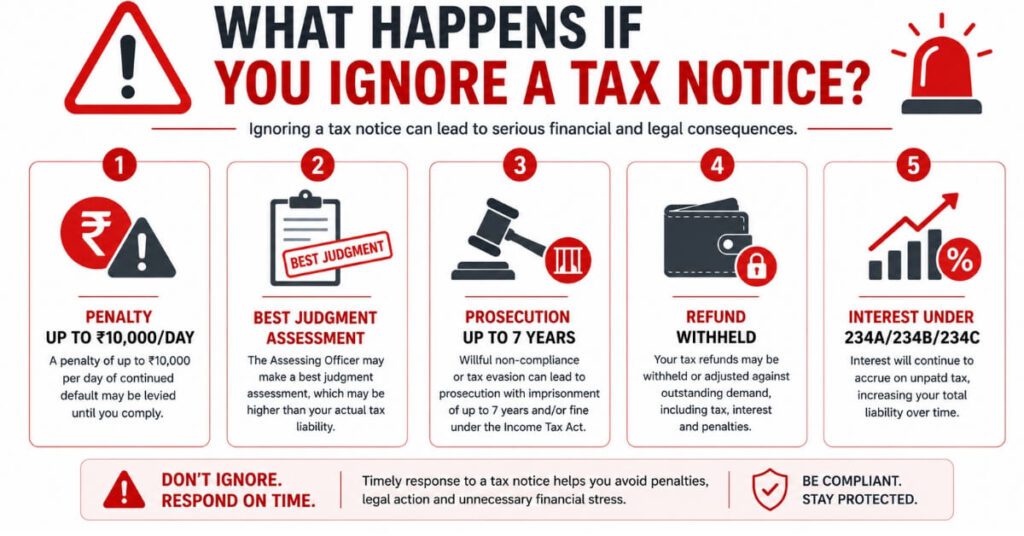
What Happens If You Ignore an Income Tax Notice?
Not knowing how to respond to income tax notice and ignoring it is never a good idea. The consequences can be serious:
Penalty under Section 272A: Up to ₹10,000 per day for non-compliance with certain notices
Best Judgment Assessment: The Assessing Officer makes an assessment based on available data, without your input — usually unfavourable
Prosecution: In cases of deliberate non-filing or concealment, imprisonment of up to 7 years is possible
Refund Withholding: Your pending refunds can be withheld until the notice is resolved
Interest on Tax Demand: Delaying your response involving a tax demand increases interest liability under Sections 234A, 234B, and 234C
Speaking of interest — if your notice involves a tax demand arising from delayed filing or assessment, be aware that the RBI’s current monetary policy also affects the interest rates used in tax calculations. You can read more about this in our article on RBI Repo Rate 2026: What It Means for Your Money.
How to Respond to Income Tax Notice: Expert Tips That Work
Here are practical tips that will help you handle any such notice with confidence:
Respond on time: The deadline mentioned in the notice is non-negotiable. Always respond at least 2-3 days before the last date to avoid last-minute technical issues on the portal.
Be truthful: Never submit false or misleading information when responding to any tax notice query. The department has access to your full financial data through AIS, Form 26AS, and third-party reports.
Keep copies: Save copies of all documents you upload and the acknowledgement of your response. These are essential if the department raises further queries.
Seek professional help: For complex notices — especially Section 143(2) scrutiny or Section 148 reassessment — consult a Chartered Accountant. The cost of professional advice is far less than the penalty for a wrong response.
Do not make payments through unofficial channels: A genuine notice will never ask you to pay money to an individual or through unofficial payment links. All tax payments are made only through the official portal.
How to Check Income Tax Notice Status Online
After submitting your response, you can track its status:
1 .Log in to incometax.gov.in
2 .Go to Pending Actions → e-Proceedings
3 .Click on the relevant notice
4 .View the response status and any follow-up communication from the department
The portal will show whether your response has been accepted, whether further clarification is needed, or whether the matter is closed.
How to Avoid Getting an Income Tax Notice in Future
The best way to never need to learn how to respond to income tax notice is to avoid receiving one altogether. Here is how:
File your ITR every year before the due date (July 31 for individuals). Late filing not only invites penalties but also increases the chance of receiving a scrutiny notice.
Ensure your income details match Form 26AS and AIS exactly before filing. If you find a mismatch, raise a correction request before you file.
Report all income — salary, interest, capital gains, freelance income, rental income. Even bank interest of a few hundred rupees must be declared.
Claim only those deductions for which you have valid documentary proof. Fake or inflated deductions are now the top trigger for scrutiny.
Report high-value transactions accurately — property purchases, large deposits, credit card spends over ₹1 lakh.
Keep PAN linked with Aadhaar and ensure your registered mobile number and email ID are updated on the portal to receive timely notices.
Download and check your AIS every year before filing to spot any mismatches or third-party reported transactions early.
Frequently Asked Questions
Q1. Is every income tax notice I receive serious?
No. Many such notices — especially Section 143(1) intimations — are routine communications. However, always know how to respond to income tax notice within the deadline, even if no action is ultimately required.
Q2. Can I reply to an income tax notice by email?
No. Responses must be submitted through the e-Filing portal at incometax.gov.in only. Email responses are not accepted.
Q3. What is DIN and why does every income tax notice carry it?
DIN stands for Document Identification Number. It is a unique 20-digit number that every genuine tax notice must carry. You can use the DIN to verify the notice on the portal.
Q4. How much time do I have when I need to know how to respond to income tax notice?
It depends on the notice type. Section 139(9) gives you 15 days. Section 156 (demand notice) gives you 30 days. For scrutiny notices under Section 143(2), the timeline is mentioned in the notice itself. Always check the specific deadline mentioned in your notice.
Q5. Can I get an extension to respond to income tax notice deadlines?
Yes. In most cases, you can request an adjournment (extension) through the e-Proceedings section on the portal. However, this must be done before the deadline, not after.
Q6. What if I disagree with the demand in an income tax notice?
Select “Disagree with demand” when submitting your response on the portal. Provide a clear written explanation and upload supporting documents. The Assessing Officer will review your response.
Q7. Can an income tax notice be withdrawn?
Yes. If your response proves the demand or query was incorrect, the department can withdraw or modify the notice. This typically happens after scrutiny assessment is completed.
Q8. Is it safe to ignore an income tax notice if the amount is small?
No. Even for a small tax demand, ignoring a tax notice can lead to penalty and interest accumulation, making the amount significantly larger over time.
Conclusion
Receiving an income tax notice can feel stressful, but knowing how to respond to income tax notice the right way makes all the difference. The process is now fully online, transparent, and manageable — especially if you act promptly, stay truthful, and keep your documents ready.
When you need to know how to respond to income tax notice, the key steps are simple: verify the notice using DIN, read it carefully, gather your documents, log in to the e-Filing portal, and submit a clear and complete response before the deadline. For complex scrutiny or reassessment notices, always take professional help.
Remember — responding correctly and on time to every notice protects your finances, avoids unnecessary penalties, and keeps your tax record clean for the years ahead.
Financial Disclaimer
The information provided in this article is for general educational purposes only and does not constitute professional tax, legal, or financial advice. Tax laws and procedures change frequently. Readers are advised to consult a qualified Chartered Accountant or tax professional before taking any action on how to respond to income tax notice received. SK Smart Digital Hub is not responsible for any financial decisions made based on the content of this article.

Pingback: How to Improve Credit Score: 7 Proven Tips for 2026