
If you have a home loan, a fixed deposit, or money invested in mutual funds, the RBI Repo Rate 2026 update is something you simply cannot ignore. Every two months, the Reserve Bank of India’s Monetary Policy Committee meets to decide this single number, and that number quietly shapes how much you pay on your EMI and how much you earn on your savings.
Whether you’re servicing a 20-year home loan, planning to open a new fixed deposit, or simply trying to understand why your bank’s interest rates haven’t moved in a while, this single policy decision sits behind almost every major financial choice you’ll make this year. In this guide, we break down everything you need to know about the latest repo rate decision, why it has stayed steady, and what it means for your money in the months ahead.
What Is the RBI Repo Rate?
Before diving into the numbers, let’s quickly understand what the repo rate actually is. The repo rate is the interest rate at which the Reserve Bank of India lends short-term funds to commercial banks against government securities. When banks face a temporary shortage of funds, they borrow from the RBI at this rate, agreeing to repurchase the pledged securities later.
This is exactly why it is called the “repurchase rate,” or repo rate for short. It is the RBI’s primary tool to control inflation, manage liquidity, and influence the overall cost of borrowing across the Indian economy. Unlike the reverse repo rate, which is the rate at which the RBI absorbs surplus funds from banks, the repo rate works in the opposite direction, injecting liquidity into the system when banks need it.
RBI Repo Rate 2026: Current Status
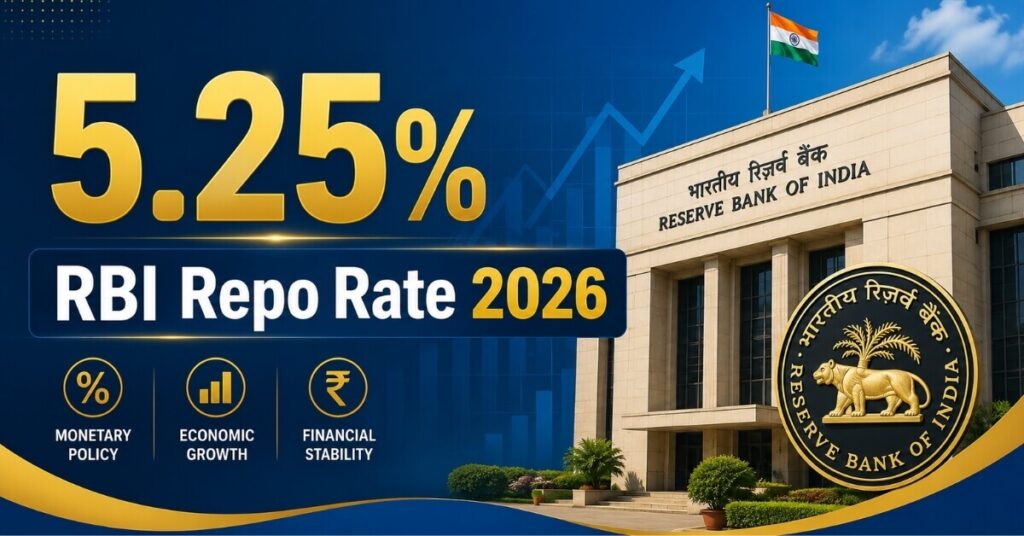
As of June 2026, the RBI Repo Rate 2026 stands at 5.25%. This is the third consecutive meeting where the Monetary Policy Committee has chosen to hold the rate steady rather than cut or hike it. Alongside this benchmark rate, the Standing Deposit Facility (SDF) rate is at 5.00%, while the Marginal Standing Facility (MSF) and Bank Rate are both at 5.50%. The Cash Reserve Ratio (CRR) stands at 3.00%. The RBI Governor and all six members of the Monetary Policy Committee voted unanimously in favour of this hold, signalling strong consensus on keeping policy steady for now.
This decision was widely expected by market participants, but the supporting commentary from the RBI carried more weight than the headline number itself. The central bank continues to maintain a “neutral” policy stance, meaning it has not committed to either cutting or hiking rates in the near term. The RBI Repo Rate 2026 path going forward will depend heavily on how inflation and growth data evolve over the coming months, and the central bank has repeatedly emphasised that it is watching incoming data closely before making its next move.
It also helps to look at how we got here. The current repo rate followed a 25 basis point cut in December 2025, which itself came after a longer cutting cycle through 2025 aimed at supporting growth. Compared to the cycle’s earlier peak of 6.50%, today’s rate reflects a meaningfully easier policy environment, even with the recent pause.
Why RBI Kept the Repo Rate Unchanged in 2026
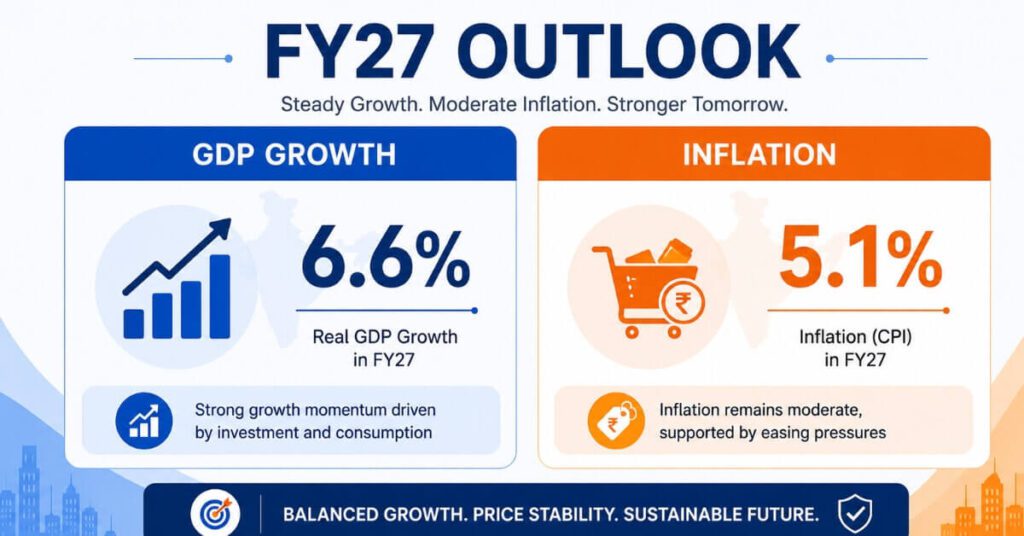
There are a few clear reasons behind this hold. First, inflation has been creeping upward. The CPI inflation projection for FY27 has been revised up to 5.1%, compared to an earlier estimate of 4.6%. This 50 basis point jump is largely linked to elevated crude oil prices, which averaged close to $110 a barrel in the months leading up to the meeting, well above what the RBI had originally factored in. Core inflation, however, has remained relatively stable at around 3.7%, suggesting that the underlying demand-side pressures are not yet alarming on their own.
Second, growth concerns are also weighing on this decision. The GDP growth forecast for FY27 has been revised down to 6.6%, from an earlier estimate of 6.9%. The West Asia conflict, rising energy costs, and global trade disruptions are cited as key reasons for this downward revision. The RBI Governor noted that while the conflict is likely to adversely affect growth, India’s economic fundamentals remain strong enough to absorb these external shocks better than in the past, thanks to healthy forex reserves and resilient domestic demand.
Given these mixed signals, rising inflation on one hand and slowing growth on the other, the Monetary Policy Committee chose to wait and watch rather than act. This cautious approach reflects the RBI’s broader data-dependent strategy, where every RBI Repo Rate 2026 decision is weighed carefully against both domestic and global developments before being finalised.
RBI Repo Rate 2026 and Its Impact on Home Loan EMIs
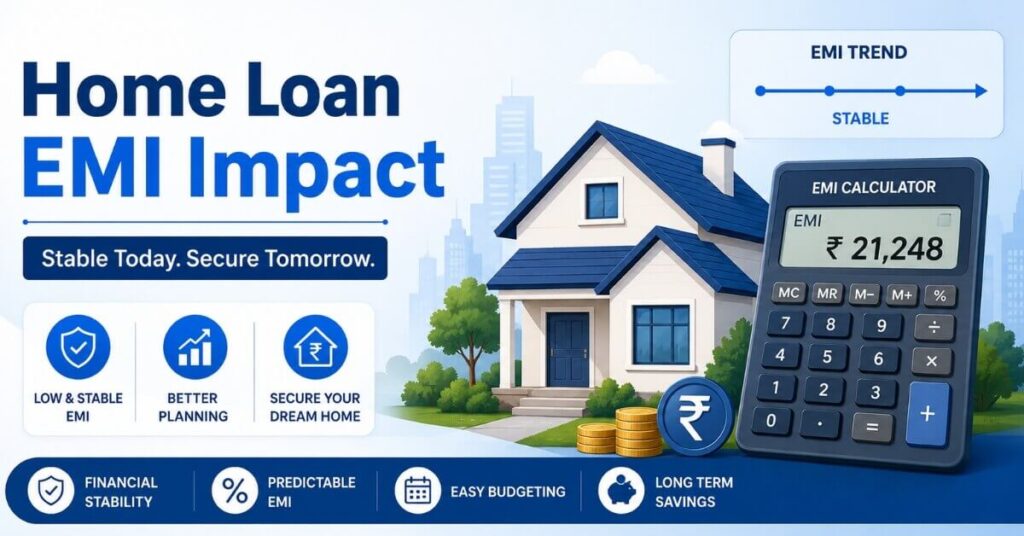
For most salaried Indians, the most immediate question is simple: what happens to my home loan EMI? Since most floating-rate home loans today are linked to external benchmarks like the repo rate through the External Benchmark Lending Rate (EBLR) system, any change in the RBI Repo Rate 2026 gets transmitted to borrowers fairly quickly, often within a quarter.
Because the rate has been held steady for the third consecutive meeting, your EMI is unlikely to change anytime soon if you already have a repo-linked loan. This is good news for borrowers who were hoping for stability after the earlier rate cuts in December 2025. However, those who were expecting further EMI relief through additional cuts will need to wait, since the current RBI Repo Rate 2026 stance suggests the rate-cutting cycle has paused for now.
It’s worth noting that loans linked to the older MCLR (Marginal Cost of Funds based Lending Rate) system respond more slowly to changes in the repo rate, since MCLR resets typically happen on a quarterly or half-yearly basis rather than instantly. If you’re still on an MCLR-linked loan, it may be worth checking with your bank whether switching to an EBLR-linked product makes sense, especially in a stable rate environment like this one.
RBI Repo Rate 2026 and Fixed Deposit Returns
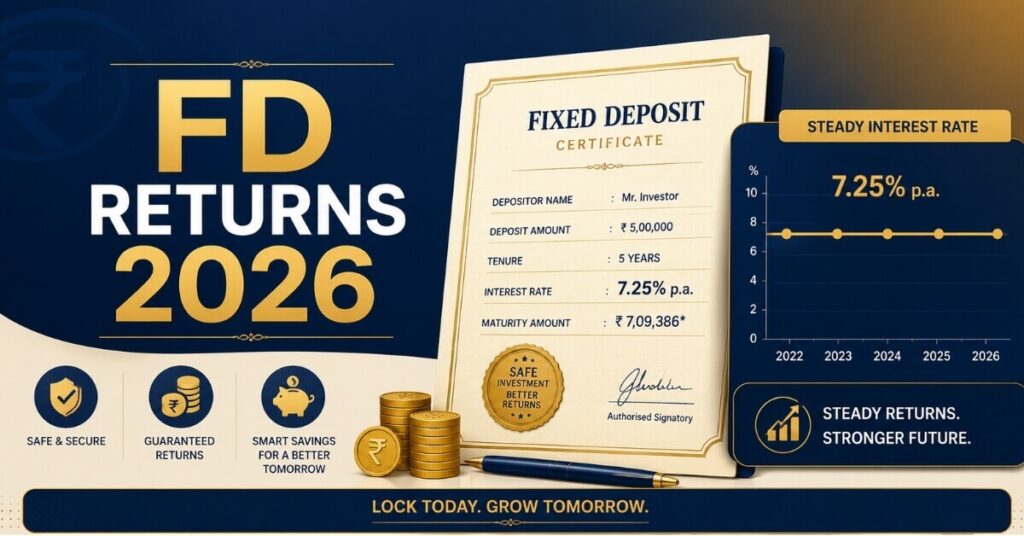
On the flip side, the repo rate also affects how much interest you earn on fixed deposits. When the repo rate rises, banks generally raise FD interest rates to attract more deposits, since their own cost of borrowing from the RBI goes up. When the rate falls, FD returns typically come down too.
With the RBI Repo Rate 2026 unchanged for three straight meetings, FD investors can expect rates to remain largely stable in the near term. If you’re someone who relies on fixed-income instruments for steady returns, this pause works in your favour, since it removes the uncertainty of falling FD rates that usually follows a rate-cut cycle. That said, savers should keep an eye on the August 2026 policy meeting, as any shift in the central bank’s stance could change this picture going forward.
RBI Repo Rate 2026: GDP and Inflation Outlook for FY27
Understanding the broader economic backdrop helps put this decision in context. The RBI now projects FY27 GDP growth at 6.6%, with Q1 growth estimated around 6.8% and a more cautious outlook for the following quarters as the West Asia conflict’s effects ripple through trade and energy costs. On the inflation side, the FY27 CPI projection stands at 5.1%, broken down roughly as 4% for Q1, 4.4% for Q2, 5.2% for Q3, and 4.7% for Q4.
This combination of slower growth and rising inflation is precisely why the RBI Repo Rate 2026 has stayed in “wait and watch” mode. A rate cut right now could add fuel to inflation, while a rate hike could further dampen already-slowing growth. The RBI’s neutral stance reflects this delicate balancing act, and it is a useful reminder that monetary policy decisions are rarely about a single number, they’re about managing competing risks at the same time.

RBI Repo Rate 2026 vs Stock Market and Mutual Funds
Interest rate decisions don’t just affect loans and deposits, they also ripple through equity and debt markets. A stable repo rate generally supports market stability, since investors dislike uncertainty around borrowing costs more than they dislike a particular rate level. Sectors like banking, auto, infrastructure, and real estate, which are sensitive to borrowing costs, tend to benefit from predictability around the RBI Repo Rate 2026.
For debt mutual fund investors, an unchanged rate also brings welcome stability to bond yields, making it easier to plan returns from government securities and other fixed-income instruments. If you’re looking to diversify beyond fixed income and explore equity-linked opportunities, our detailed guide on the SBI Mutual Fund IPO is a useful next read for building a more balanced portfolio.
Alongside this policy hold, the central bank and the Ministry of Finance jointly announced a coordinated capital-inflow package targeting a balance of payments deficit of nearly $50 billion for FY2026-27. This includes expanding investment limits for NRIs and overseas individual investors from 5% to 10% of paid-up equity, removing certain taxes on FPI investments in government securities, and broadening the Fully Accessible Route for long-tenure government bonds. These measures, layered on top of the RBI Repo Rate 2026 decision, are designed to attract stronger foreign capital inflows and support the rupee, which is expected to trade around 94 to the US dollar in the near term.
What to Expect from RBI Repo Rate 2026 in the August Meeting
The next big test comes at the Monetary Policy Committee meeting scheduled for 3-5 August 2026. Market forecasts currently lean toward the possibility of the RBI eventually shifting course, with some analysts even projecting the rate climbing to 5.75% by the end of FY27 if inflation continues to run hot. However, this is purely market speculation and not official RBI guidance.
Much will depend on how crude oil prices behave and whether the West Asia conflict eases in the coming weeks. If inflation cools faster than expected, the RBI Repo Rate 2026 could remain on hold for longer. But if inflationary pressure builds further, a hike cannot be ruled out. For now, the central bank has made it clear that all future decisions on the RBI Repo Rate 2026 will be strictly data-dependent, with no pre-committed direction either way.
How to Plan Your Finances Around RBI Repo Rate 2026
Whether you’re a borrower, a saver, or an investor, here’s how you can navigate the current environment sensibly. If you have a floating-rate home loan, this stable phase is a good time to consider prepaying a portion of your loan, since your EMI isn’t going to drop further in the near term. If you’re parking money in fixed deposits, locking in current rates now makes sense, especially if you believe the rate might eventually move higher.
For equity and mutual fund investors, a stable rate environment generally supports market confidence, so this could be a reasonable window to continue your SIPs without worrying about sudden rate shocks. And if you’re planning a fresh loan, comparing lenders now, while the policy rate is steady, gives you more predictability in your EMI planning. Finally, keep a close watch on crude oil prices and the West Asia situation over the next few weeks, since these two factors are likely to have the biggest influence on the next rate decision.
RBI Repo Rate History: A Quick Look Back
To appreciate where things stand today, it helps to zoom out a little. India’s benchmark lending rate has moved through several distinct phases over the past decade and a half. Back in 2012, the rate touched a high of 8.50% as the RBI fought to control runaway inflation. Through the mid-2010s, the rate gradually eased as inflation cooled, settling in the 6% to 6.5% range for several years. The pandemic years saw aggressive cuts to support a struggling economy, bringing the rate down to historic lows before a sharp tightening cycle began in 2022 to combat post-pandemic inflation, pushing rates back up toward 6.50%.
From late 2024 onward, as inflation moderated and growth needed support, the RBI began a gradual easing cycle, cutting rates step by step through 2025, including a notable cut in December 2025 that brought the rate down to its current level. Viewed against this longer history, today’s pause looks less like indecision and more like a deliberate breather after a fairly active couple of years of policy moves. It also shows how closely tied India’s monetary policy is to both domestic price pressures and global shocks, whether that’s a pandemic, a commodity price spike, or a geopolitical conflict.
This historical context matters for everyday financial planning too. Borrowers who locked in loans during the low-rate pandemic years have already seen their EMIs rise once during the 2022-23 tightening cycle, and many are understandably cautious about reading too much into any single policy pause. Savers, similarly, remember how quickly FD rates can move once the cycle turns, which is why financial advisors often recommend laddering your fixed deposits across different tenures rather than locking all your savings in at one rate.
Frequently Asked Questions
Q1.What is the current RBI Repo Rate 2026?
As of the June 2026 Monetary Policy Committee meeting, the RBI Repo Rate 2026 stands at 5.25%, unchanged for the third consecutive policy review.
Q2.Will the RBI Repo Rate 2026 change in the next meeting?
It’s uncertain. The next MPC meeting is scheduled for 3-5 August 2026, and any change will depend on inflation and growth data released between now and then.
Q3.How does the RBI Repo Rate 2026 affect my home loan EMI?
If your home loan is linked to an external benchmark like the repo rate, your EMI moves in line with changes to the policy rate. Since it is currently unchanged, your EMI should also remain stable.
Q4.Does the RBI Repo Rate 2026 affect fixed deposit interest rates?
Yes. A higher repo rate generally pushes FD rates up, while a lower rate tends to bring them down. With the current rate steady, FD rates are expected to stay largely stable too.
Q5.Why has the RBI kept the Repo Rate unchanged in 2026?
The RBI Repo Rate 2026 has been held steady due to rising inflation projections, driven mainly by high crude oil prices, alongside a downward revision in GDP growth, prompting a cautious wait-and-watch approach.
Conclusion
The story so far has been one of stability amid global uncertainty. With the RBI Repo Rate 2026 steady at 5.25% for three consecutive meetings, borrowers get predictable EMIs, savers get steady FD returns, and investors get a calmer backdrop for planning. As the outlook unfolds heading into the August meeting, keeping an eye on inflation and crude oil trends will help you stay ahead of any changes.
Rather than reacting to every headline, the smarter approach is usually to revisit your loan, savings, and investment plan once every quarter, right around when the MPC announces its decision, so your financial choices stay aligned with where interest rates are actually heading. For official updates, you can always refer to the RBI Monetary Policy page directly.
Disclaimer
This article is for informational and educational purposes only and should not be considered financial, investment, or tax advice. Repo rate figures, GDP and inflation projections, and market forecasts are based on data available at the time of writing and are subject to change following future RBI Monetary Policy Committee announcements. Please consult a certified financial advisor before making any borrowing, savings, or investment decisions.

Pingback: How to Respond to Income Tax Notice: Best Guide 2026