

If you have been following Indian financial markets in 2025, you must have heard the term what is SIF in India coming up again and again. SIF, or Specialised Investment Fund, is one of the most talked-about investment products introduced by SEBI this year. It is a completely new asset class that is changing the way Indian investors think about wealth creation.
In this article, we will explain everything you need to know about what is — from its meaning and features to its benefits, risks, and how you can invest in it.
What is SIF in India? — Basic Meaning
What is SIF in India — SIF stands for Specialised Investment Fund. It is a new investment category introduced by the Securities and Exchange Board of India (SEBI), effective from April 1, 2025. Understanding is important because it fills a major gap that existed between traditional Mutual Funds and Portfolio Management Services (PMS).
Before SIF was introduced, Indian investors had only two main options:
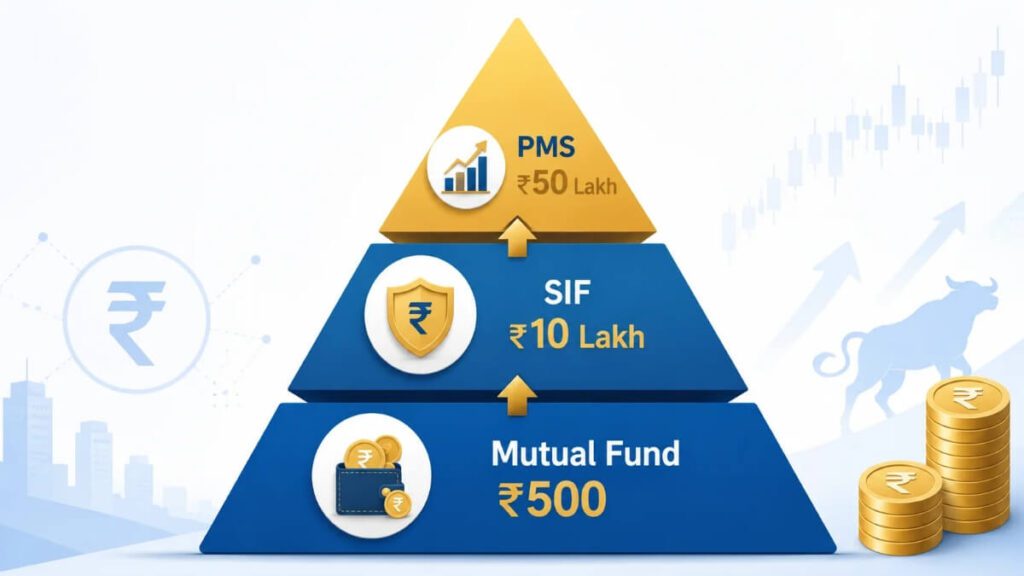
Mutual Funds — minimum investment as low as ₹500, but limited strategies
PMS (Portfolio Management Services) — advanced strategies, but minimum ₹50 lakh required
What is SIF in India in simple terms? It is a “Mutual Fund Plus” — regulated like a mutual fund, but with more advanced investment strategies, available at a minimum investment of just ₹10 lakh.
SEBI officially announced what is SIF in India through its circular dated February 27, 2025, making it effective from April 1, 2025.
Why Did SEBI Introduce SIF in India?
To fully understand SIF in India, you need to understand the gap it is filling.
For years, middle-level investors — people with ₹10 lakh to ₹50 lakh to invest — had no good option. Mutual funds were too rigid and PMS was too expensive to enter. SEBI recognized this gap and introduced what is SIF as a solution.
The key reasons SEBI launched SIF in India:
To democratize sophisticated investment strategies
To give HNIs and mass-affluent investors more options
To allow long-short strategies under a regulated framework
To bridge the ₹500 (mutual fund) to ₹50 lakh (PMS) gap
What is SIF in India is essentially SEBI’s answer to hedge-fund-style investing within a safe, regulated environment.
Key Features of SIF in India
Now that you understand is SIF at a basic level, let us look at its key features:
1. Minimum Investment of ₹10 Lakh
The most important feature of is SIF is that you need a minimum of ₹10 lakh to invest. This applies per PAN per AMC across all SIF strategies. However, accredited investors are exempt from this minimum limit.
2. Long-Short Strategies Allowed
Unlike regular mutual funds, what is SIF in India allows fund managers to take both long and short positions. This means they can earn returns even when markets are falling.
3. Derivative Exposure Permitted
What is SIF in India also permits the use of derivatives for hedging and portfolio management. Fund managers can take unhedged short positions up to 25% of the portfolio using derivatives.
4. Multiple Asset Classes
What is SIF in India covers equity, debt, and hybrid strategies. SEBI has defined specific categories under SIF:
Equity Long-Short Fund
Equity Ex-Top 100 Long-Short Fund
Debt Long-Short Fund
Hybrid Long-Short Fund
5. SEBI Regulated and Transparent
Even though what is SIF in India offers more flexibility than mutual funds, it operates under the same SEBI regulatory framework. This means the same transparency, structure, and investor protection apply.
“Agar aap apni financial health improve karna chahte hain, to pehle RBI Credit Score Rules 2026 zaroor padhen.”
6. SIP, SWP, and STP Available
What is SIF in India also allows systematic investment plans (SIP), systematic withdrawal plans (SWP), and systematic transfer plans (STP) — provided the minimum investment threshold is maintained.
7. Same Taxation as Mutual Funds
One of the best things about what is SIF in India is that its taxation is the same as mutual funds. For equity-based SIFs, STCG tax of 20% and LTCG tax of 12.5% apply. For debt-based SIFs, capital gains are taxed as per your income slab.
Who Can Invest in SIF in India?
What is SIF in India is not for everyone. SEBI has designed it for:
High Net Worth Individuals (HNIs) — investors with ₹10 lakh or more to invest
Accredited Investors — exempt from the ₹10 lakh minimum
Pension Funds and Institutions — can invest via SIF for better returns
Sophisticated Investors — those who understand market risks and advanced strategies
What is SIF in India is NOT recommended for:
First-time investors
Risk-aver se investors
People with less than ₹10 lakh to invest in a single fund house
SIF vs Mutual Fund vs PMS — Complete Comparison
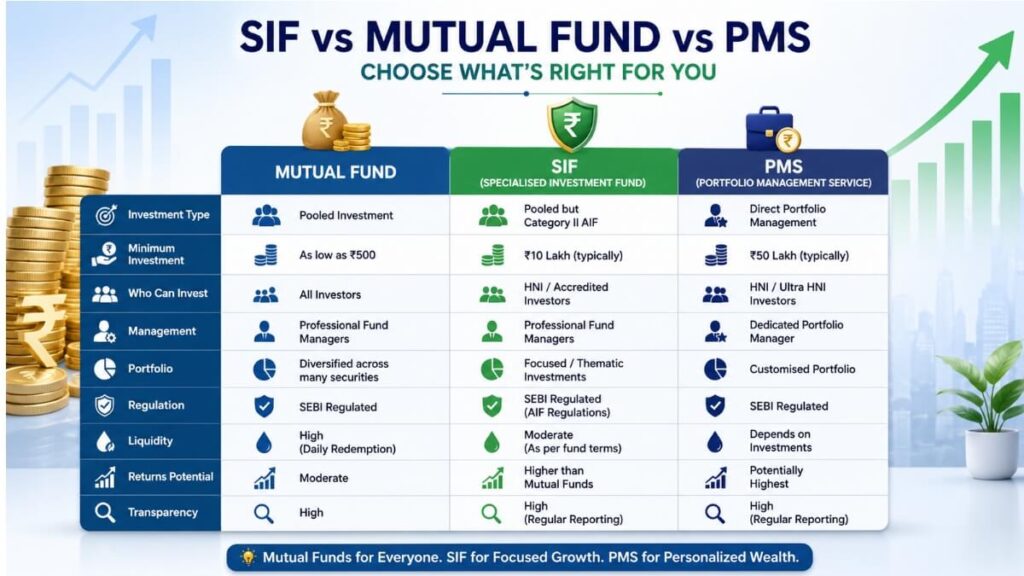
Understanding what is SIF in India becomes much clearer when you compare it with Mutual Funds and PMS:
| Feature | Mutual Fund | SIF | PMS |
| Minimum Investment | ₹500 | ₹10 Lakh | ₹50 Lakh |
| Strategies | Long-only | Long + Short | Customized |
| Derivatives | Limited | Up to 25% short | Allowed |
| Regulation | SEBI | SEBI | SEBI |
| Transparency | High | High | Moderate |
| Taxation | Mutual Fund rules | Mutual Fund rules | Varies |
| For | All investors | HNIs, Accredited | Ultra HNIs |
This comparison makes it very clear what is SIF in India — it is the middle ground that Indian investors were missing for years.
How Does SIF Work in India?
To understand what is SIF in India in practice, let us look at how it actually works:
AMC launches SIF strategy — Only AMCs with minimum AUM of ₹10,000 crore or fund managers with 3+ years managing ₹500 crore can launch SIF
Investor deposits ₹10 lakh minimum — This is mandatory per PAN per AMC
Fund manager executes strategy — Using long-short positions, derivatives, and multi-asset allocation
Returns generated — Both in bull and bear markets
Investor redeems — As per the fund’s redemption policy
What is SIF in India in working terms is essentially a professionally managed fund that uses hedge-fund-like strategies but within SEBI’s regulated framework.
AMC Eligibility to Launch SIF in India
Not every AMC can offer what is SIF in India. SEBI has set strict eligibility criteria:
AMC must have minimum AUM of ₹10,000 crore, OR
Fund manager must have at least 3 years experience managing ₹500 crore
AMC must appoint a Chief Investment Officer (CIO) with 10+ years experience managing ₹5,000 crore
Fund manager must have NISM certification as required by SEBI
These strict rules ensure that only experienced and credible professionals manage your money under what is SIF in India.

Benefits of Investing in SIF in India
Here are the top benefits of what is SIF in India:
Access to Advanced Strategies
What is SIF in India gives you access to hedge-fund-style strategies like long-short equity, sector rotation, and dynamic asset allocation — previously only available to ultra-rich investors.
Lower Entry Compared to PMS
What is SIF in India requires only ₹10 lakh versus ₹50 lakh for PMS. This makes it accessible to a much wider group of investors.
SEBI Regulated Safety
Even though what is SIF in India uses advanced strategies, it operates under the same SEBI mutual fund regulations. Investor protection is strong.
SIF ko SEBI Official Website ke guidelines ke under strictly regulate kiya jata hai.
Returns in Bull and Bear Markets
Because what is SIF in India allows short positions, fund managers can potentially earn returns even when the stock market is falling.
Diversification Across Asset Classes
What is SIF in India allows investment across equity, debt, and hybrid strategies. This gives better diversification than traditional mutual funds.
Same Tax Efficiency as Mutual Funds
What is SIF in India is taxed like a mutual fund — which is one of the most tax-efficient investment vehicles in India.
Risks of Investing in SIF in India
No investment is without risk. Here are the key risks of what is SIF in India:
High Minimum Investment
₹10 lakh is a large amount. Not every investor can afford to lock this in a single AMC’s SIF strategies. What is SIF in India is clearly not for small investors.
No Long-Term Track Record
What is SIF in India became effective only on April 1, 2025. There is no 5-year or 10-year performance data available yet. Investors are essentially betting on a new and untested product.
Complex Strategies — Higher Risk
The long-short and derivative strategies used in what is SIF in India are complex. If the fund manager’s strategy goes wrong, losses can be significant.
Not for Beginners
What is SIF in India requires a good understanding of financial markets. Beginners should stay with regular mutual funds before considering SIF.
Market Risk Remains
Even with sophisticated strategies, SIF is still subject to market risk, credit risk, and liquidity risk.

How to Invest in SIF in India — Step by Step
Here is how you can invest in India:
Step 1: Complete your KYC — Make sure your PAN and Aadhaar-based KYC is updated
Step 2: Choose an AMC — Select an AMC that is SEBI-approved to offer strategies
Step 3: Select your SIF Strategy — Choose from Equity Long-Short, Debt Long-Short, or Hybrid Long-Short based on your risk appetite
Step 4: Invest Minimum ₹10 Lakh — Deposit the minimum required amount per PAN per AMC
Step 5: Monitor Performance — Track your SIF performance regularly through the AMC’s platform or your investment app
Step 6: Use SIP/SWP if needed — You can set up systematic plans as long as the ₹10 lakh threshold is maintained
Top AMCs Offering SIF in India (2025)
Since what is SIF in India became effective in April 2025, several leading AMCs have launched SIF strategies. Look for SIF offerings from major fund houses like:
Nippon India Mutual Fund
HDFC Mutual Fund
SBI Mutual Fund
ICICI Prudential Mutual Fund
Kotak Mutual Fund
Always check the latest SEBI-approved list before investing in India, as new AMCs keep getting approval.
SIF and the Future of Investing in India
is just the beginning. As more AMCs launch SIF strategies and more investors understand in India, this category is expected to grow significantly in the coming years.
What is SIF in India represents a major evolution in India’s investment landscape. It shows that SEBI is actively working to make sophisticated strategies available to a wider pool of investors — not just ultra-rich individuals.
Financial experts believe SIF will attract significant capital from HNIs, family offices, and institutions who were earlier forced to choose between rigid mutual funds and expensive PMS options.
Frequently Asked Questions (FAQs) —
Q1. What is the full form of SIF in India?
SIF stands for Specialised Investment Fund. Understanding in starts with knowing that it is a new SEBI-regulated investment category launched in 2025.
Q2. What is the minimum investment for SIF in India?
The minimum investment for India is ₹10 lakh per PAN per AMC across all SIF strategies from that fund house. Accredited investors are exempt.
Q3. Is SIF safe to invest in India?
SIF in India is regulated by SEBI and operates under the mutual fund framework, making it relatively safe. However, it uses complex strategies and is best suited for experienced investors who understand market risks.
Q4. What is the difference between SIF and mutual fund in India?
The key difference in understanding what is SIF in India vs mutual fund is: SIF allows long-short strategies and derivative exposure, while regular mutual funds are mostly long-only. SIF requires ₹10 lakh minimum vs ₹500 for mutual funds.
Q5. Is SIF better than PMS in India?
What is SIF vs PMS depends on your investment amount. SIF requires only ₹10 lakh while PMS needs ₹50 lakh. Both offer advanced strategies, but SIF has more transparency and lower cost since it operates under the mutual fund framework.
Q6. When did SIF launch in India?
What is became effective from April 1, 2025. SEBI announced the framework on February 27, 2025.
Q7. Can I do SIP in SIF in India?
Yes! allows SIP, SWP, and STP options, as long as the minimum ₹10 lakh investment threshold is maintained across all strategies in the same AMC.
Q8. What is the taxation of SIF in India?
The taxation of is the same as mutual funds. Equity SIFs attract STCG of 20% and LTCG of 12.5%. Debt SIFs are taxed as per your income slab.
Conclusion
What is SIF in India — it is the most significant investment innovation of 2025. SEBI has carefully designed what to fill the long-standing gap between traditional mutual funds and expensive Portfolio Management Services.
If you are an experienced investor with ₹10 lakh or more to invest and you want access to advanced strategies like long-short equity and derivatives within a regulated, transparent framework — is worth seriously exploring.
However, remember that is a new product with no long-term track record. Do thorough research, consult a SEBI-registered financial advisor, and invest only if you fully understand the risks involved.
As what is SIF in India matures over the next few years, it has the potential to become one of the most important investment categories for India’s growing class of mass-affluent and HNI investors.
Disclaimer
The information provided in this article about what is SIF in India is for educational and informational purposes only. It does not constitute financial, investment, or legal advice. Investing in Specialised Investment Funds (SIF) involves market risks. Past performance is not indicative of future results. Please read all scheme-related documents carefully and consult a SEBI-registered financial advisor before making any investment decisions. sksmartdigitalhub.blog is not responsible for any financial losses arising from investment decisions made based on this article.


Pingback: Education Loan vs Personal Loan in India: 8 Best Tips