
Introduction
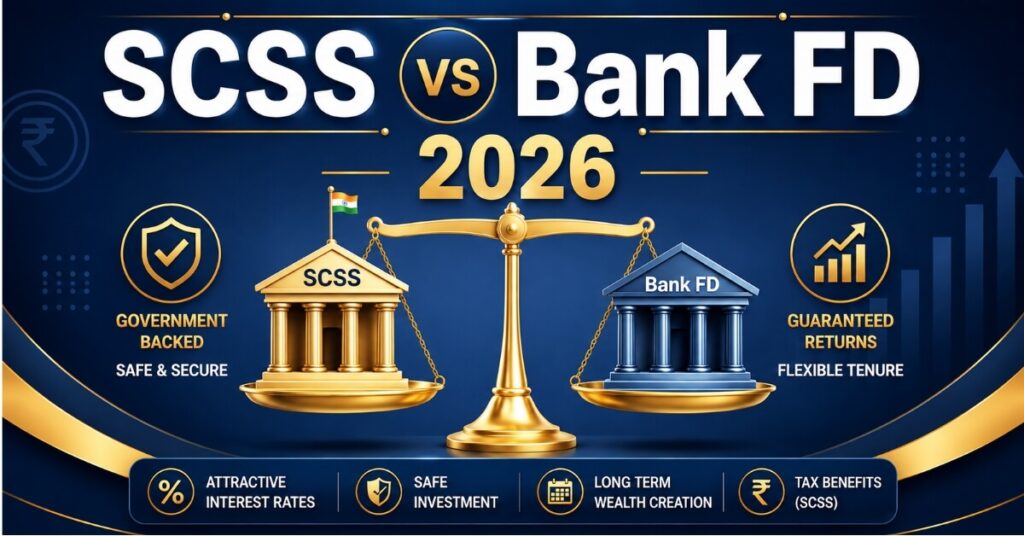
Choosing where to park retirement savings is one of the most important financial decisions a senior citizen will make, and the SCSS vs Bank FD 2026 debate sits right at the center of that choice. Both options promise safety and steady returns, but they work quite differently under the hood. This guide breaks down the SCSS vs Bank FD 2026 comparison in plain language, covering interest rates, safety, taxation, liquidity, and which option might suit your specific retirement needs.
Whether you are a retiree looking for guaranteed quarterly income or someone comparing flexible bank fixed deposits against a government-backed scheme, this article walks through everything relevant to the SCSS vs Bank FD 2026 decision so you can choose with confidence.
What Is SCSS and How Does It Work
The Senior Citizen Savings Scheme, or SCSS, is a government-backed savings instrument specifically designed for individuals aged 60 and above. It currently offers an interest rate of 8.2 percent per annum for the July to September 2026 quarter, paid out quarterly rather than compounded, which makes it especially attractive for retirees who depend on a predictable income stream. Understanding how SCSS works is the first step in any meaningful SCSS vs Bank FD 2026 comparison.
SCSS accounts can be opened at post offices or authorised banks, with a maximum investment limit of Rs. 30 lakh per individual. You can find the official scheme rules and current rates on the India Post Savings Schemes page. The scheme carries a five-year tenure, with an option to extend for an additional three years once the initial term matures. Because it is backed directly by the Government of India, SCSS carries near-zero sovereign risk, which is a significant factor for many retirees weighing the SCSS vs Bank FD 2026 choice.
What Is a Bank Fixed Deposit and How Does It Work
A bank fixed deposit, or FD, is a familiar and widely used investment option where you deposit a lump sum with a bank for a fixed tenure in exchange for a predetermined interest rate. Unlike SCSS, bank FDs are offered by a wide range of institutions, from large public sector banks to smaller private and small finance banks, each with their own rate structures and tenure options.
Many banks offer a higher interest rate specifically for senior citizens, typically an additional 0.25 to 0.75 percent over the standard rate. This senior citizen premium is one of the key reasons bank FDs remain competitive in this comparison, since some small finance banks now offer rates that rival or even exceed the SCSS rate for certain tenures.
Comparing Interest Rates: SCSS vs Bank FD 2026
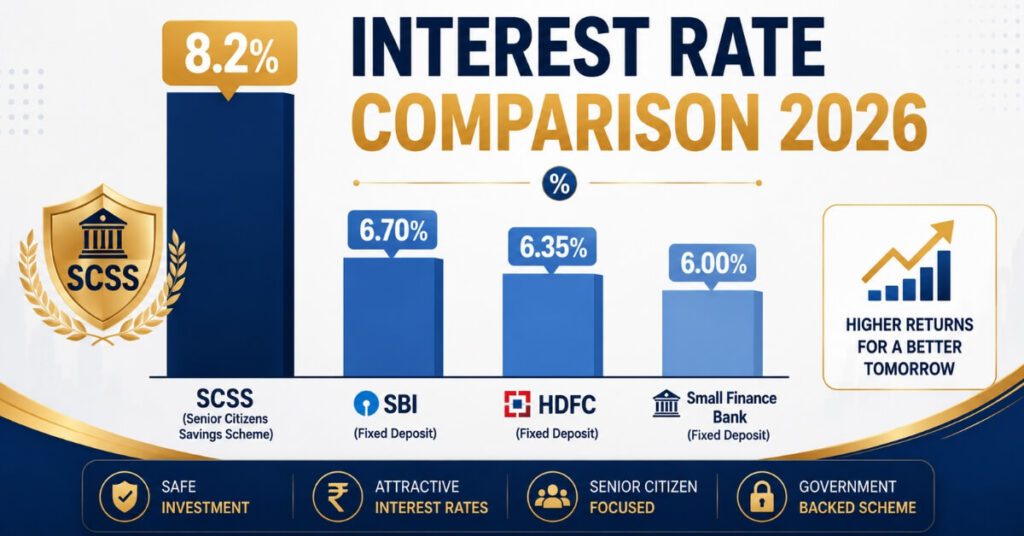
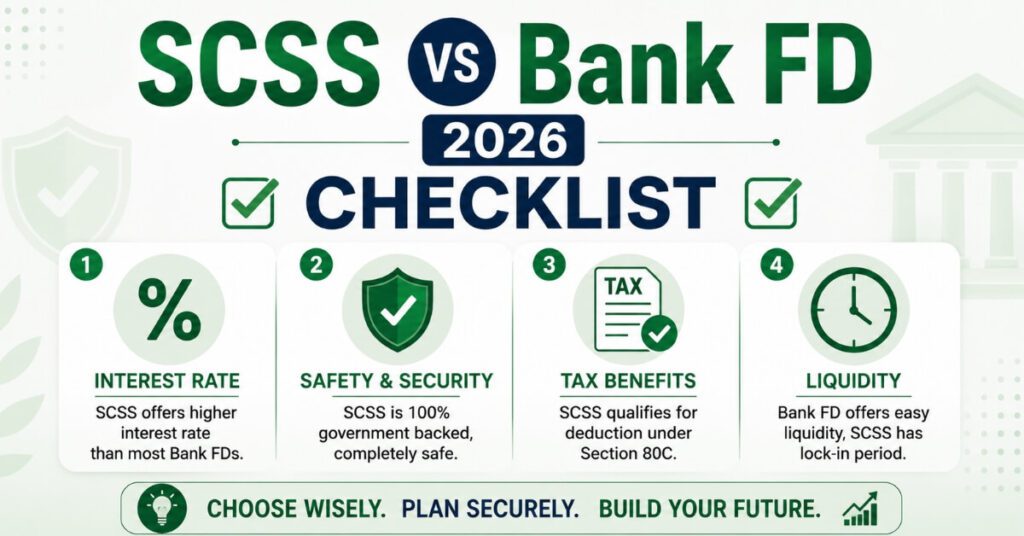
When it comes to raw numbers, the SCSS vs Bank FD 2026 comparison gets interesting. SCSS currently offers a flat 8.2 percent per annum across the board, regardless of which bank or post office you open the account with. This consistency is a major advantage, since you do not need to shop around for the best rate.
Bank FDs, on the other hand, vary considerably. Large banks such as SBI, HDFC, and ICICI typically offer senior citizen FD rates in the range of 6.5 to 7.5 percent for medium-term tenures, which is noticeably lower than SCSS. However, small finance banks such as Jana, Suryoday, and Equitas have been offering rates as high as 7.9 to 8 percent, and in some cases even higher for shorter tenures, making the SCSS vs Bank FD 2026 rate comparison much closer than it first appears.
Safety and Security: Which Option Protects Your Money Better
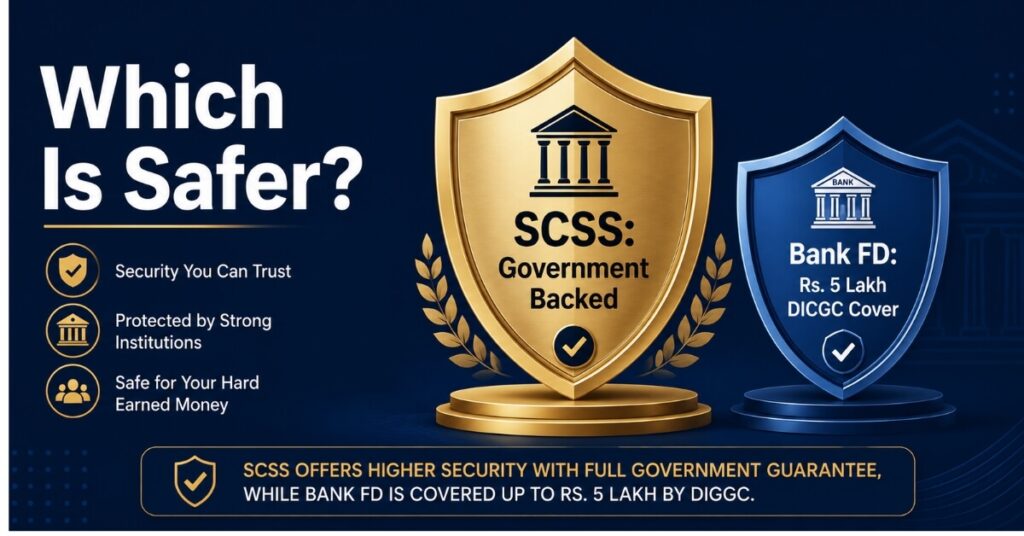
Safety is often the deciding factor in the SCSS vs Bank FD 2026 debate, and here the two options diverge significantly. SCSS is backed directly by the Government of India, which means your principal and interest are guaranteed by sovereign backing, carrying essentially no default risk.
Bank FDs, in contrast, carry bank-specific credit risk. While deposits are insured by the Deposit Insurance and Credit Guarantee Corporation, this insurance only covers up to Rs. 5 lakh per depositor per bank, including both principal and interest. For retirees investing amounts larger than this limit in a single bank FD, especially in smaller private or small finance banks, this coverage gap is an important consideration in the SCSS vs Bank FD 2026 decision.
Taxation: How SCSS and Bank FDs Are Treated Differently
Tax treatment is another area where the SCSS vs Bank FD 2026 comparison matters significantly. Interest earned on both SCSS and bank FDs is fully taxable as per your income tax slab, so neither option offers tax-free interest. However, SCSS investments qualify for a deduction under Section 80C of the Income Tax Act, up to the applicable limit, which can meaningfully reduce your taxable income if you have not already exhausted this deduction through other investments.
Bank FDs also qualify for Section 80C benefits, but only if you specifically opt for a five-year tax-saving fixed deposit, which typically comes with a lower interest rate and a mandatory five-year lock-in with no premature withdrawal allowed. This is a subtle but important distinction in the SCSS vs Bank FD 2026 tax planning conversation, since regular bank FDs without the tax-saving label do not offer this deduction at all.
If you are separately planning for long-term capital gains tax exemptions on property sales, it is worth understanding related provisions such as the Section 54F Exemption 2026, which can significantly reduce your tax liability when reinvesting proceeds from the sale of a capital asset, and pairing that knowledge with your retirement income planning can lead to a more tax-efficient overall strategy.
Liquidity and Premature Withdrawal Rules
Liquidity needs vary from person to person, and this is where the SCSS vs Bank FD 2026 comparison becomes more personal. SCSS allows premature withdrawal after one year, though a penalty of 1 to 1.5 percent of the deposit is deducted depending on how early the withdrawal is made. This makes SCSS moderately flexible but not entirely liquid in the first year.
Bank FDs generally offer more flexible premature withdrawal terms, with most banks allowing withdrawal after a minimum lock-in period, subject to a penalty that is usually lower than SCSS in percentage terms, though this varies by bank. For retirees who anticipate needing access to funds on short notice, this flexibility can tip the SCSS vs Bank FD 2026 decision in favor of bank FDs, particularly those with shorter tenures.
Investment Limits and Account Opening Rules
Another practical difference in the SCSS vs Bank FD 2026 comparison is the investment ceiling. SCSS caps individual investment at Rs. 30 lakh, which means retirees with larger retirement corpuses cannot place their entire savings into a single SCSS account. Bank FDs, by contrast, have no upper limit on deposit amounts, allowing for much larger single deposits if needed, though spreading deposits across multiple banks is generally advisable to stay within the DICGC insurance limit.
Opening an SCSS account requires proof of age, identity, and address, along with a straightforward application at a post office or participating bank. Bank FDs are typically even quicker to open, often completable entirely online within minutes through internet banking or a mobile app, which is a convenience factor worth considering here.
Interest Payout Frequency: Quarterly vs Flexible Options
For many retirees relying on investment income to cover monthly expenses, payout frequency is a practical concern in the SCSS vs Bank FD 2026 discussion. SCSS pays interest quarterly, on fixed dates, providing a predictable income stream that many retirees find easy to budget around.
Bank FDs offer more flexibility here, with options for monthly, quarterly, half-yearly, annual, or cumulative payout at maturity. This flexibility can be genuinely useful for retirees who prefer monthly income over quarterly payouts, giving bank FDs an edge in this specific aspect of the SCSS vs Bank FD 2026 comparison, even though the underlying interest rate may be lower.
Which Option Should You Choose
The SCSS vs Bank FD 2026 decision ultimately depends on your individual priorities. If safety, guaranteed government backing, and a strong 8.2 percent rate matter most to you, SCSS is likely the stronger choice, especially for the portion of your savings up to the Rs. 30 lakh limit. If you need monthly income, greater flexibility on premature withdrawal, or want to invest amounts beyond what SCSS allows, a mix of bank FDs across reputable banks and small finance banks can complement your SCSS investment effectively.
Many financial advisors recommend a combination approach rather than choosing one exclusively, using SCSS for the safety-focused core of retirement savings while supplementing with bank FDs for additional flexibility and potentially higher returns on the remaining corpus. This balanced approach to the SCSS vs Bank FD 2026 question can help retirees achieve both security and flexibility simultaneously.
A Practical Example of the SCSS vs Bank FD 2026 Trade-off
Consider a retiree with Rs. 40 lakh in retirement savings. By placing Rs. 30 lakh into SCSS at 8.2 percent, they would earn roughly Rs. 2.46 lakh annually in guaranteed, government-backed interest, paid out quarterly. The remaining Rs. 10 lakh could be split across two or three bank FDs, potentially at a small finance bank offering 7.5 to 8 percent, earning an additional Rs. 75,000 to Rs. 80,000 annually while staying within the DICGC insurance limit at each institution.
This kind of blended strategy illustrates why the SCSS vs Bank FD 2026 comparison is not necessarily an either-or decision for many retirees, but rather a question of how to allocate savings across both instruments to balance safety, income, and flexibility.
Eligibility Differences You Should Know
Age and residency rules add another layer to the SCSS vs Bank FD 2026 comparison that many people overlook. SCSS is available only to Indian resident individuals aged 60 years or above, with a lower age threshold of 55 years for those who have taken voluntary retirement, provided the investment is made within one month of receiving retirement benefits. NRIs are generally not eligible to open a fresh SCSS account, which immediately narrows the field for non-resident retirees.
Bank FDs, by contrast, are open to a much wider range of depositors, including NRIs through NRE, NRO, or FCNR routes, and there is no minimum age requirement to open a standard FD, though the enhanced senior citizen rate only applies once the depositor turns 60. This broader eligibility is a meaningful factor for families where investment decisions span multiple generations or residency statuses.
Documents Required to Open Each Account
Before deciding in the SCSS vs Bank FD 2026 comparison, it helps to know what paperwork each option requires. Opening an SCSS account typically requires proof of age such as a birth certificate, PAN card, or senior citizen card, along with identity proof, address proof, and passport-size photographs. If applying based on voluntary retirement, additional documents proving the date and amount of retirement benefits are also required.
Bank FDs require comparatively simpler documentation, usually just KYC documents such as PAN and address proof, since most banks already have this information on file for existing customers. New customers can typically complete the entire process online, including document upload and video KYC, making bank FDs marginally faster to set up when time is a factor in your decision.
How Joint Accounts Work Under Each Option
Joint account rules are another practical consideration in the SCSS vs Bank FD 2026 comparison. SCSS allows joint accounts, but only with a spouse, and the entire deposit amount is attributed to the first account holder for the purpose of the Rs. 30 lakh investment limit, regardless of contribution. This means couples cannot simply double their effective investment ceiling by opening a joint account.
Bank FDs offer more flexibility in this regard, allowing joint accounts with virtually any combination of family members, and since there is no investment ceiling on FDs, joint holding does not restrict the total amount that can be deposited. For families planning retirement savings together, this distinction is worth factoring into your final decision.

Common Mistakes Retirees Make When Choosing
Many retirees approach the SCSS vs Bank FD 2026 decision by focusing only on the headline interest rate, without considering safety limits, tax implications, or their own liquidity needs. Others place their entire corpus in a single small finance bank FD chasing a slightly higher rate, without accounting for the DICGC insurance cap, which can expose a meaningful portion of their savings to unnecessary risk. Being aware of these common pitfalls can help you make a more balanced and informed decision.
Frequently Asked Questions
Q1.Which offers a higher interest rate, SCSS or bank FD, in 2026?
SCSS currently offers a flat 8.2 percent per annum, which is higher than most large bank FD rates, though some small finance banks offer competitive or slightly higher rates for select tenures.
Q2.Is SCSS safer than a bank FD?
Yes, SCSS is backed directly by the Government of India, while bank FDs carry bank-specific credit risk and are insured only up to Rs. 5 lakh per depositor per bank under DICGC.
Q3.Can I invest more than Rs. 30 lakh in SCSS?
No, the maximum investment limit for SCSS is Rs. 30 lakh per individual, so any amount beyond this must be invested elsewhere, such as in bank FDs.
Q4.Is interest from SCSS tax-free?
No, interest earned on SCSS is fully taxable as per your income tax slab, though the initial investment qualifies for a Section 80C deduction up to the applicable limit.
Q5.Can I withdraw my SCSS deposit before maturity?
Yes, premature withdrawal is allowed after one year, but a penalty of 1 to 1.5 percent of the deposit amount is deducted depending on how early the withdrawal is made.
Q6.Which option is better for monthly income?
Bank FDs generally offer more flexibility with monthly payout options, while SCSS pays interest strictly on a quarterly basis, so bank FDs may suit retirees who prefer monthly income.
Q7.Should I choose only SCSS or only bank FD for retirement?
Most financial advisors recommend a combination, using SCSS for the safety-focused core of your savings and bank FDs for additional flexibility and higher potential returns on the remaining amount.
Conclusion
The SCSS vs Bank FD 2026 comparison ultimately comes down to balancing safety, returns, liquidity, and tax planning based on your individual retirement needs. SCSS offers unmatched government-backed security and a strong 8.2 percent rate, making it an excellent core holding for retirement savings up to the Rs. 30 lakh limit. Bank FDs, particularly from small finance banks, can offer competitive or even higher rates along with greater flexibility on payout frequency and premature withdrawal, making them a useful complement rather than a replacement. For most retirees, a thoughtful combination of both instruments, informed by the details covered in this SCSS vs Bank FD 2026 guide, offers the most balanced path to a secure and flexible retirement income.
Disclaimer
This article is for informational purposes only and does not constitute professional financial or tax advice. Interest rates, scheme rules, and tax provisions are subject to change, and readers should verify current details with their bank or post office and consult a qualified financial advisor before making investment decisions.