
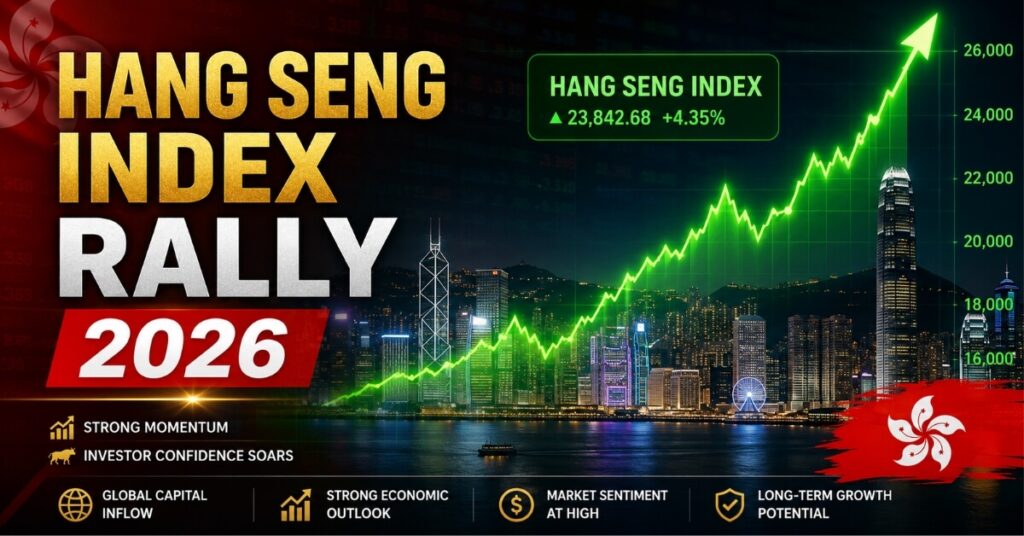
The Hang Seng Index has become one of the most searched financial terms in India today, and for good reason. On 16 July 2026, this benchmark jumped sharply during trading hours, touching an over-one-month high and pulling global attention toward Hong Kong’s stock market. If you have been wondering why this index is suddenly trending, why Alibaba shares are climbing, and what this rally means for Indian investors watching global markets, this guide breaks it all down in simple, easy-to-understand language.
Many Indian investors track this index as a barometer of Asian market sentiment, especially because Hong Kong sits at the crossroads of Chinese and global capital flows. Today’s sharp move is not an isolated event — it reflects broader shifts happening across Asian equity markets, and understanding it can help you make smarter decisions with your own portfolio, whether you invest only in India or also look at global opportunities.
In this article, we will cover what the index actually measures, why it moved so sharply today, how it compares with the Sensex, what options Indian investors have if they want exposure, and the risks worth watching before you make any decision based on today’s headlines.
What Is the Hang Seng Index?
The Hang Seng Index, often shortened to HSI, is a market-capitalisation-weighted stock market index that tracks the largest and most actively traded companies listed on the Hong Kong Stock Exchange. Compiled and maintained by Hang Seng Indexes, this benchmark is adjusted for free float, meaning it only counts shares that are actually available for public trading rather than those locked up by promoters or governments.
Think of it the way you think of the Sensex or Nifty in India — it is the single most-watched number that tells you, at a glance, whether Hong Kong’s stock market had a good day or a bad one. This benchmark includes major names from banking, technology, insurance, and property sectors, and it serves as the primary indicator of overall market performance in Hong Kong.
Because Hong Kong acts as a financial gateway between mainland China and the rest of the world, movements in this index often ripple across Asian and even global markets, including India. That is exactly why so many Indian readers are searching for updates on this index today.
A brief history is useful here too. The index was first introduced decades ago as a way to give investors a simple snapshot of Hong Kong’s equity market, and over the years it has expanded to include technology giants alongside traditional banking and property names. This evolution is one reason today’s rally, driven heavily by a technology stock, feels significant to long-term market watchers.
Why Is the Hang Seng Index Rising Today?
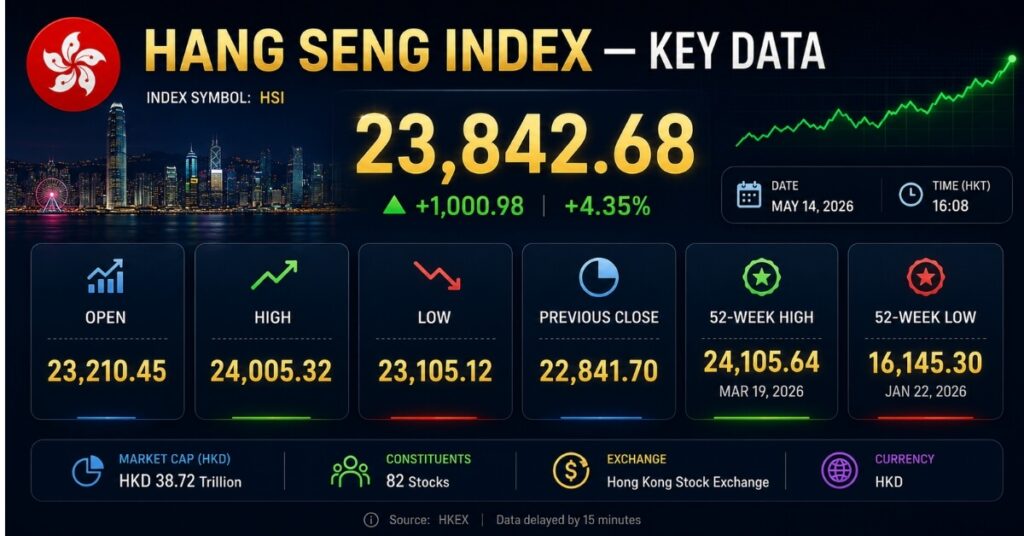
As of 16 July 2026, this benchmark was trading at 25,008.60 points, up 1.33 percent, or 327.50 points, compared to the previous close of 24,681.10. This move pushed it to its highest level in over a month, according to reports from The Standard (HK).
Several factors are being credited for today’s strength in the Hang Seng Index:
1.Renewed investor confidence in Chinese technology stocks, with Alibaba shares reportedly climbing around 3 percent on the day, lifting overall sentiment across the index and pulling several related counters higher along with it.
2.Search interest around this benchmark has spiked significantly, with trend data showing activity levels roughly 800 percent higher than usual over the past few hours, suggesting heavy retail and institutional attention across multiple markets, including India.
3 .Broader Asian market movement, as investors rotate capital between regional indices while assessing global interest rate signals and currency trends that typically influence risk appetite.
4.Technical buying momentum, as prices broke past recent resistance levels during the morning trading session before easing slightly after the midday lunch break, a typical pattern for Hong Kong markets that trade in two separate sessions each day.
5.Improved liquidity conditions following recent policy signals, which have encouraged some institutional investors to rotate back into Hong Kong-listed equities after a period of caution.
It is worth noting that not every related market moved in the same direction today. While this benchmark gained ground, some mainland Chinese indices actually slipped, which tells us this rally was driven by Hong Kong and technology-specific factors rather than a broad China-wide rebound.
Hang Seng Index: Key Data at a Glance
Here is a quick snapshot of today’s trading data for the index, useful for anyone tracking it for research or investment purposes:
Opening level: 24,825.02
Day’s high: 25,221.44
Day’s low: 24,825.02
Previous close: 24,681.10
52-week high: 28,056.10
52-week low: 22,518.00
Looking at this range, the current level is still meaningfully below its 52-week high, which means there could be further room for movement depending on how global sentiment evolves over the coming weeks. Long-term investors often use this kind of range data to understand whether a benchmark is closer to overbought or oversold territory, and the same logic applies when studying the Hang Seng Index over longer timeframes.
It also helps to look at the gap between the 52-week high and low. A swing of more than 5,500 points over twelve months tells you this is not a sleepy, low-volatility index — it demands active monitoring if you plan to build any exposure around it, directly or indirectly.
Hang Seng Index vs Sensex: What Indian Investors Should Know
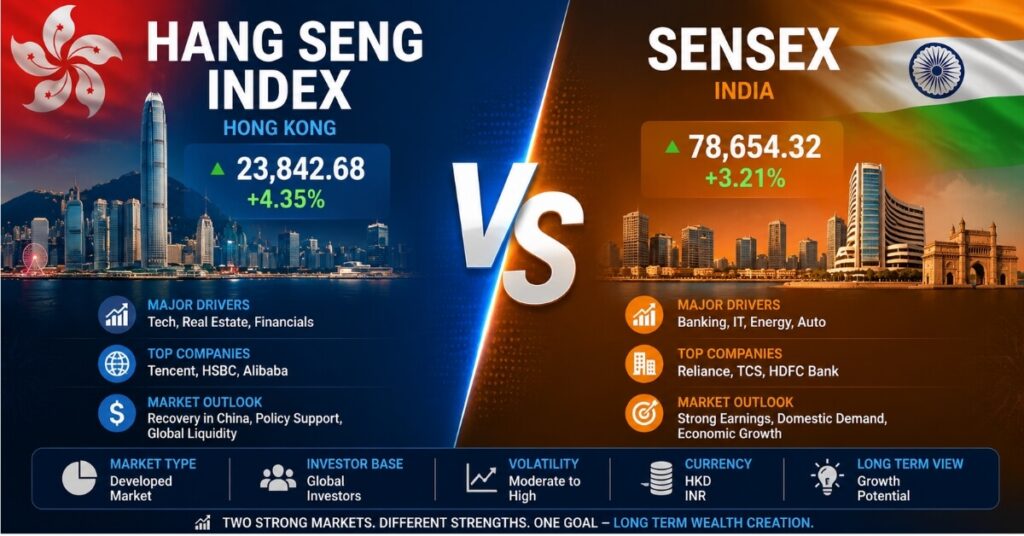
A common question among Indian readers is how this Hong Kong benchmark compares with our own Sensex. Both are headline stock indices, but they represent very different economies and investor bases. The Sensex reflects the performance of 30 large, established Indian companies, while the index reflects Hong Kong-listed companies that are heavily influenced by mainland Chinese economic policy, technology regulation, and global trade flows.
When this index moves sharply, Indian markets do not always follow the same direction, but global fund managers often view Asian markets as a connected basket. A strong session for this index can sometimes indicate improving risk appetite across Asia, which occasionally spills over into Indian equities as well, particularly in sectors like IT and pharma that have global revenue exposure.
Another difference worth noting is sector composition. The Sensex leans heavily on banking, financial services, and energy, while Hong Kong’s benchmark carries a much larger weight in technology and property names. This is one reason the two indices can move in opposite directions even on the same trading day.
If you are someone who likes to track how Indian companies raise capital during periods of strong regional sentiment, it is worth reading our detailed breakdown on SBI Funds Management IPO GMP which explains how grey market premium signals can indicate investor demand even before listing day — a concept that applies just as much to Hong Kong-listed companies tracked under this index.
How Can Indian Investors Invest in the Hang Seng Index?
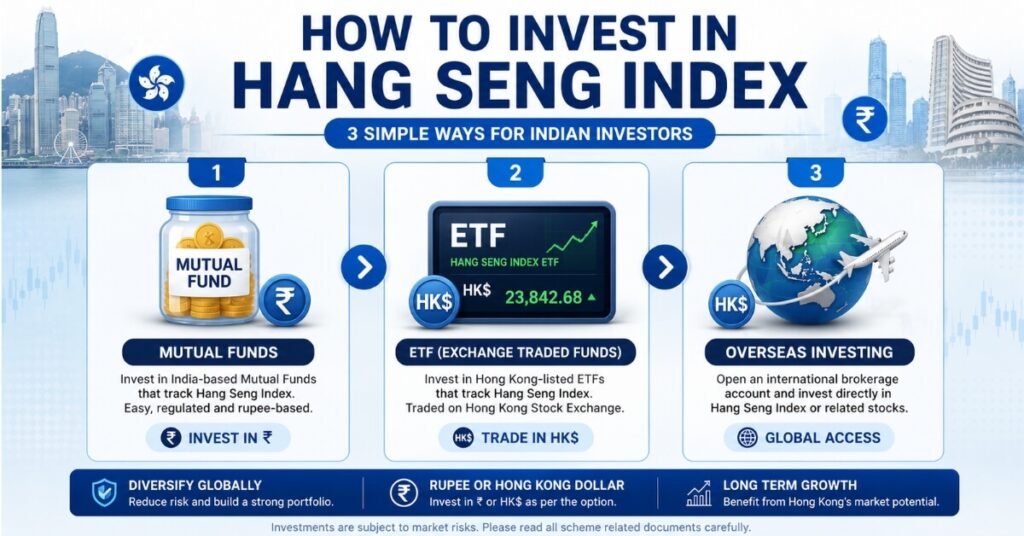
While you cannot buy this benchmark directly the way you buy a single stock, there are a few practical routes available to Indian investors who want exposure to it.
International mutual funds: Some Indian asset management companies offer funds that invest in Hong Kong or broader Asia-Pacific equities, giving indirect exposure to companies within this benchmark without the need to open an overseas account.
Exchange-traded funds (ETFs): Certain global ETFs listed on Indian exchanges track indices closely correlated with this benchmark, allowing investors to gain diversified exposure through their existing demat account.
Direct overseas investing: Under the RBI’s Liberalised Remittance Scheme, Indian residents can open international trading accounts through select brokers and invest directly in Hong Kong-listed stocks that make up the index, subject to annual remittance limits set by the central bank.
Before choosing any of these routes, it is important to remember that international exposure through this index adds currency risk and geopolitical risk on top of regular market risk, so position sizing should be conservative, especially for first-time investors who are new to global markets.
Before choosing any of these routes, it is important to remember that international exposure through this index adds currency risk and geopolitical risk on top of regular market risk, so position sizing should be conservative, especially for first-time investors who are new to global markets. Investors who prefer predictable, low-volatility returns, particularly senior citizens who cannot absorb sharp swings like the one seen in the Hang Seng Index today, may want to balance any such exposure with safer domestic instruments, such as fixed deposits, as part of a well-diversified overall portfolio that does not depend entirely on global market timing.
Sector-Wise Breakdown: Where Today’s Rally Is Coming From
Not every sector within this benchmark moved by the same magnitude today. Technology counters, led by the reported strength in Alibaba, appear to have contributed the largest share of today’s gains, given how heavily this segment is weighted within the overall calculation. Banking and financial services names also traded firmer, supported by improved regional liquidity conditions, though the move here was comparatively modest.
Property-linked counters, which have faced prolonged pressure over the past couple of years due to China’s real estate slowdown, showed only limited participation in today’s rally. This uneven pattern is worth noting because it suggests today’s strength is narrower than a full-market rebound — a detail that easily gets lost in headline numbers but matters a great deal for anyone deciding whether to increase exposure right now.
Consumer discretionary and insurance names, both closely tied to broader consumer confidence in the region, posted mixed results, with some counters gaining alongside technology while others lagged behind. For readers who prefer to look beyond a single headline figure, this kind of sector-level detail often tells a more complete story than the overall percentage move alone, and it can help you judge whether a rally has broad support or is being carried by just one or two large names.
Related Markets Impacting the Hang Seng Index
This benchmark does not move in isolation. Two related mainland indices are worth watching alongside it:
SSE Composite Index (Shanghai): trading at 3,882.41, down 1.85 percent on the day.
SZSE Component Index (Shenzhen): trading at 14,488.65, down 1.97 percent on the day.
The fact that both mainland Chinese indices fell while this benchmark rose is an important signal. It suggests that today’s strength was driven more by Hong Kong-specific and technology-sector catalysts, such as the reported rally in Alibaba shares, rather than a broad wave of optimism across all Chinese equity markets. Investors who only look at headline China news without checking this divergence often miss an important part of the story.
Risks and Factors to Watch Going Forward
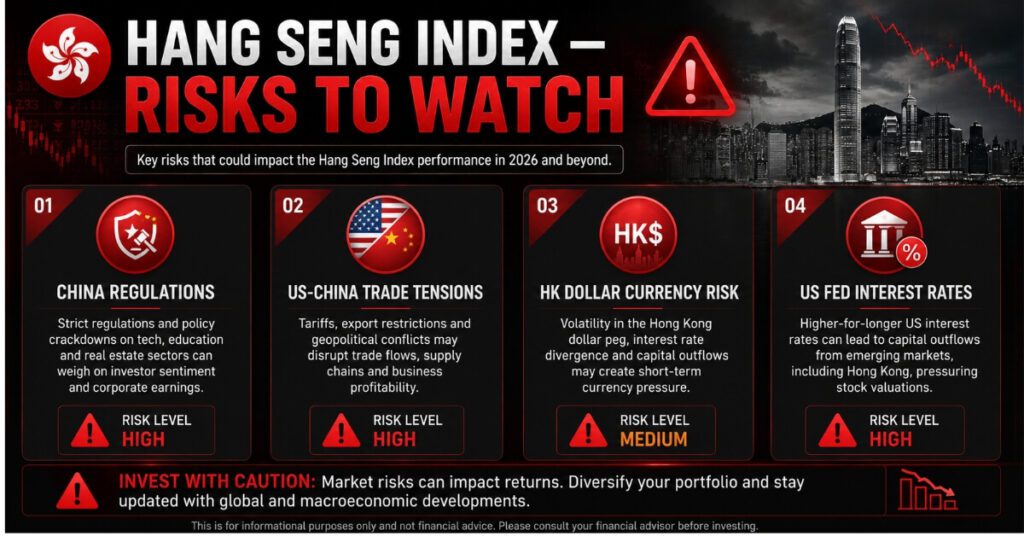
Anyone tracking the Hang Seng Index closely should keep an eye on a few recurring risk factors that have historically driven volatility in this benchmark.
Regulatory announcements from Chinese authorities affecting technology, real estate, or financial sectors can move this index sharply within a single trading session, sometimes with very little advance warning.
US-China trade relations and tariff developments continue to influence investor sentiment toward Hong Kong-listed companies, and any escalation or resolution tends to show up quickly in index levels.
Currency movements in the Hong Kong dollar and its peg mechanics can affect foreign capital flows into and out of this market, which in turn affects overall index performance.
Global interest rate decisions, particularly from the US Federal Reserve, tend to influence liquidity conditions across Asian markets, including this index, since Hong Kong’s monetary policy is closely tied to US rates.
Because of these interconnected factors, short-term movements in the Hang Seng Index should be read with caution rather than treated as a standalone buy or sell signal. A single day’s rally, however sharp and however widely reported, does not automatically guarantee a sustained, longer-term trend.
What This Rally Means for Everyday Indian Investors
If you are an everyday investor in India, today’s move in the Hang Seng Index is a useful reminder of how global markets are increasingly connected. You do not need to trade Hong Kong stocks directly to benefit from this awareness — simply understanding why the index moves the way it does can sharpen your overall reading of global risk sentiment, which indirectly affects flows into Indian equities, gold, and even the rupee.
Seasoned investors often use days like this as a checkpoint rather than a trigger for immediate action. Ask yourself whether your current portfolio already has enough diversification, whether you understand the risks of any international exposure you are considering, and whether today’s headline is a short-term blip or part of a longer trend before making any changes.
For readers who want to go deeper into the technical background of this benchmark, including its full weighting methodology and historical performance, the Hang Seng Index page on Wikipedia offers a well-documented overview that is regularly updated with historical index data and constituent details.
Frequently Asked Questions About the Hang Seng Index
Q1.What is the Hang Seng Index?
The Hang Seng Index is a market-capitalisation-weighted benchmark that tracks the largest companies listed on the Hong Kong Stock Exchange, serving as the primary indicator of that market’s overall performance.
Q2.Why did the Hang Seng Index rise sharply today?
It rose mainly due to strength in technology stocks like Alibaba, along with renewed investor interest in Hong Kong-listed companies, even as some mainland Chinese indices declined on the same day.
Q3.Can Indian investors buy the Hang Seng Index directly?
No, this index itself cannot be purchased directly. Indian investors can gain exposure through international mutual funds, select ETFs, or direct overseas investing under RBI’s remittance guidelines.
Q4.Is the Hang Seng Index the same as the Chinese stock market?
No. It tracks companies listed in Hong Kong, which operates under a different regulatory and currency system compared to mainland China’s Shanghai and Shenzhen exchanges.
Q5.How volatile is the Hang Seng Index compared to the Sensex?
Historically, this benchmark has shown higher volatility than the Sensex due to its greater exposure to technology stocks, regulatory shifts in China, and global trade sentiment.
Q6.What was the 52-week range of the Hang Seng Index?
Over the past year, it has traded between a low of 22,518.00 and a high of 28,056.10, showing meaningful swings driven by regional and global developments.
Conclusion
Today’s sharp move in the Hang Seng Index highlights just how quickly sentiment can shift in global markets, and why staying informed matters even if you only invest within India. Whether you choose to explore international exposure through mutual funds and ETFs, or you prefer the safety of instruments like fixed deposits, understanding the forces behind this benchmark adds another useful layer to your overall financial decision-making.
Keep tracking these movements regularly, compare them carefully against domestic benchmarks like the Sensex, and always align any new investment decision with your own personal risk appetite, time horizon, and long-term financial goals rather than reacting to a single day’s headline.
Disclaimer
This article is for informational and educational purposes only and should not be considered financial or investment advice. Stock market indices, including international benchmarks like the Hang Seng Index, are subject to market risks and can be highly volatile, and past performance is never a guarantee of future results. Readers are strongly advised to consult a certified, qualified financial advisor before making any investment decisions based on the information shared in this article.

Pingback: Wipro Dividend 2026: 5 Important Facts You Must Know